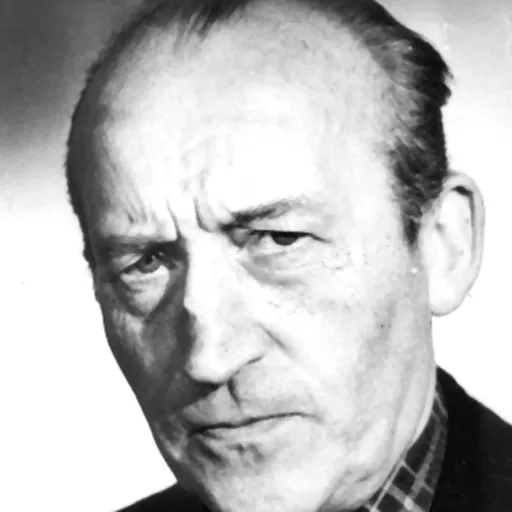
About William Heinesen
Lived 1900 – 1991 (aged 91). William Heinesen was a Danish poet, painter, translator, composer, writer and screenwriter.
Andreas William Heinesen (15 January 1900 – 12 March 1991) was a poet, writer, composer and painter from the Faroe Islands.
His writing
The Faroese capital Tórshavn is always the centre of Heinesen's writing, and he is famous for having once called Tórshavn "The Navel of the World". His writing focuses on contrasts between darkness and light, between destruction and creativity. Then following is the existential struggle of man to take sides. This is not always easy, however, and the lines between good and bad are not always clearly defined.
Heinesen was captivated by the mysterious part of life, calling himself religious in the broadest sense of the word. His life could be described as a struggle against defeatism with one oft-quoted aphorism of his is that "life is not despair, and death shall not rule". William Heinesen (second from right) with his friends and contemporaries Janus Djurhuus, Jørgen-Frantz Jacobsen, and Hans Andrias Djurhuus.
Publications
As he was born and raised before the Faroese language was taught in the schools, he wrote mainly in Danish but his spoken language was Faroese. All his books were later translated into his native Faroese.
He published his first collection of poetry when he was 21 and he had three more published before he wrote his first novel Blæsende gry (Stormy Dawn) in 1934. He read every single one of the chapters to the painter Sámal Joensen-Mikines, as he was worried that his Danish was not good enough. That was followed up with Noatún (1938). Noatún has a strong political message – solidarity is the key to a good society. His next book The Black Cauldron (1949) deals with the aftermath of decadent living combined with religious hysteria. In The Lost Musicians (1950) Heinesen leaves the social realism of his earlier works behind, instead giving himself over to straightforward storytelling. Mother Pleiades (1952) is an ode to his imagination. Its subtitle is "a Story From the Beginning of Time".
Heinesen was not content with writing only novels. In the fifties he began writing short stories as well. Most of them have been printed in these three collections entitled The Enchanted Light, Gamaliel's Bewitchment and Cure Against Evil Spirits (1969). In the novel The Good Hope, his main character the Rev. Peder Børresen is based on the historical person Rev. Lucas Debes. When Heinesen was asked how long it had taken to write it, he answered "Forty years. But then I did other things in between."
Recognition He was awarded the Danish literary prize Holberg Medal in 1960.
He received The Nordic Council's Literature Prize in 1965 for his novel Det gode håb (The Good Hope), published in 1964. In the story Heinesen had the difficult task of reproducing 17th-century Danish. He succeeded, and won the prize. It is widely considered his best work.
When there were rumours that William Heinesen was about to receive the Nobel Prize for literature in 1981, he wrote to the Swedish Academy and renounced his candidacy. Later he explained why:
The Faroese language was once held in little regard – indeed it was suppressed outright. In spite of this, the Faroese language has created a great literature, and it would have been reasonable to give the Nobel Prize to an author who writes in Faroese. If it had been given to me, it would have gone to an author who writes in Danish, and in consequence Faroese efforts to create an independent culture would have been dealt a blow.
He was awarded with the Faroese Literature Prize in 1975.
In 1980 on his 80th birthday Heinesen was appointed "Tórshavn's Citizen of Honour" by his home town.
In 1980 he received the Danish Critics Prize for Literature (Kritikerprisen).
In 1984 he received the Children's Books Prize of Tórshavn City Council (Barnabókaheiðursløn Tórshavnar býráðs)
In 1985 he was awarded the Karen Blixen Medal from the Danish Academy.
In 1987 he was awarded the Swedish Academy Nordic Prize ("little Nobel").
Don’t just read it —
keep it.
Full-length biographies made to live with: read them, listen on the way to work, watch them tonight.
- E-book
- Audio
- Video
Instant download · yours to keep · every purchase keeps this site free
Important facts
People in William Heinesen's life
Named in this biography and alive at the same time

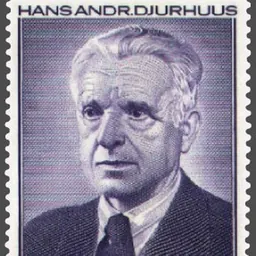



Related people
Same field, nearest in time

Contemporaries
People whose lives overlapped William Heinesen's




Frequently asked questions
Who was William Heinesen?
Faroese Danish-language writer (1900-1991)
When was William Heinesen born?
William Heinesen was born on 15 January 1900 in Tórshavn.
When did William Heinesen die?
William Heinesen died on 12 March 1991 in Tórshavn.
What was William Heinesen's occupation?
William Heinesen was a poet, painter, translator, composer, writer and screenwriter.
What nationality was William Heinesen?
William Heinesen was Danish.
Sources & further reading
Cite this page
APA: Biography.guide. (2026). William Heinesen. https://biography.guide/william-heinesen/
MLA: "William Heinesen." Biography.guide, https://biography.guide/william-heinesen/.
Chicago: "William Heinesen." Biography.guide. https://biography.guide/william-heinesen/.
Data last updated: 2026-09-21 · Spot an error? Report a correction.
Portrait: Wikimedia Commons · author & licence
Page generated 2026-09-27 04:59 UTC