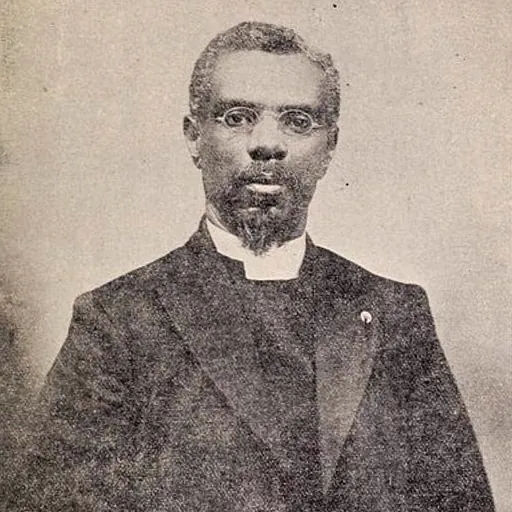
About William H. Heard
Lived 1850 – 1937 (aged 87). William H. Heard was an American diplomat, religious person and politician.
William Henry (Harrison) Heard (June 25, 1850 – September 12, 1937) was a clergyman of the African Methodist Episcopal Church who served as United States Ambassador to Liberia from 1895 through 1898.
Early life, family and education William Heard was born into slavery about 1843 (1850?) in Elbert County, Georgia, some three miles from the small settlement of Longstreet. His father was George W. Heard (b. circa 1813), recorded in the 1870 census as of mixed race. Before emancipation, he was an enslaved skilled workman: he worked first as a blacksmith and later as a wheelwright and carpenter. George did not know the name of his mother. His biological father was said to have been a white man named Thomas Heard Galloway (d. circa 1859). She was skilled in plowing, but she was also valued by her owners as a "breeder" (a woman who regularly produced children). She was allowed to work close to her own cabin in order to nurse and care for her children. joined the African Methodist Episcopal Church, formed in the early 19th century as the first independent black denomination in the United States. He rose rapidly through its ranks, being ordained elder in 1883
With the help of Henry McNeal Turner, head Bishop of the AME Church, Heard obtained a diplomatic appointment, being nominated as Minister Resident and Consul General to Liberia by President Grover Cleveland on February 21, 1895. While in Monrovia, Heard also served as superintendent of the Liberia Annual Conference of the A.M.E. Church. He built the first A.M.E. church in the city, the Eliza Turner Memorial Chapel. Before returning to America, he toured Europe, observing during a visit to the British Museum that the mummies of Ancient Egypt were clearly of African, not Caucasian, ethnicity. He said that racial prejudice was less strong in France than in any English-speaking country, and seemed non-existent in Switzerland.
Marriage Heard married Josephine Delphine Henderson of Salisbury, N.C., in 1882.
Death William H. Heard died in Philadelphia on September 12, 1937. His death was reported in major newspapers both in the United States and in Britain.
Works Africa: Verse and Song Atlanta, Ga. : Union Publishing Col., [ca. 1900?] The Bright Side of African Life A.M.E. Publishing Co, Philadelphia, 1898 From slavery to the bishopric in the A.M.E. Church New York : Arno Press, 1969. The American Negro's Opportunities in Africa (essay)
Don’t just read it —
keep it.
Full-length biographies made to live with: read them, listen on the way to work, watch them tonight.
- E-book
- Audio
- Video
Instant download · yours to keep · every purchase keeps this site free
Important facts
Family & relationships
People in William H. Heard's life
Named in this biography and alive at the same time
Related people
Same field, nearest in time

Contemporaries
People whose lives overlapped William H. Heard's


Frequently asked questions
Who was William H. Heard?
American clergyman and diplomat (1850–1937)
When was William H. Heard born?
William H. Heard was born on 25 June 1850 in Elbert County.
When did William H. Heard die?
William H. Heard died on 12 September 1937 in Philadelphia, Pennsylvania.
What was William H. Heard's occupation?
William H. Heard was a diplomat, religious person and politician.
What nationality was William H. Heard?
William H. Heard was American.
Sources & further reading
· DBpedia: William Henry Heard
Cite this page
APA: Biography.guide. (2026). William H. Heard. https://biography.guide/william-h-heard/
MLA: "William H. Heard." Biography.guide, https://biography.guide/william-h-heard/.
Chicago: "William H. Heard." Biography.guide. https://biography.guide/william-h-heard/.
Data last updated: 2026-09-22 · Spot an error? Report a correction.
Portrait: Wikimedia Commons · author & licence
Page generated 2026-09-27 04:57 UTC