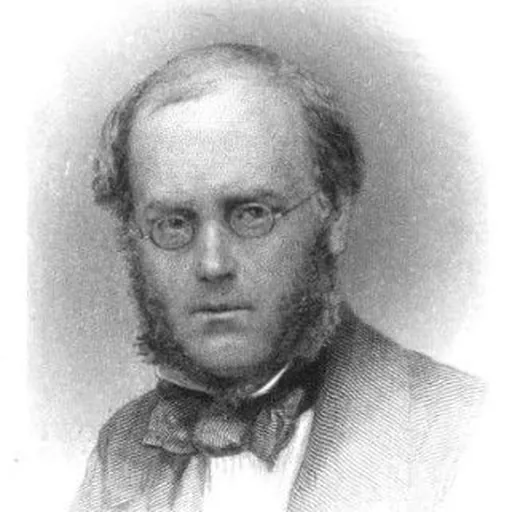
William George Clark
English classical and Shakespearean scholar
About William George Clark
Lived 1821 – 1878 (aged 57). William George Clark was a British classical scholar, philologist and editor.
William George Clark (18 March 18216 November 1878) was an English writer and classical scholar. He was best known for founding the Journal of Philology and The Cambridge Shakespeare alongside writer William Aldis Wright.
Life He was born at Barford Hall, Darlington. He was educated at Sedbergh School, Shrewsbury School, and Trinity College, Cambridge, where he graduated in classics and won a Browne medal and was subsequently elected Fellow. In 1857 he was appointed Public Orator. He travelled much during the long vacations, visiting Spain, Greece, Italy and Poland.
In 1853 Clark had taken orders, but left the Church after the passing of the Clerical Disabilities Act 1870 (33 & 34 Vict. c. 91), of which he was one of the promoters. He also resigned the public oratorship in the same year, and in consequence of illness left Cambridge in 1873. He died at York on 6 November 1878.
He bequeathed a sum of money to his old college for the foundation of a lectureship in English literature.
Works Clark established the Cambridge Journal of Philology, and cooperated with Benjamin Hall Kennedy and James Riddell in the production of the Sabrinae Corolla. He published little as a classical scholar. A contemplated edition of the works of Aristophanes was never published. He visited Italy in 1868 to examine the Ravenna manuscript of Aristophanes and other manuscripts, and on his return began the notes to the Acharnians, but they were left incomplete.
The work by which he is best known is the Cambridge Shakespeare (1863–6), containing a collation of early editions and selected emendations, edited by him at first with John Glover and later with William Aldis Wright. Gazpacho (1853) gives an account of his tour in Spain; his Peloponnesus (1858) was a contribution to the knowledge of Greece. His visits to Italy at the time of Garibaldi's insurrection, and to Poland during the insurrection of 1863, are described in Vacation Tourists, ed. Francis Galton, i and iii.
Hugh Andrew Johnstone Munro in Journal of Philology (viii. 1879) described Clark as "the most accomplished and versatile man he ever met".
Don’t just read it —
keep it.
Full-length biographies made to live with: read them, listen on the way to work, watch them tonight.
- E-book
- Audio
- Video
Instant download · yours to keep · every purchase keeps this site free
Important facts
People in William George Clark's life
Named in this biography and alive at the same time




Related people
Same field, nearest in time

Contemporaries
People whose lives overlapped William George Clark's





Frequently asked questions
Who was William George Clark?
English classical and Shakespearean scholar
When was William George Clark born?
William George Clark was born on 1 March 1821.
When did William George Clark die?
William George Clark died on 6 November 1878.
What was William George Clark's occupation?
William George Clark was a classical scholar, philologist and editor.
What nationality was William George Clark?
William George Clark was British.
Sources & further reading
· Wikipedia: William George Clark
· DBpedia: William George Clark
Cite this page
APA: Biography.guide. (2026). William George Clark. https://biography.guide/william-george-clark/
MLA: "William George Clark." Biography.guide, https://biography.guide/william-george-clark/.
Chicago: "William George Clark." Biography.guide. https://biography.guide/william-george-clark/.
Data last updated: 2026-09-21 · Spot an error? Report a correction.
Portrait: Wikimedia Commons · author & licence
Page generated 2026-09-27 04:59 UTC