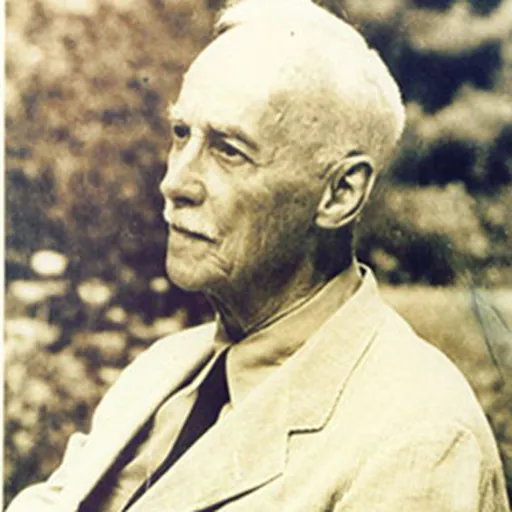
About William Franklin Sands
Lived 1874 – 1946 (aged 71). William Franklin Sands was an American diplomat, writer, university teacher, author and professor.
William Franklin Sands (July 29, 1874 – June 17, 1946) was a United States diplomat most known for his service in Korea on the eve of Japan's colonization of that country.
Biography William Franklin Sands was born in Washington, D.C., on July 29, 1874, the son of James Hoban and Mary Elizabeth (Meade) Sands. He was the grandson of Benjamin F. Sands and Henrietta M. (French) Sands, and a descendant of Hobert Sands, who came to America in 1776 and settled at West River, Maryland. Members of his family have played prominent roles in every war since the American Revolution.
Sands was educated at the College de St. Michel in Fribourg, Switzerland, and at Feldkirch, Austria, and later attended Georgetown College (class of 1896). He graduated from Georgetown University Law School, where he received the LL.B. degree, also in 1896.
Following graduation, Sands was appointed second secretary of legation at Tokyo, and in the following year became the first secretary of legation at Seoul, where he remained for two years. Between 1900 and 1904 he served as adviser to Emperor Gojong of Korea, succeeding Clarence Greathouse and General Charles Legendre, both of whom had died in Seoul in 1899. It was during this period, in 1901, that Sands received the Cross of the Legion of Honor of France and was made a chevalier of that order for protecting French missionaries during an uprising on the island of Jeju.
At the outbreak of the Russo-Japanese War Sands was succeeded by Durham White Stevens. He reentered the U.S. diplomatic service where he functioned as an "emergency man" or "trouble shooter"; his assignments at that time were usually as special envoy to capital cities in which there was a perceived crisis. He was sent to Panama in this capacity in 1904 as first secretary of legation under Charles E. Magoon, in order to ease frictions and allay fears that had arisen from the American involvement in the revolt against Columbia and from Theodore Roosevelt's seizure of the canal zone.
In Our Jungle Diplomacy, Sands pointed out that United States policy in South America was creating a perception among Latin Americans that the U.S. was intending to absorb their continent. He noted that the Japanese took US foreign policy in the region as a precedent to justify their own imperialistic plans in Asia. In his November 25, 1944 review of the book, in The Saturday Review, Ambassador Charles Yost wrote: "The episodes and anecdotes with which the book abounds catch the flavor of existence in those informal days and passionate climes" Yost goes on to say that the book argues "that in foreign policy our grasp exceeded our reach. The book moves from this premise…to the somewhat startling conclusion that we are responsible for Japanese imperialism…A similar lack of proportion and balance would seem to characterize the conclusion…that we are still the Big Bad Wolf of the Western Hemisphere." When the book sticks to being "a memoir on the olden days…the book is delightful and rewarding." But, continued Yost, when the author and his collaborator [Joseph M Lalley] comment on "the burning issues of the moment…the result is not impressive, since their political conclusions are based on data the collection of which apparently ceased about the year 1910." His obituary in the NY Times stated that if the US government had listened to him, World War II could have been averted.
Two years after arriving in Panama, Sands proceeded to Guatemala in a similar capacity, and in 1908 became the first secretary of the embassy in Mexico. In 1909 he became envoy extraordinary and minister plenipotentiary to Guatemala.
Family Sands married Edith Gertrude Keating, daughter of John M. Keating of Philadelphia, on August 17, 1909. They had four sons, James Sands, William Franklin Sands, Robert Sands, and John Keating Sands.
Sands died in Washington, D.C. on June 17, 1946.
Don’t just read it —
keep it.
Full-length biographies made to live with: read them, listen on the way to work, watch them tonight.
- E-book
- Audio
- Video
Instant download · yours to keep · every purchase keeps this site free
Important facts
People in William Franklin Sands's life
Named in this biography and alive at the same time



Related people
Same field, nearest in time

Contemporaries
People whose lives overlapped William Franklin Sands's

Frequently asked questions
Who was William Franklin Sands?
American diplomat (1874–1946)
When was William Franklin Sands born?
William Franklin Sands was born on 29 July 1874 in Washington, D.C..
When did William Franklin Sands die?
William Franklin Sands died on 17 June 1946 in Washington, D.C..
What was William Franklin Sands's occupation?
William Franklin Sands was a diplomat, writer, university teacher, author and professor.
What nationality was William Franklin Sands?
William Franklin Sands was American.
Sources & further reading
· Wikipedia: William Franklin Sands
· DBpedia: William Franklin Sands
Cite this page
APA: Biography.guide. (2026). William Franklin Sands. https://biography.guide/william-franklin-sands/
MLA: "William Franklin Sands." Biography.guide, https://biography.guide/william-franklin-sands/.
Chicago: "William Franklin Sands." Biography.guide. https://biography.guide/william-franklin-sands/.
Data last updated: 2026-09-20 · Spot an error? Report a correction.
Page generated 2026-09-27 05:09 UTC