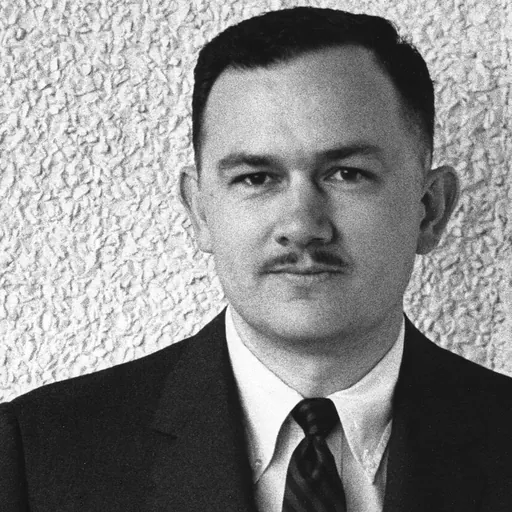
About William Fetter
Lived 1928 – 2002 (aged 74). William Fetter was an American engineer and boeing.
William Fetter (March 14, 1928 – June 23, 2002), also known as William Allan Fetter or Bill Fetter, was an American graphic designer and pioneer in the field of computer graphics. He explored the perspective fundamentals of computer animation of a human figure from 1960 on and was the first to create a human figure as a 3D model. The First Man was a pilot in a short 1964 computer animation, also known as Boeing Man and now as Boeman by the Boeing company. Fetter preferred the term "Human Figure" for the pilot. In 1960, working in a team supervised by Verne Hudson, he helped coin the term Computer graphics. He was art director at the Boeing Company in Wichita.
Life Born in Independence, Missouri, Fetter attended school in Englewood and graduated in 1945 from Northeast High School in Kansas City. He studied at the University of Illinois where he was awarded a BA in graphic design in 1952. His professional career started while studying at the University of Illinois Press (UIP), an American university press. Employed there from 1952 to 1954, even at this early date he thought of using computers as a tool for his work as a graphic designer. Together with a computer manager, he worked on the development of a program but before the project was completed, Fetter accepted employment as art director of Boeing in Wichita in 1959. Boeing also notes that Verne L. Hudson was the first to coin the term.
In a 1966 editorial in the special "The designer and the computer" issue of Print magazine, editor Martin Fox explained the semantic difference, the meaning and interpretation of the words "graphics" and "design", as used by traditional graphic designers and designers, in contrast to how they were used by the new generation of computer graphic designers.
Computer Graphics From the start of the 1950s, successful developments were underway in controlling machines with computers for industrial production. Subsequent development of computer aided design programs for 2D and 3D production drawings began in the mid-50s. In 1959, Fetter was recruited by Boeing as art director of the CAD department to explore creative new ideas for the production of 3D drawings.
He created a new concept of drawing perspectives. Supported by Walter Bernhardt, assistant professor of Applied Mechanics at Wichita State University, Kansas, his ideas were successfully implemented as mathematical formulae. Programmers subsequently entered these into the computer. Fetter was the team leader (supervisor) of this group. Due to the success of the first experiments, a Boeing research program was launched in November 1960 with Fetter as manager. The result of the research was registered as a "Planar Illustration Method and Apparatus" under US patent in November 1961 – Patent 1970 obtained with the number 3,519,997. The January 1965 issue of Architectural Record magazine described how Fetter had worked as a graphic designer in a team of engineers and programmers to create computer graphics.
In 1963, the research department relocated from Wichita to Seattle, where Fetter became the manager of Boeing's newly founded Computer Graphics Group.
The first human figure, which he managed with a computer for a film, however, was the Landing Signal Officer on a CV-A 59 aircraft carrier. The figure was shown in a short CV A-59 film but only as a silhouette and not as detailed elaboration as the First Man had been. Fetter published this in November 1964 in his book Computer Graphics in Communication in the section "Aircraft Carrier Landing Depiction with images".
The Portland E.A.T. Group
In 1965 Fetter was invited to a meeting at Bell Labs in Murray Hill, New Jersey, where he was the only one with an education in graphic and art. Participants at the meeting were Ken Knowlton and Ed Zajac of Bell Laboratories and others who conducted research on the development of computer films. Because of the travel to Bell and New York City, he learned of the Experiments in Art and Technology (E.A.T.) movement and became an active member of the group. His contacts with E.A.T. inspired him in 1968 to help found the Pacific Northwest chapter of the movement. At the founding event Fetter and Hans Graf showed the film Sorcerer's Apprentice. The Human Figure by Fetter was seen in all exhibitions as Boeing Man. In the catalog for Cybernetic Serendipity only The Boeing Computer Graphics organization is mentioned as the author.
1968: Cybernetic Serendipity: The Computer and the Arts, London, Institute of Contemporary Art. 1968: On the Path to Computer Art, MIT, und TU Berlin, Berlin. 1968: Some More Beginnings: An Exhibition of Submitted Works Involving Technical Materials and Processes, E.A.T., New York, Brooklyn Museum. 1969: Tendencija 4, Computers and Visual Research, galerija suvremene umjetnosti, Contemporary Art Gallery, Zagreb. 1969: Computerkunst-On the Eve of Tomorrow, Galerie Kubus, Hanover. Thereafter, in Munich, Hamburg, Oslo, Brussels, Rome and Tokyo. 1989: 25 Jahre Computerkunst – Grafik, Animation und Technik, BMW Pavillon, München. 2007: Ex Machina - Frühe Computergrafik bis 1979: Herbert W. Franke zum 80. Geburtstag, Kunsthalle Bremen, Bremen. 2007: bit international: [Nove] Tendencije - Neue Galerie Graz - Universalmuseum Joanneum, Graz. 2008: Bit International, (Nove) tendencije, 1961 bis 1973, Zagreb, In: ZKM, Medienmuseum, Karlsruhe. 2009: Digital Pioneers, Victoria & Albert Museum, London 2015: Galerija suvremene umjetnosti, Contemporary Art Gallery, Zagreb 2015: Tendenzen 4, Computer und Visuelle Forschung, ZKM, Karlsruhe
Work Human Figure
Book Computer Graphics in Communication, New York, Verlag McGraw-Hill, 1964.
Articles The Art Machine, In: The Journal of Commercial Art & Design, Vol. 4, No.2, Feb. 1962, p. 36. Computer Graphics. In 1967 University of Illinois Conference Emerging Concepts in Computer Graphics, edited by Don Secrest and Jurg Nievergelt. W.A.Benjamin, Inc., 1968, p. 397-418. A Computer Graphics Human Figure System Applicable to Biostereornetrics, CAD J. Fourth Int'l Con/. and Exhibition on Computers in Engineering and Building Design, IDC Science and Technology Press, Guildford, Surrey, England, 1980, coverandpp.175–179. A Computer Graphics Human Figure System Applicable to Kineseology, ACM Special Interest Group on Design Automation Newsletter, Vol. No.2 of 3 (late issue), June 1978, pp. 3–7. A Progression of Human Figures Simulated by Computer Graphics, PROCEEDINGS, SPIE, Volume 166, NATO Symposium on APPLICATIONS OF HUMAN BIOSTEREOMETRICS. July 9–13, 1978 Paris France. Wide Angle Displays for Tactical Situations, Proc. US Army Third Computer Graphics Workshop, Virginia Beach, Va., Apr. 1981, pp. 99–103. II. Bui-Tuong Phong, Illumination for Computer Generated Images, Comm. ACM, Vol. 18, June 1975, pp. 311–317. Progression of Human Figures Simulated by Computer Graphics. IEEE Computer Graphics and Applications, 1982, Vol. 2, No. 9, p. 9-13.
Literature Herbert W. Franke: Computergraphik Computerkunst. Bruckmann, München 1971, first published. Herbert W. Franke: Computer Graphics Computer Art. Phaidon Press, London, Phaidon Publishers, New York, 1971. Translation by Gustav Metzger.
Don’t just read it —
keep it.
Full-length biographies made to live with: read them, listen on the way to work, watch them tonight.
- E-book
- Audio
- Video
Instant download · yours to keep · every purchase keeps this site free
Important facts
People in William Fetter's life
Named in this biography and alive at the same time





Related people
Same field, nearest in time




Contemporaries
People whose lives overlapped William Fetter's

Frequently asked questions
Who was William Fetter?
American computer graphics art director (1928–2002)
When was William Fetter born?
William Fetter was born on 14 March 1928 in Independence.
When did William Fetter die?
William Fetter died on 23 June 2002 in Bellevue.
What was William Fetter's occupation?
William Fetter was an engineer and boeing.
What nationality was William Fetter?
William Fetter was American.
Sources & further reading
Cite this page
APA: Biography.guide. (2026). William Fetter. https://biography.guide/william-fetter/
MLA: "William Fetter." Biography.guide, https://biography.guide/william-fetter/.
Chicago: "William Fetter." Biography.guide. https://biography.guide/william-fetter/.
Data last updated: 2026-09-22 · Spot an error? Report a correction.
Portrait: Wikimedia Commons · author & licence
Page generated 2026-09-27 05:01 UTC