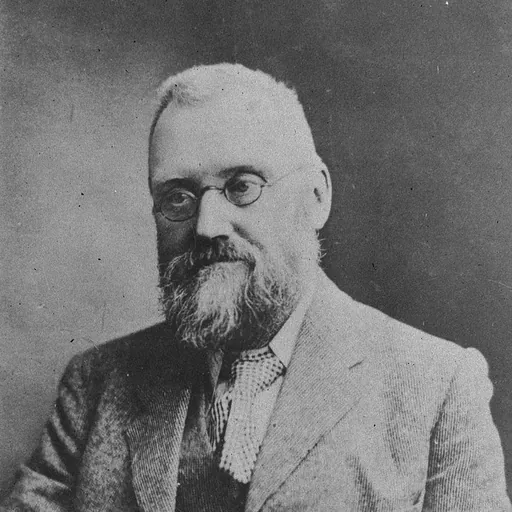
About William Farrer
Lived 1845 – 1906 (aged 61). William Farrer was an Australian agronomist and farmer.
William James Farrer (3 April 184516 April 1906) was a leading English Australian agronomist and plant breeder. Farrer is best remembered as the originator of the "Federation" strain of wheat, distributed in 1903. His work resulted in significant improvements in both the quality and crop yields of Australia's national wheat harvest, a contribution for which he earned the title 'father of the Australian wheat industry'.
Early years
Farrer was born on 3 April 1845 in the town of Docker, Westmorland in the English north west (now Cumbria). The son of Thomas Farrer, a tenant farmer, and his wife Sarah William, William Farrer was selected for a scholarship at Christ's Hospital, London where he was awarded a gold and silver medal for mathematics and soon earned a scholarship to Pembroke College where, after earning a B.A. at Pembroke College, Cambridge in 1868, Farrer emigrated to Australia in 1870. A sufferer of tuberculosis, Farrer hoped to find Australia's drier warmer climate more agreeable to his then delicate medical condition.
Initially, Farrer lived with friends at Parramatta but was later employed as a tutor in Duntroon, In 1873 he published Grass and Sheep-farming A Paper: Speculative and Suggestive. After working as a tutor on George Campbell's sheep station at Duntroon, he qualified as a surveyor in 1875. Farrer worked for the Department of Lands in wheat growing districts of NSW from 1875 to 1886.
In 1882 Farrer married Henrietta Nina, the only daughter of Leopold Fane de Salis, the then Member of Parliament for Queanbeyan, NSW. Four years later De Salis gifted to Nina alone, 97 hectares of land. A farm rather than a station "Lambrigg" (named for Farrer's home district), formerly part of "Cuppacumbalong"", was located on the Murrumbidgee River, near Tharwa in the present day Australian Capital Territory. Farrer's initial attempts at establishing a vineyard were thwarted as the soil proved unsuitable and he turned his attention to wheat cultivation. His goal was to produce a good loaf of bread. He would consider himself a scientific gardener.
Lambrigg experiments William Farrer is remembered in Queanbeyan bust sculpture by Rayner Hoff. The Wheat leaf rust disease had a major impact on both the quality and yields of wheat harvests throughout the colonies. Farrer applied his scientific knowledge to developing wheat hybrids, initially applying cross-pollination techniques to create rust immune strains of wheat. He readily improvised using hairpins to transfer pollen until he could obtain forceps. A statue of Farrer was erected in Queanbeyan by the Federal government in 1935 and another at Lambrigg in 1938.
A suburb and a primary school in Canberra have been named in his honour. The school's logo is a wheat sheaf and the sports houses are named after his most famous types of wheat. An Australian electoral division has been named after him, and Farrer was also remembered on the reverse of the Australian two-dollar banknote issued in 1966 (now withdrawn). A specialist agricultural high school (Farrer Memorial Agricultural High School, Tamworth NSW) was named in his honour and continues to provide specialist agricultural education. There is also a hall of residence at Monash University named in his honour.
William Farrer is also remembered in Wagga Wagga with the Farrer Hotel and the Farrer Football League (Australian rules football).
Farrer was previously depicted on the $2 banknote. The Australian $2 banknote was officially replaced by a gold-coloured coin on 20 June 1988.
Don’t just read it —
keep it.
Full-length biographies made to live with: read them, listen on the way to work, watch them tonight.
- E-book
- Audio
- Video
Instant download · yours to keep · every purchase keeps this site free
Important facts
People in William Farrer's life
Named in this biography and alive at the same time


Related people
Same field, nearest in time


Contemporaries
People whose lives overlapped William Farrer's

Frequently asked questions
Who was William Farrer?
Australian agronomist and plant breeder (1845–1906)
When was William Farrer born?
William Farrer was born on 3 April 1845 in Cumbria.
When did William Farrer die?
William Farrer died on 16 April 1906 in Tharwa.
What was William Farrer's occupation?
William Farrer was an agronomist and farmer.
What nationality was William Farrer?
William Farrer was Australian.
Sources & further reading
Cite this page
APA: Biography.guide. (2026). William Farrer. https://biography.guide/william-farrer-agronomist/
MLA: "William Farrer." Biography.guide, https://biography.guide/william-farrer-agronomist/.
Chicago: "William Farrer." Biography.guide. https://biography.guide/william-farrer-agronomist/.
Data last updated: 2026-09-23 · Spot an error? Report a correction.
Portrait: Wikimedia Commons · author & licence
Page generated 2026-09-27 05:07 UTC