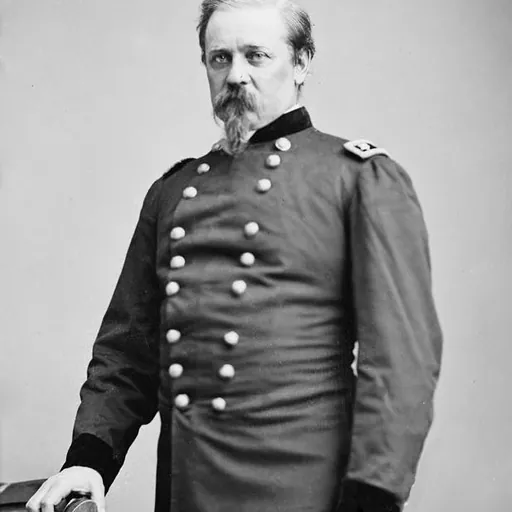
William Farrar Smith
United States Army general, civil engineer, mathematics professor, police commissioner
About William Farrar Smith
Lived 1824 – 1903 (aged 79). William Farrar Smith was an American military officer, civil engineer, cartographer and soldier.
William Farrar Smith (February 17, 1824 – February 28, 1903), known as "Baldy" Smith, was a Union general in the American Civil War, notable for attracting the extremes of glory and blame. He was praised for his gallantry in the Seven Days Battles and the Battle of Antietam, but was demoted for professional and political reasons after the disastrous defeat at the Battle of Fredericksburg. As chief engineer of the Army of the Cumberland, he achieved recognition by restoring a supply line that saved that army from starvation and surrender, known as the "Cracker Line", that helped Union troops to success in the Chattanooga campaign in the autumn of 1863. Leading the first operation against Petersburg, Smith's caution, possibly illness-related, may have cost the Union a prime opportunity for a quick end to the war. He was relieved of command shortly thereafter.
Early life Smith, known to his friends as "Baldy", was born at St. Albans, Vermont, the son of Ashbel and Sarah Butler Smith, and a cousin of J. Gregory Smith (governor of Vermont, 1863–1865).
During his service in the Corps, Smith conducted surveys of the Great Lakes, the states of Texas, Arizona, and Florida, as well as much of Mexico. While serving in Florida, Smith was stricken with the infectious disease malaria. Although he would recover at the time, the illness affected his physical health for the rest of his life. In 1856 Smith began his involvement in the lighthouse service, which was headquartered in Detroit, Michigan, and eventually rose to become the Engineer Secretary of the Lighthouse Board.
Smith was also twice assistant professor of mathematics at West Point (1846–48 and 1855–56). He was promoted to captain on July 1, 1859. maintained that they were purely of a personal character.
For the Overland Campaign of 1864, Smith was assigned by Grant to command the XVIII Corps in Maj. Gen. Benjamin Butler's Army of the James, which he led in the Battle of Cold Harbor and the first operations against Petersburg. Smith's corps and a division of black troops (under Edward W. Hinks) were ordered to take the city. Remembering the debacle at Cold Harbor, Smith performed exhaustive reconnaissance. Determining that the section of the defensive line was manned primarily by artillery, he ordered an attack. The attack was successful in capturing several Confederate batteries and over a mile of entrenchments. However, by the time this was accomplished, Smith determined that darkness prevented him from effectively moving further. Both the time it took to prepare for the attack and suspending the attack at night has led some historians to see the outcome of the battle as a missed opportunity to shorten the war by nearly a year. But the fault may also lay with General Grant who failed to communicate with Smith, Major General George Gordon Meade and Major General Winfield Scott Hancock the full picture of the battle's true objective and provide the time to develop an effective operational plan. Smith's personal and professional differences with Generals Butler and Meade led General Grant to relieve Smith from command of the XVIII Corps on July 19, 1864. Smith spent the remainder of the war serving on military commissions, including one that discovered significant corruption in the Department of the Gulf. His Autobiography of Major General William F. Smith, 1861–1864 was published posthumously in 1990.
Don’t just read it —
keep it.
Full-length biographies made to live with: read them, listen on the way to work, watch them tonight.
- E-book
- Audio
- Video
Instant download · yours to keep · every purchase keeps this site free
Important facts
People in William Farrar Smith's life
Named in this biography and alive at the same time


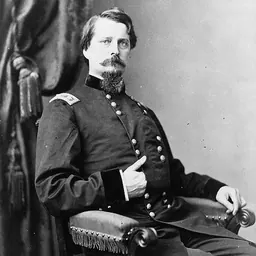
Related people
Same field, nearest in time

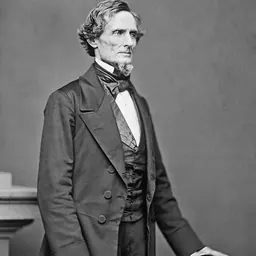
Contemporaries
People whose lives overlapped William Farrar Smith's





Frequently asked questions
Who was William Farrar Smith?
United States Army general, civil engineer, mathematics professor, police commissioner
When was William Farrar Smith born?
William Farrar Smith was born on 17 February 1824 in St. Albans.
When did William Farrar Smith die?
William Farrar Smith died on 28 February 1903 in Philadelphia.
What was William Farrar Smith's occupation?
William Farrar Smith was a military officer, civil engineer, cartographer and soldier.
What nationality was William Farrar Smith?
William Farrar Smith was American.
Sources & further reading
· Wikipedia: William Farrar Smith
· DBpedia: William Farrar Smith
Cite this page
APA: Biography.guide. (2026). William Farrar Smith. https://biography.guide/william-farrar-smith/
MLA: "William Farrar Smith." Biography.guide, https://biography.guide/william-farrar-smith/.
Chicago: "William Farrar Smith." Biography.guide. https://biography.guide/william-farrar-smith/.
Data last updated: 2026-09-20 · Spot an error? Report a correction.
Portrait: Wikimedia Commons · author & licence
Page generated 2026-09-27 04:57 UTC