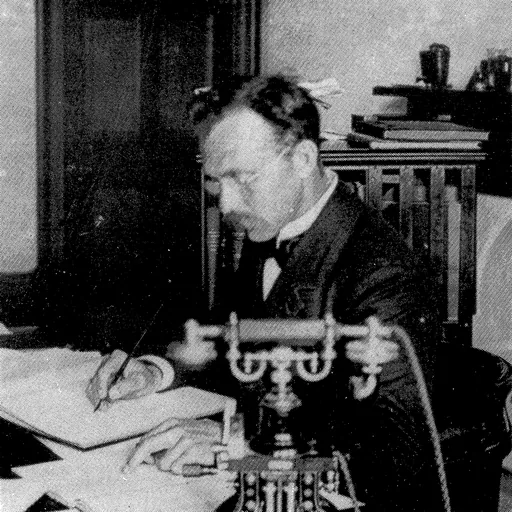
About William Ernest Cooke
Lived 1863 – 1947 (aged 84). William Ernest Cooke was an Australian astronomer.
William Ernest Cooke (25 July 1863 – 7 November 1947), generally referred to as W. Ernest Cooke or informally Ernest Cooke, was an Australian astronomer, credited with a number of important scientific breakthroughs and improved methodologies in astronomical observations and star cataloguing. He was the first Western Australian Government Astronomer and established the Perth Observatory as one of the best equipped and productive establishments of its type in Australia.
Cooke was born in Adelaide, the son of Ebenezer Cooke, public servant and politician from South Australia. He was educated at The Collegiate School of St Peter in Adelaide (1875–79) and the University of Adelaide (B.A., 1883; M.A., 1889).
Cooke did well at school: in 1879 he was first placed in St Peter's First Class of matriculants, with passes in Greek and Chemistry. He signed the student roll at the University of Adelaide in March the same year, while he was still 15. After a glowing reference from his headmaster, he took a Civil Service cadetship under Sir Charles Todd at the Adelaide Observatory in December 1878. He was awarded a Bachelor of Arts degree in 1883 and a Master of Arts in 1889.
Cooke married Jessie Elizabeth Greayer in Adelaide in 1887 and they had six children—five before arriving in Western Australia: Violet Ogden (1888), Lionel Ernest (1889), Rosalie (1891, died in infancy), Frank Basil (1892), and Erica Carrington (1894). The sixth child, Maxwell Greayer was born in Perth in 1898. With the catalogue, Cooke produced a critique of the international programme, referring to lack of coordination, refinements that he had made in observation methods and suggested procedures to be used at other sites around the world. As a result, he received wide acclaim from international peers. The Astronomer Royal wrote to the Government astronomer at Adelaide, "to follow implicitly the head of the Perth Observatory and copy their methods ... their catalogues are excellent, and they seem to be able to maintain maximum efficiency with the minimum of energy". He had been given promises of a new observatory and equipment at Wahroonga, but political machinations and economic priorities associated with the First World War meant the project was abandoned and the Sydney Observatory remained as the principal New South Wales facility. The government pushed for its closure in 1926 but was narrowly defeated after a bitter opposition campaign, however Cooke became the political scapegoat and was forced into early retirement in the same year.
Cooke returned to Adelaide in 1936 and died there in 1947.
During his time in Western Australia he was also the government meteorologist until 1908 and the founding chairman of the Civil Service Association in 1902.
Achievements
His star cataloguing system was accepted at an international astronomical conference in Paris in 1909. He developed a method of plotting the transit of tropical cyclones, and issuing weather warnings for shipping and pearling industries He invented a type of heliochronometer which could be used to determine local time and true north accurately. The device was known as a sunclock (picture). In 1924 the device won a gold medal at the British Empire Exhibition. He recognised that by using radio signals form other parts of the world would enable the accurate measurement of longitude. He worked with his son Basil, a pioneer amateur radio operator, who received time signals from Lyon, France. This technique was used in 1921 by the WA Government Astronomer, Curlewis and the SA Government Astronomer, Dodwell, at Deakin, Western Australia to fix a position for the 129th meridian east longitude (129° east). The same group also travelled to Wyndham, Western Australia to determine the WA/NT border on the ground. Cooke is said to have patented over one hundred inventions
Satellite 3894 Williamcooke and Mount Cooke in the Darling Scarp near Jarrahdale are named in his honour.
Partial bibliography
Don’t just read it —
keep it.
Full-length biographies made to live with: read them, listen on the way to work, watch them tonight.
- E-book
- Audio
- Video
Instant download · yours to keep · every purchase keeps this site free
Important facts
People in William Ernest Cooke's life
Named in this biography and alive at the same time


Related people
Same field, nearest in time


Contemporaries
People whose lives overlapped William Ernest Cooke's




Frequently asked questions
Who was William Ernest Cooke?
Australian astronomer (1863–1947)
When was William Ernest Cooke born?
William Ernest Cooke was born on 25 July 1863 in Adelaide.
When did William Ernest Cooke die?
William Ernest Cooke died on 7 November 1947 in Adelaide.
What was William Ernest Cooke's occupation?
William Ernest Cooke was an astronomer.
What nationality was William Ernest Cooke?
William Ernest Cooke was Australian.
Sources & further reading
· Wikipedia: William Ernest Cooke
· DBpedia: William Ernest Cooke
Cite this page
APA: Biography.guide. (2026). William Ernest Cooke. https://biography.guide/william-ernest-cooke/
MLA: "William Ernest Cooke." Biography.guide, https://biography.guide/william-ernest-cooke/.
Chicago: "William Ernest Cooke." Biography.guide. https://biography.guide/william-ernest-cooke/.
Data last updated: 2026-09-22 · Spot an error? Report a correction.
Portrait: Wikimedia Commons · author & licence
Page generated 2026-09-27 05:04 UTC