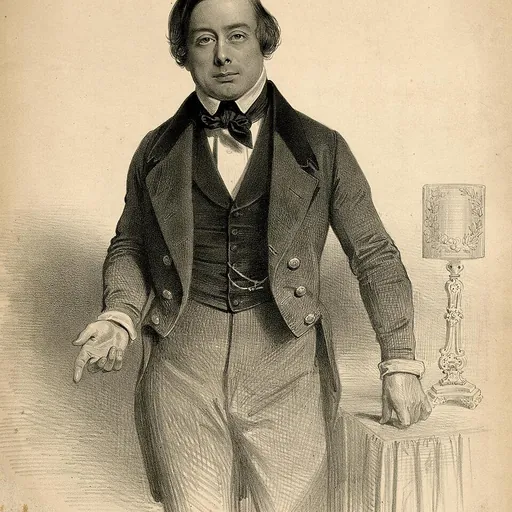
William Edward Love
British impressionist
About William Edward Love
Lived 1806 – 1867 (aged 60–61). William Edward Love was an impressionist.
William Edward Love (6 February 1806 – 16 March 1867) was an English impressionist.
Biography
Love, son of a merchant in the city of London, was born in London 6 February 1806, and was educated at Harlow in Essex and at Nelson House Academy, Wimbledon, Surrey.
At the age of twelve, while still at school, he commenced imitating the noises occasioned by the action of machinery and inanimate objects, and soon proceeded to mimic the sounds made by musical instruments, beasts, birds, and insects.
From about 1820 to 1826, he was connected with London journalism. In the latter year, he appeared for a benefit in a solo entertainment, entitled The False Alarm, and his success led him to become a public performer.
He travelled in 1827 through parts of England and France; in 1828, he came out at the Fishamble Street Theatre, Dublin; and in June 1829, he produced The Peregrinations of a Polyphonist, with which he visited the chief towns in England. In this, as in all his later entertainments, he was the sole performer; he represented various characters, making very rapid changes of dress while talking, singing, and displaying his remarkable powers of mimicry and ventriloquism.
He went to Scotland in 1830, where he brought out Love in a Labyrinth, or the Adventures of a Day, and in 1833, he opened at Oxford with a piece called Ignes Fatui.
In Lent 1834, he made his first appearance in London, and acted at the City of London Assembly Rooms, Bishopsgate Street, for several months. In September, he went to France and had his entertainments translated, delivering one half in French and the other in English.
In 1836, he appeared on alternate nights at the St James's Theatre and in the city.
In 1838, he visited the United States, the West Indies, and South America. Returning to England he played at the Strand Theatre, Almack's, Hanover Square Rooms, Store Street Music Hall, Philharmonic Rooms, Crosby Hall, and the Princess's Concert Rooms.
On 26 December 1854, he took possession of the Upper Hall, 69 Quadrant, Regent Street, London, where he produced the London Season, which was very successful.
The names of other entertainments produced by Love were: Love in All Shapes Love's Labour Lost A Voyage to Hamburg A Reminiscence of Bygone Times Love's Lucubrations Love's Mirror A Traveller's Reminiscences, by Charles Forrester A Christmas Party The Wolf in Sheep's Clothing, by H. Ball Dinner at Five Precisely
He played at the Regent Gallery on 8 February 1856, the 300th consecutive night, and this was stated to be his 2,406th performance in London.
In 1858, he was seized with permanent paralysis, when a benefit was organised for him at Sadler's Wells. He died at 33 Arundel Street, Strand, London, on 16 March 1867.
Don’t just read it —
keep it.
Full-length biographies made to live with: read them, listen on the way to work, watch them tonight.
- E-book
- Audio
- Video
Instant download · yours to keep · every purchase keeps this site free
Important facts
Related people
Same field, nearest in time




Contemporaries
People whose lives overlapped William Edward Love's





Frequently asked questions
Who was William Edward Love?
British impressionist (1806–1867)
When was William Edward Love born?
William Edward Love was born in 1806.
When did William Edward Love die?
William Edward Love died in 1867.
What was William Edward Love's occupation?
William Edward Love was an impressionist.
Sources & further reading
· Wikipedia: William Edward Love
· DBpedia: William Edward Love
Cite this page
APA: Biography.guide. (2026). William Edward Love. https://biography.guide/william-edward-love/
MLA: "William Edward Love." Biography.guide, https://biography.guide/william-edward-love/.
Chicago: "William Edward Love." Biography.guide. https://biography.guide/william-edward-love/.
Data last updated: 2026-09-22 · Spot an error? Report a correction.
Portrait: Wikimedia Commons · author & licence
Page generated 2026-09-27 05:02 UTC