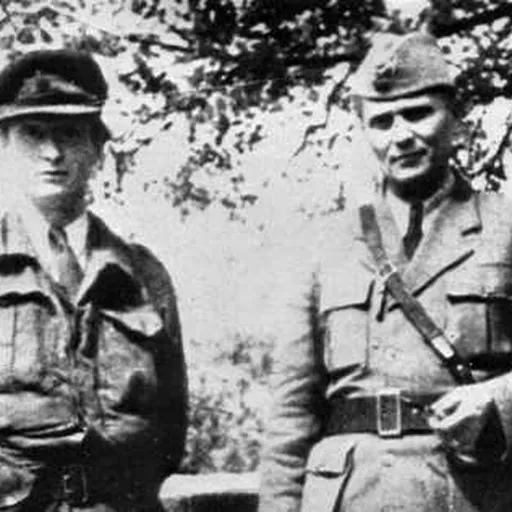
About William Deakin
Lived 1913 – 2005 (aged 91). William Deakin was a British historian.
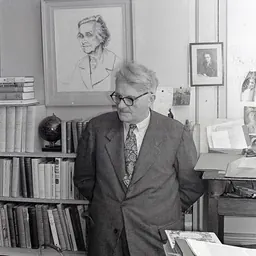
Sir Frederick William Dampier Deakin DSO (3 July 1913 – 22 January 2005) also known as F. W. Deakin, was a British historian, World War II veteran, literary assistant to Winston Churchill and the first warden of St Antony's College, Oxford.
Life Deakin was educated at Westminster School, then at Christ Church, Oxford, where he began to develop a reputation as one of the most brilliant and dashing figures of his generation.
Second World War In 1941 he was seconded to Special Operations, War Office, in 1941. On 28 May 1943 he parachuted into highlands of Montenegro as representative of the British GHQ in the Middle East to the central command of the Yugoslav Partisans, who were led by Josip Broz Tito. Deakin's mission, codenamed Typical, joined Tito as the Partisans were being hunted through the gorges of the Tara River between the triple chains of mountain massifs of Mount Durmitor and Ljubišnja and canyons ravines of the region by German and Italian forces during Operation Schwarz. Just below the summit of Mount Ozren, the Partisans were trapped by German aerial bombardment and forced to take cover among birch groves. Deakin's impressive reporting on the situation from on the ground is considered to have had a decisive impact on British policy towards the support of resistance movements in Yugoslavia (although the significant role of intelligence decrypts was not revealed until the 1970s, see Yugoslavia and the Allies).
He was assigned the role of Literary Assistant to Sir Winston Churchill during the years 1936–40, and the period 1945–55. He was described by Churchill's biographer, Sir Martin Gilbert, as being "at the centre of the web of all Churchill's literary efforts." as well as The Brutal Friendship, published in 1962. The latter was a detailed examination of German-Italian relations during World War II, and revealed Deakin not only as a formidable historian of diplomacy, but also, in his assessment of the death of Italian fascism, a notable political analyst. He was later editor, with his friend Alan Bullock, of two series of historical texts, The British Political Tradition and The Oxford History of Modern Europe.
In 1950, he was appointed as the first Warden (or principal) of the new St Antony's College, Oxford. He remained in this role until 1968, when he was succeeded by another historian, Raymond Carr, who had been appointed as his Sub-Warden in 1966. His memoir was published as The Embattled Mountain, the title referring to Mount Durmitor, the environs of which Deakin and Tito's army had been pursued over by German and Italian forces; see Battle of the Sutjeska.
Don’t just read it —
keep it.
Full-length biographies made to live with: read them, listen on the way to work, watch them tonight.
- E-book
- Audio
- Video
Instant download · yours to keep · every purchase keeps this site free
Important facts
People in William Deakin's life
Named in this biography and alive at the same time
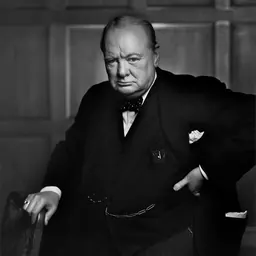



Related people
Same field, nearest in time

Contemporaries
People whose lives overlapped William Deakin's




Frequently asked questions
Who was William Deakin?
British historian (1913–2005)
When was William Deakin born?
William Deakin was born on 3 July 1913 in London.
When did William Deakin die?
William Deakin died on 22 January 2005 in Le Castellet.
What was William Deakin's occupation?
William Deakin was a historian.
What nationality was William Deakin?
William Deakin was British.
Sources & further reading
Cite this page
APA: Biography.guide. (2026). William Deakin. https://biography.guide/william-deakin/
MLA: "William Deakin." Biography.guide, https://biography.guide/william-deakin/.
Chicago: "William Deakin." Biography.guide. https://biography.guide/william-deakin/.
Data last updated: 2026-09-21 · Spot an error? Report a correction.
Portrait: Wikimedia Commons · author & licence
Page generated 2026-09-27 04:59 UTC