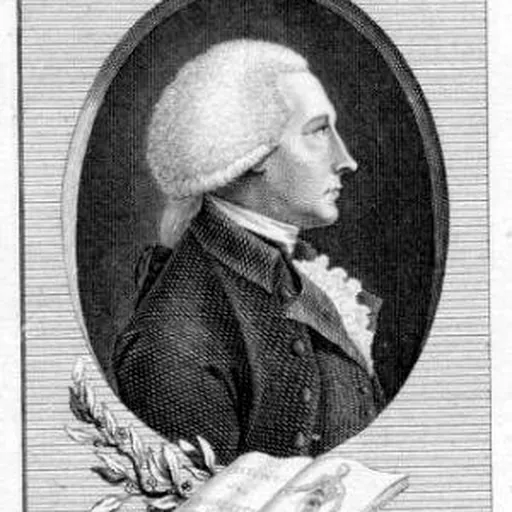
About William Cruickshank
Lived 1800 – 1809. William Cruickshank was a British chemist, university teacher and surgeon, known for Carbon monoxide.
William Cruickshank (born circa 1741 or 1750, died 1810 or 1811 ) was a Scottish military surgeon and chemist, and professor of chemistry at the Royal Military Academy, Woolwich.
William Cruickshank was awarded a diploma by the Royal College of Surgeons of England on 5 October 1780. In March 1788 he became assistant to Adair Crawford at the Royal Military Academy, Woolwich, at a salary of £30 a year. On 24 June 1802, he became a Fellow of the Royal Society (FRS).
Discoveries and inventions In 1797 he discovered that concentrated urine treated with nitric acid gives crystals, which exhibit acidic properties in solution, and may detonate if set on fire. That was urea nitrate.
He identified carbon monoxide as a compound containing carbon and oxygen in 1800. In 1800 he also used chlorine to purify water. He also discovered the chloralkali process.
Strontium Some authors credit Cruickshank with first suspecting an unknown substance in a Scottish mineral, strontianite, found near Strontian, in Argyleshire. Other authors name Adair Crawford for the discovery of this new earth, due to the mineral's property of imparting a redding color to a flame. It was later isolated by Humphry Davy and is now known as strontium.
Diabetes Cruickshank worked with John Rollo at Woolwich in the 1790s, and some of his discoveries about diabetes were published in Rollo's book on the dietary treatment of the condition.
Trough battery Circa 1800, Cruickshank invented the Trough battery, an improvement on Alessandro Volta's voltaic pile. The plates were arranged horizontally in a trough, rather than vertically in a column.
Electrolysis Shortly after learning of Alessandro Volta's discovery of the Voltaic Pile in 1800, Cruickshank conducted a number of experiments involving electrolysis. He connected wires of silver to the poles of a battery and placed them into a solution of distilled water, and later into a variety of other solutions, observing the results. When the wires were placed into the various solutions of lead acetate, copper sulfate and silver nitrate, deposits of pure lead, copper and silver formed, respectively, on one wire. From these experiments he observed that "where metallic solutions are employed instead of water, the same wire which separates the hydrogen revives the metallic calx, and deposits it at the extremity of the wire in its pure metallic state." This process of extraction of pure metals from metallic solutions is known today as electrowinning. It is used in the refining of copper and other metals.
Retirement and death In March 1803, Cruickshank became very ill and it is possible that this was due to exposure to phosgene during his experiments. On 6 July 1804, he retired on a pension of 10 shillings a day. He died in 1810 or 1811 and military records state that the death occurred in Scotland.
Don’t just read it —
keep it.
Full-length biographies made to live with: read them, listen on the way to work, watch them tonight.
- E-book
- Audio
- Video
Instant download · yours to keep · every purchase keeps this site free
Important facts
People in William Cruickshank's life
Named in this biography and alive at the same time


Related people
Same field, nearest in time


Frequently asked questions
Who was William Cruickshank?
British chemist and surgeon
When was William Cruickshank born?
William Cruickshank was born in 1800 in Scotland.
When did William Cruickshank die?
William Cruickshank died on 14 February 1809 in Scotland.
What was William Cruickshank's occupation?
William Cruickshank was a chemist, university teacher and surgeon.
What was William Cruickshank known for?
William Cruickshank was known for Carbon monoxide.
What nationality was William Cruickshank?
William Cruickshank was British.
Sources & further reading
· Wikipedia: William Cruickshank
· DBpedia: William Cruickshank (chemist)
Cite this page
APA: Biography.guide. (2026). William Cruickshank. https://biography.guide/william-cruickshank/
MLA: "William Cruickshank." Biography.guide, https://biography.guide/william-cruickshank/.
Chicago: "William Cruickshank." Biography.guide. https://biography.guide/william-cruickshank/.
Data last updated: 2026-09-21 · Spot an error? Report a correction.
Portrait: Wikimedia Commons · author & licence
Page generated 2026-09-27 05:01 UTC