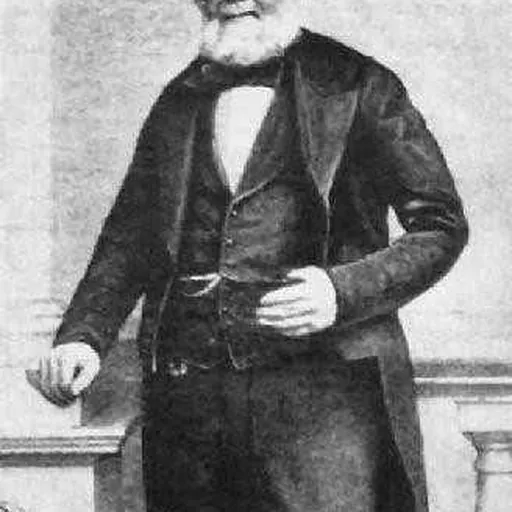
William Calcraft
English hangman
About William Calcraft
Lived 1800 – 1879 (aged 79). William Calcraft was a British executioner.
William Calcraft (11 October 1800 – 13 December 1879) was an English hangman, one of the most prolific of British executioners. It is estimated in his 45-year career he carried out 450 executions.
A cobbler by trade, Calcraft was initially recruited to flog juvenile offenders held in Newgate Prison. While selling meat pies on streets around the prison, Calcraft met the City of London's hangman, John Foxton. After Foxton's death in 1829 the government appointed Calcraft the official Executioner for the City of London and Middlesex. His services were in great demand throughout England.
Nevertheless, some considered Calcraft incompetent, in particular for his controversial use of the short-drop hanging method in which the condemned were slowly strangled to death, instead of having their necks broken. Because with his methods the condemned took several minutes to die, to hasten death Calcraft would sometimes dramatically pull on legs or climb on shoulders in an effort to break the victim's neck. It has been speculated that he used these methods partly to entertain the crowds, sometimes numbering 30,000 spectators or more.
Executions in England were public until 1868. That year the law changed, mandating executions would take place privately and inside the prison. In 1868 Calcraft carried out the last public and first private executions. Among his executions were Marie and Frederick Manning, the first husband and wife to be hanged together since 1700.
Early life Calcraft was born in Baddow, near Chelmsford, in 1800. He was a cobbler by trade, but had also worked as a nightwatchman at Reid's brewery in Clerkenwell, London. While attempting to earn a living by selling meat pies on the streets around Newgate Prison he made the acquaintance of John Foxton, who was the City of London's hangman for 40 years. That meeting led to his employment at Newgate to flog juvenile offenders, for which he was paid 10 shillings a week. a position for which he was paid one guinea a week plus an additional guinea for each execution. He also received an allowance for cats o' nine tails and birch rods, Calcraft's first duty in his new role was the execution of Thomas Lister and George Wingfield, hanged together on 27 March 1829, Lister for burglary and Wingfield for highway robbery. Esther Hibner, known in the press as the "Evil Monster", was the first woman hanged by Calcraft. She was executed on 13 April 1829, having been found guilty of starving to death her apprentice, Frances Colppits. Hibner did not go to the scaffold willingly, but had to be restrained in a straitjacket to prevent her from attacking her executioners. As she was hanged the watching crowd shouted out "Three cheers for the Hangman!"
Calcraft was "in great demand" as an executioner elsewhere in the country as well, such as at Reading Gaol.
On 14th November 1864, Calcraft hanged Franz Müller outside Newgate Prison. Müller was convicted of murdering Thomas Briggs, a 69-year-old City of London banker, on 9th July 1864. The murder was the first ever carried out on a British train. Müller's execution was witnessed by 50,000 spectators.
The number of executions Calcraft carried out is unrecorded, but it has been estimated at 450, of whom 35 were women, making him one of the most active of British executioners. Among his better-known victims was François Courvoisier,
Calcraft officiated at one of the very few executions of a husband and wife, and the first since 1700, when he hanged Marie and Frederick Manning at Horsemonger Lane Gaol on 13 November 1849. Although Calcraft's career as a hangman spanned 45 years, he appears to have been "particularly incompetent", frequently having to "rush below the scaffold to pull on his victim's legs to hasten death". After the noose had been secured around each victim's neck and the hangman had retired to a safe distance, the trapdoor was released. The bodies were left hanging for some time to ensure that death had occurred, before being lowered to the ground. Calcraft employed the short-drop method of execution, in which the drop through the trapdoor might be around or so. That was often insufficient to break the prisoner's neck, and therefore death was not always instantaneous, typically occurring slowly by strangulation. Historians Anthony Stokes and Theodore Dalrymple have suggested that Calcraft's "controversial" use of the short-drop allowed him a couple of minutes to entertain the large crowds of 30,000 plus that sometimes attended his public executions. "Renowned for his poor taste", he would sometimes swing from his victim's legs or climb onto their shoulders in an attempt to break their necks. In one of the first executions Calcraft carried out at the new Reading Gaol his victim, Thomas Jennings, took more than three minutes to die.
On 31 March 1856, Calcraft executed William Bousfield, but a threat he had received that he would be shot on the scaffold unnerved him. After releasing the bolt securing the trapdoor on which the condemned man was standing, Calcraft ran off, leaving Bousfield hanging; a few moments later Bousfield raised one of his legs to support himself on the platform. Calcraft's assistant tried to push the victim off, but Bousfield repeatedly succeeded in supporting himself. The officiating chaplain forced the frightened Calcraft to return to the scaffold, where he "threw himself around his [Bousfield's] legs and by the force of his weight finally succeeded in strangling him".
Father Gadd refused to allow Calcraft to dispatch O'Brien in the same way, and so "for three-quarters of an hour the good priest [Father Gadd] knelt, holding the dying man's hands within his own, reciting the prayers for the dying. Then the long drawn out agony ended."
Later life
By 1869 Calcraft's mother, Sarah, was living as a pauper in a workhouse at Hatfield Peverel near Chelmsford. and is buried in Abney Park Cemetery, Stoke Newington. An obituary published in The New York Times on 1 January 1880 reported that "Several so-called biographies of Calcraft were published during his lifetime, but all are notable for a narrow stream of fact meandering through a broad meadow of commentary, and not one may be considered worthy of the subject or to be relied on for a strict accuracy of statement". The earliest of them was an octavo pamphlet published in 1846 entitled The Groans of the Gallows; or; The Past and Present Life of William Calcraft, the Living Hangman of Newgate.
Don’t just read it —
keep it.
Full-length biographies made to live with: read them, listen on the way to work, watch them tonight.
- E-book
- Audio
- Video
Instant download · yours to keep · every purchase keeps this site free
Important facts
People in William Calcraft's life
Named in this biography and alive at the same time

Related people
Same field, nearest in time


Contemporaries
People whose lives overlapped William Calcraft's






Frequently asked questions
Who was William Calcraft?
English hangman
When was William Calcraft born?
William Calcraft was born on 10 October 1800 in Chelmsford.
When did William Calcraft die?
William Calcraft died on 13 December 1879 in Stoke Newington.
What was William Calcraft's occupation?
William Calcraft was an executioner.
What nationality was William Calcraft?
William Calcraft was British.
Sources & further reading
Cite this page
APA: Biography.guide. (2026). William Calcraft. https://biography.guide/william-calcraft/
MLA: "William Calcraft." Biography.guide, https://biography.guide/william-calcraft/.
Chicago: "William Calcraft." Biography.guide. https://biography.guide/william-calcraft/.
Data last updated: 2026-09-21 · Spot an error? Report a correction.
Portrait: Wikimedia Commons · author & licence
Page generated 2026-09-27 04:59 UTC