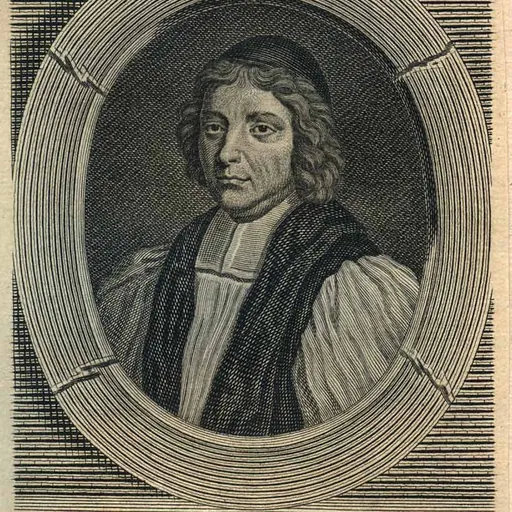
About William Beveridge
Lived 1637 – 1708 (aged 71). William Beveridge was a British anglican priest, anglican theologian, bishop, patristic scholar and anglican ministry.
William Beveridge (1637 – 5 March 1708) was an English writer and clergyman who served as Bishop of St Asaph from 1704 until his death.
Life Son of the Rev. William Beveridge, B.D., he was born at Barrow, near Leicester, and baptised on 21 February 1637 at Barrow, Leicestershire, of which his grandfather, father, and elder brother John were successively vicars. He was first taught by his learned father and for two years was sent to Oakham School, Rutland, where William Cave was his schoolfellow.
On 24 May 1653, he was admitted a sizar in St John's College, Cambridge, with Bullingham as his tutor. Dr. Anthony Tuckney was then head of the college and took a special interest in young Beveridge. Beveridge especially devoted himself to the learned languages, including the oriental. In his twenty-first year, he published a Latin treatise on the Excellency and Use of the Oriental Tongues, especially Hebrew, Chaldee, Syriac, and Samaritan, together with a Grammar of the Syriac Language, (1658; 2nd ed. 1664). In 1656, he proceeded H.A., and in 1660 M.A. On 3 January 1660-1, he was ordained deacon by Dr. Robert Sanderson, Bishop of Lincoln.
He was rector of Ealing, 1661–1672, and of St. Peter's, Cornhill, London, 1672–1704, when he became bishop. On 22 December 1674, he was collated to the prebend of Chiswick in St. Paul's, London. In 1679 he proceeded D.D. On 3 November 1681, he was appointed Archdeacon of Colchester. On 27 November 1681 he preached a sermon on the Excellency and Usefulness of the Common Prayer. It rapidly went through four editions. In 1683 he preached another popular sermon on the anniversary of the Great Fire of London in 1666. On 5 November 1684, he was made prebendary of Canterbury in succession to Peter du Moulin. In 1687–88 he joined with Dr. Horneck and others in forming religious societies for 'reformation of manners.' In 1689 he became president of Sion College. He was installed bishop of St. Asaph on 16 July 1704.
He died in apartments in the cloisters of Westminster Abbey in London on 5 March 1708.
During his lifetime Beveridge refused to sit for his portrait, but following his death Benjamin Ferrers, a relative, painted one, now in the Bodleian Library, Oxford, from his corpse.
Works In his day he was styled "the great reviver and restorer of primitive piety" because in his sermons and other writings, he dwelt on the Church of the early centuries. His collected works (incomplete) are in the Library of Anglo-Catholic Theology in 12 volumes (Oxford, 1842–48). They contain six volumes of sermons, and in addition: The Doctrine of the Church of England Consonant to Scripture, Reason, and the Fathers: A Complete System of Divinity (2 vols.); Συνοδικόν, sive pandectae canonum ss. Apostolorum, et conciliorum ab ecclesia Graeca receptorum; nec non canonicarum ss. patrum epistolarum; nec non canonicarum SS. patrum epistolarum: una cum scholiis antiquorum singulis eorum annexis, et scriptis aliis huc spectantibus... Totum opus in duos tomos divisum Guilielmus Beveregius ... recensuit, prolegomenis munivit, & annotationibus auxit. Codex canonum ecclesiæ primitivæ vindicatus ac illustratus, with the appendices, I. Prolegomena in Συνοδικὸν, sive pandectas canonum; and II. Præfatio ad annotationes in canones apostolicos (2 vols.); Private Thoughts on Religion, and Church Catechism Explained.
His Institutionum chronotogicarum libri duo, una cum totidem arithmetices chronologicæ libellis (London, 1669) was once an admired treatise on chronology. In it, he also includes a full explanation of the Chinese remainder theorem for the case in which the moduli are relatively prime. This was the first general proof of the ta-yen rule. It is also said by Francis Fauvel Gouraud that a discussion on Hebrew linguistics inspired Richard Grey to create his system of mnemotechniques which later evolved into the Mnemonic major system.
Don’t just read it —
keep it.
Full-length biographies made to live with: read them, listen on the way to work, watch them tonight.
- E-book
- Audio
- Video
Instant download · yours to keep · every purchase keeps this site free
Important facts
People in William Beveridge's life
Named in this biography and alive at the same time





Related people
Same field, nearest in time



Contemporaries
People whose lives overlapped William Beveridge's






Frequently asked questions
Who was William Beveridge?
English bishop
When was William Beveridge born?
William Beveridge was born on 21 February 1637 in Barrow upon Soar.
When did William Beveridge die?
William Beveridge died on 5 March 1708 in London.
What was William Beveridge's occupation?
William Beveridge was an anglican priest, anglican theologian, bishop, patristic scholar and anglican ministry.
What nationality was William Beveridge?
William Beveridge was British.
Sources & further reading
· Wikipedia: William Beveridge
· DBpedia: William Beveridge (bishop)
Cite this page
APA: Biography.guide. (2026). William Beveridge. https://biography.guide/william-beveridge-anglican-priest/
MLA: "William Beveridge." Biography.guide, https://biography.guide/william-beveridge-anglican-priest/.
Chicago: "William Beveridge." Biography.guide. https://biography.guide/william-beveridge-anglican-priest/.
Data last updated: 2026-09-22 · Spot an error? Report a correction.
Portrait: Wikimedia Commons · author & licence
Page generated 2026-09-27 05:03 UTC