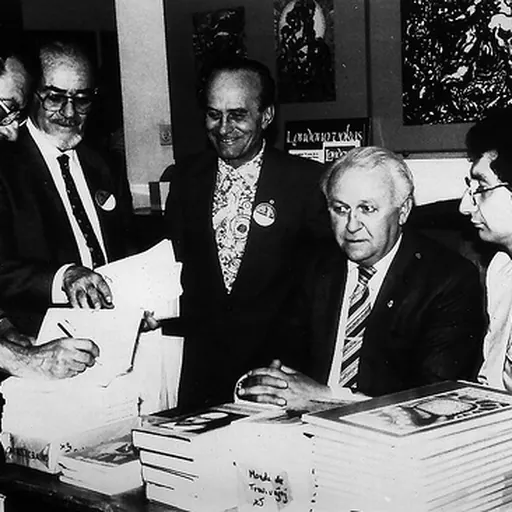
About William Auld
Lived 1924 – 2006 (aged 81). William Auld was a British poet, writer, translator, esperantist, essayist and musicologist.
William Auld (6 November 1924 – 11 September 2006) was a British poet, author, translator and magazine editor who wrote chiefly in Esperanto.
Life
Auld was born at Erith in Kent, and then moved to Glasgow with his parents, attending Allan Glen's School. After wartime service as a spitfire pilot in the Royal Air Force, he studied English literature at Glasgow University, and then qualified as a teacher.
In 1952 he married his childhood sweetheart Margaret (Meta) Barr Stewart, also an Esperantist, and had two children. In 1960, he was appointed to a secondary school in Alloa and he remained there for the rest of his life. He was nominated for the Nobel Prize in Literature in 1999, 2004, and 2006, making him the first person nominated for works in Esperanto.
His masterpiece, La infana raso (The Infant Race), is a long poem that, in Auld's words, explores "the role of the human race in time and in the cosmos," and is partly based on The Cantos by Ezra Pound.
Auld began to learn Esperanto in 1937 but only became active in the propagation of the language in 1947, and from then on wrote many works in Esperanto. He edited various magazines and reviews, including Esperanto en Skotlando (1949–1955), Esperanto (1955–1958, 1961–1962), Monda Kulturo (1962–1963), Norda Prismo (1968–1972), La Brita Esperantisto (1973–1999) and Fonto (1980–1987).
He was Vice President of the Universal Esperanto Association (1977–1980), President of the Academy of Esperanto (1979–1983), and President of the Esperanto PEN Centre (1999–2005). He donated his personal collection of nearly 5,000 books in and about Esperanto to the National Library of Scotland, where it is now housed, in 2001.
He died in Dolair/Dollar, Clackmannanshire, and is buried in Dollar churchyard. The grave lies on the approach path to the church from the main road.
List of works
Collected poetry Spiro de l' pasio (in Kvaropo, 1952) La infana raso (1956) Unufingraj melodioj (1960) Humoroj (1969) Rimleteroj (with Marjorie Boulton, 1976) El unu verda vivo (1978) En barko senpilota (Edistudio, 1987) Unu el ni (1992)
Anthologies Angla antologio 1000–1800 (poetry editor, 1957) Esperanta antologio (1958/1984) 25 jaroj (poetry editor, 1977) Skota antologio (associate editor, 1978) Sub signo de socia muzo (1987) Nova Esperanta Krestomatio (1991) Plena poemaro: Miĥalski (ed. 1994) Tempo fuĝas (1996)
Translations from English La balenodento, by Jack London (1952) Epifanio, by Shakespeare (1977) La urbo de terura nokto, by James Thomson (1977) Don Johano, Kanto 1, by Lord Byron (1979) La robaioj de Omar Kajam, by Edward Fitzgerald (1980) La sonetoj, de Shakespeare (Edistudio, 1981) Fenikso tro ofta, by Christopher Fry (1984) Montara vilaĝo, by Chun-chan Je (1984) La graveco de la Fideliĝo, by Oscar Wilde (1987) La komedio de eraroj, by Shakespeare (with Asen M. Simeonov, 1987) Omaĝoj. Poemtradukoj (1987) Gazaloj, by Hafiz (1988) Spartako, by Leslie Mitchell (1993) La stratoj de Aŝkelono, by Harry Harrison (1994) Teri-strato, by Douglas Dunn (1995) La kunularo de l' ringo, by J. R. R. Tolkien (1995) La du turegoj, by J. R. R. Tolkien (1995) La reveno de la reĝo, by J. R. R. Tolkien (1997) La hobito, by J. R. R. Tolkien (poems and songs; with Christopher Gledhill, 2000) La Hobito, aŭ Tien kaj Reen, by J. R. R. Tolkien (poems and songs; with Christopher Gledhill, Evertype 2015, , ) Kantoj, poemoj kaj satiroj, by Robert Burns (with Reto Rossetti, 1977) Jurgen, by James Branch Cabell (2001)
Translations Aniaro, by Harry Martinson (from Swedish with Bertil Nilsson, 1979) Julia on Pandataria
Song collections Floroj sen kompar (with Margaret Hill, 1973), British folksongs translated into Esperanto Kantanta mia bird (with Margaret Hill, 1973), British folksongs translated into Esperanto Dum la noktoj (with Margaret and David Hill, 1976), original songs
Textbooks Esperanto: A New Approach; (1965) Paŝoj al plena posedo (1968) A first course in Esperanto (1972) Traduku! (1993)
Bibliographies Bibliografio de tradukoj el la angla lingvo (with E. Grimley Evans, 1996)
Essay collections Facetoj de Esperanto (1976) Pri lingvo kaj aliaj artoj (1978) Enkonduko en la originalan literaturon de Esperanto (1979) Vereco, distro, stilo (1981) Kulturo kaj internacia lingvo (1986) La fenomeno Esperanto (1988) La skota lingvo, hodiaŭ kaj hieraŭ (1988)
Miscellaneous literature Pajleroj kaj stoploj: elektitaj prozaĵoj (1997)
Don’t just read it —
keep it.
Full-length biographies made to live with: read them, listen on the way to work, watch them tonight.
- E-book
- Audio
- Video
Instant download · yours to keep · every purchase keeps this site free
Important facts
People in William Auld's life
Named in this biography and alive at the same time




Related people
Same field, nearest in time


Contemporaries
People whose lives overlapped William Auld's

Frequently asked questions
Who was William Auld?
Scottish poet, author, translator (1924–2006)
When was William Auld born?
William Auld was born on 6 November 1924 in Erith.
When did William Auld die?
William Auld died on 11 September 2006 in Dollar.
What was William Auld's occupation?
William Auld was a poet, writer, translator, esperantist, essayist and musicologist.
What nationality was William Auld?
William Auld was British.
Sources & further reading
Cite this page
APA: Biography.guide. (2026). William Auld. https://biography.guide/william-auld/
MLA: "William Auld." Biography.guide, https://biography.guide/william-auld/.
Chicago: "William Auld." Biography.guide. https://biography.guide/william-auld/.
Data last updated: 2026-09-22 · Spot an error? Report a correction.
Portrait: Wikimedia Commons · author & licence
Page generated 2026-09-27 05:03 UTC