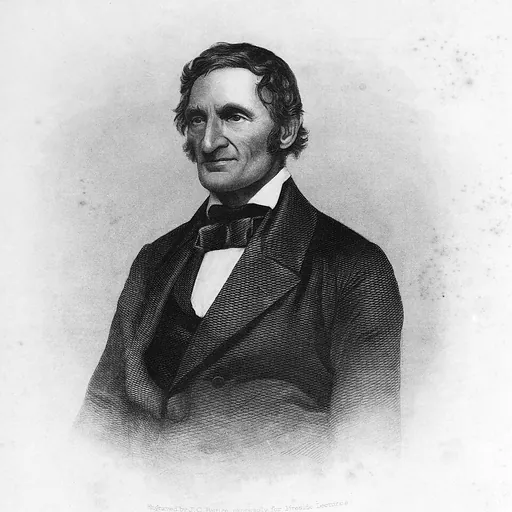
About William Alcott
Lived 1798 – 1859 (aged 60). William Alcott was an American author, physician, writer and children's writer.
William Andrus Alcott (August 6, 1798 – March 29, 1859), also known as William Alexander Alcott, was an American educator, educational reformer, medical doctor, vegetarian and writer. His works, which include a wide range of topics including educational reform, physical education, school house design, family life, and diet, are still widely cited today.
Early life and family
William Alcott was born in Wolcott, Connecticut. His father, Obedience Alcox (1776–1847), was a farmer; in the 1820s, like many members of the family, he altered the spelling of his last name, which on his tombstone appears as "Obid. Alcott". His mother was Anna Andrus (1777–1864), who was the daughter of a Revolutionary War soldier and William's most important educational influence. He attended local schools and became a close friend of his near neighbor Amos Bronson Alcott, who would later enjoy wide fame as a philosopher and as the father of writer Louisa May Alcott. Although sometimes described simply as "cousins" the two were actually second cousins; William's grandfather David Alcott (1740–1841) was the brother of Amos Bronson Alcott's grandfather, Captain John Alcott. The two boys shared books, exchanged ideas, and started a small library together. Odell Shepard had written of Amos Bronson Alcott, "Indeed there is a sense in which nearly everything Alcott wrote and did is attributable to William".
Alcott lived in Dedham, Massachusetts, where he was the superintendent of the Sunday School at the Allin Congregational Church. He was known to walk barefoot on summer mornings from his home in the village up to Federal Hill to obtain a bucket of milk. in the summer of 1824 he suffered an attack of the disfiguring, dangerous skin infection erysipelas, and about this time was beginning to suffer from tuberculosis. He would suffer symptoms of both for the remainder of his life. He began studying medicine, with the thought that the extra knowledge would aid his teaching. His formal study of medicine was brief. In the winter of 1825–26 he attended "a regular course of medical studies" in New Haven, Connecticut. In March 1826 he was granted a license to practice medicine. In addition to teaching, he practiced medicine at least until 1829.
William Channing Woodbridge and early writing
In the spring of 1830 he met William Channing Woodbridge. Woodbridge had just returned from Europe and was in the process of revising his second geography. Alcott at first worked as an assistant to Woodbridge He would later publish a poignant memoir of Woodbridge's life. While still teaching he had begun to contribute articles to newspapers and started work on the book that would become The Young Man's Guide.
Later life
On June 14, 1836, he married Phebe Lewis Bronson (June 14, 1812 – November 9, 1907). They had three children. For a time they shared a house, Cottage Place, with the family of his old friend and cousin Amos Bronson Alcott. In the 1840s William moved to the town of Newton, Massachusetts, just outside Boston. Eventually he would settle into a house in Auburndale in the town of Newton. He died here
"Vegetable Diet"
Alcott published Vegetable Diet: As Sanctioned by Medical Men and By Experience in All Ages in 1838. It is his best known work and is significant to the medical literature about a vegetarian diet. A second edition was published in 1849 "with an added cookbook and medical testimonies supporting what today would be called a vegan diet."
In his book, Eating History: Thirty Turning Points in the Making of American Cuisine, Andrew F. Smith attributed Alcott's Vegetable Diet as being "America's first vegetarian cookbook." In 2020, journalist Avery Yale Kamila wrote: "The book is considered a seminal work in the cannon of American vegetarian literature." The book contains letters written by physicians, including Horace A. Barrows, about vegetarian diets. The book is still in print.
The book is included in the American Antiquarian Cookbook Collection. In 2012, the book was republished by Andrews McMeel publishing with an introduction by Anna Thomas.
Ideas, diet and morals
Alcott became one of the most prolific authors in early American history. He wrote frequently on the topics of education and health. In 1836, he wrote a letter defending Grahamism to the editor of the Boston Medical and Surgical Journal, published on May 4, 1836. Alcott titled the letter “The Graham System” and signed the article with the name “M.D.” In 1850, Alcott wrote three letters on vegetarianism for the New York Daily Tribune (one published on April 14 and the other two on November 6).
Alcott opposed the consumption of alcohol, coffee, meat, spices, and tea. He argued against the use of condiments, which were "stimulating" substances. He rejected the use of ginger, fennel, cardamom, mace, nutmeg, and coriander. He believed that garlic, horseradish, molasses, and sauces were disgusting and indecent "drugs". He was the editor of the vegetarian Library of Health journal. In 1840, the Moral Reformer and The Graham Journal of Health and Longevity were merged in the Library of Health. The ASP sought to make the study of health access to all citizens and promoted a vegetarian diet. On May 15, 1850, Alcott, Sylvester Graham, and William Metcalfe founded the American Vegetarian Society, with Alcott serving as the first president.
Books In all, he wrote about one hundred books, which were influential in reforming educational methods and improving people's physical and moral well-being. The Young Man's Guide, 1834 The Moral Reformer, and Teacher on the Human Constitution, Vol. 1, 1835; Vol. 2, 1836. Edited by Alcott. The Use of Tobacco: Its Physical, Intellectual, and Moral Effects on The Human System, 1836 The House I Live In; or The Human Body, 1837 Vegetable Diet: As Sanctioned by Medical Men, and by Experience in All Ages, 1838 Tea And Coffee, 1839 Confessions of a School Master, 1839 The Young Housekeeper, 1842 The Boy’s Guide to Usefulness, 1845 Art of Good Behavior, 1848 The Young Mother: or, Management of Children in Regard to Health The Young Mother Adventures of Lot, the Nephew of Abraham Familiar letters to young men on various subjects.: Designed as a companion to The young man's guide, 1850 Trust in the Lord; or the Story of Elijah and the Ravens. Stories of Eliot and the Indians Lectures on Life and Health, Or, The Laws and Means of Physical Culture, 1853 The Physiology of Marriage, 1856 Forty Years in the Wilderness of Pills and Powders, 1859 The Laws of Health: Or, Sequel to "The House I Live In", 1859
Don’t just read it —
keep it.
Full-length biographies made to live with: read them, listen on the way to work, watch them tonight.
- E-book
- Audio
- Video
Instant download · yours to keep · every purchase keeps this site free
Important facts
People in William Alcott's life
Named in this biography and alive at the same time


Related people
Same field, nearest in time


Contemporaries
People whose lives overlapped William Alcott's






Frequently asked questions
Who was William Alcott?
American physician and author (1798-1859)
When was William Alcott born?
William Alcott was born on 6 August 1798 in Wolcott.
When did William Alcott die?
William Alcott died on 29 March 1859 in Auburndale.
What was William Alcott's occupation?
William Alcott was an author, physician, writer and children's writer.
What nationality was William Alcott?
William Alcott was American.
Sources & further reading
Cite this page
APA: Biography.guide. (2026). William Alcott. https://biography.guide/william-alcott/
MLA: "William Alcott." Biography.guide, https://biography.guide/william-alcott/.
Chicago: "William Alcott." Biography.guide. https://biography.guide/william-alcott/.
Data last updated: 2026-09-23 · Spot an error? Report a correction.
Portrait: Wikimedia Commons · author & licence
Page generated 2026-09-27 05:07 UTC