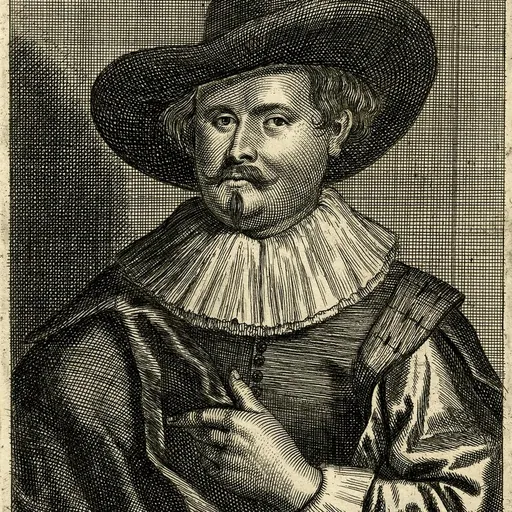
Willem van Nieulandt II
Flemish painter, engraver, poet and playwright
About Willem van Nieulandt II
Lived 1584 – 1635 (aged 50–51). Willem van Nieulandt II was a Dutch painter, playwright, printmaker, writer and artist.
Guilliam or Willem van Nieulandt or van Nieuwelandt (1582/84–1635) was a Flemish painter, engraver, poet and playwright from Antwerp. He spent two thirds of his career in the Habsburg Netherlands and the remainder in Italy and the Dutch Republic. He is known for his Italianate landscape paintings and prints, often real views or capricci of landscapes and buildings from in or around Rome enlivened by contemporary figures or biblical or mythological scenes. He is regarded as the principal poet and playwright active in the Habsburg Netherlands in the first three decades of the 17th century. His family included a number of artists such as his uncle Guilliam or Willem van Nieulandt (I) who was a painter and draftsperson. His younger brother Adriaen van Nieulandt the younger (born in 1586 in Antwerp) became a decorative painter of interiors, print artist, art dealer, appraiser, painter and draftsperson and was mainly active in Amsterdam. The van Nielandt family moved to Amsterdam in 1589, after the Fall of Antwerp, possibly because they were Protestants or simply for economic reasons as Antwerp was suffering the effects of the ongoing war with Holland. Father van Nieulandt became a poorter of Amsterdam in 1594, which shows that he was of good means. Contemporary art historians have argued that he was not the pupil of Roelant Savery, but of his brother Jacob Savery, an artist specialised in still lifes, animals, landscapes en genre paintings. On 13 April 1606 he became a citizen of Antwerp. His son Adriaen was born in 1607.
The violence of the Eighty Years' War had caused the decline of Antwerp's chambers of rhetoric (rederijkerskamers) which staged theatre plays in the city. The Twelve Years' Truce, which established a temporary reprieve from the Eighty Years' War from 1609 to 1621, allowed for their revival. It is likely that the Antwerp chamber of rhetoric Olyftack (Olive Branch) commissioned Willem van Nieulandt to assist with the restoration of their meeting room and performance area. It paid him for a painting of the Virgin Mary and the renewal of its blazon. By the winter of 1615, he had finished his restoration work. On 25 September of the same year, together with Joan David Heemsen, he took the oath as an elder (hoofdman) of the resurrected chamber of rhetoric, and in November the performances of two of his tragedies, Livia, already completed in March 1614, and Saul, written shortly afterwards, began. He was very successful with these plays which helped revive the Antwerp theatre scene.
On 22 May 1629 he witnessed in Antwerp the baptism of the first child of his daughter Constantia. At some unknown time after this date he returned to Amsterdam where he published his final tragedy in 1635, which he had written in the two years before he left Antwerp. He executed a will on 24 October 1635 while he was sick in bed in his home in Amsterdam. He signed the will with ' Giu. v. Nieulandt'. Shortly thereafter he died.
He was a prolific printmaker who created many etchings of Roman ruins and Italian landscapes that were published in Antwerp under his supervision. Some of them were carved after drawings of the brothers Matthijs Bril and Paul Bril, Sebastiaen Vrancx and his own drawings. He was a member of the Antwerp chamber of rhetoric the Olyftack (Olive Branch) from 1613 to 1621, transferring to the rival Violieren from 1621 to 1629. His tragedies followed the classical type of tragedies introduced by the Ancient dramatist Seneca and were imbued with the neo-stoic moralist principles which were then very popular among Antwerp's humanist elites. The action in the tragedies was dominated by extreme scenes of horror, including gruesome murders and mutilations. The protagonists were constantly driven by extreme emotions. In May 1624 the Violieren produced his play Aegyptica (a tragedy on the theme of Anthony and Cleopatra).
Literary works Van Nieulandt was better known as a poet and playwright than as a painter. He was a member of the Antwerp chamber of rhetoric the Olyftack (Olive Branch) from 1613 to 1621, transferring to the rival Violieren from 1621 to 1629. His tragedies followed the classical type of tragedies introduced by the Ancient dramatist Seneca and were imbued with neo-stoic moralism. The tragedies were driven by extreme scenes of horror, including gruesome murders and mutilations. The protagonists were constantly affected by extreme emotions.
In May 1620 he won the prize for best poem at a rhetoric competition in Mechelen, writing under the pen name Dient uwen Al (Serve your All). In May 1624 the Violieren produced his play Aegyptica (a tragedy on the theme of Anthony and Cleopatra).
Poetry Poëma van den Mensch (1621)
Drama Livia (1617) Saul (1617) Claudius Domitius Nero (1618) Aegyptica (1624) Sophonisba Aphricana (1626, 1635) Salomon (1628) Jerusalems Verwoestingh door Nabuchodonosor (1635)
Public collections Musée des Beaux-Arts de Tours, Tours Museum of Fine Arts (Budapest), Budapest Norton Museum of Art, West Palm Beach Pushkin Museum, Moscow Rijksmuseum, Amsterdam Royal Museum of Fine Arts, Antwerp
Notes and references
Don’t just read it —
keep it.
Full-length biographies made to live with: read them, listen on the way to work, watch them tonight.
- E-book
- Audio
- Video
Instant download · yours to keep · every purchase keeps this site free
Important facts
more
Willem van Nieulant, Guiliam van Nieuwelandt, Guglielmo Terranova Nieuwelandt, Willem van, the younger Nieuwlandt, II Nieulant, Willem II Van Nieulant, Willem II Van Nieulandt, Willem van Nieuland, Guilielmus van Nieuwelandt, II Nieulandt, Willem van Nieuwland, II Nijeulandt, II NPeople in Willem van Nieulandt II's life
Named in this biography and alive at the same time



Related people
Same field, nearest in time

Contemporaries
People whose lives overlapped Willem van Nieulandt II's



Frequently asked questions
Who was Willem van Nieulandt II?
Flemish painter, engraver, poet and playwright (1584–1635)
When was Willem van Nieulandt II born?
Willem van Nieulandt II was born in 1584 in Antwerp.
When did Willem van Nieulandt II die?
Willem van Nieulandt II died in 1635 in Amsterdam.
What was Willem van Nieulandt II's occupation?
Willem van Nieulandt II was a painter, playwright, printmaker, writer and artist.
What nationality was Willem van Nieulandt II?
Willem van Nieulandt II was Dutch.
Sources & further reading
· Wikipedia: Willem van Nieulandt II
· DBpedia: Willem van Nieulandt II
Cite this page
APA: Biography.guide. (2026). Willem van Nieulandt II. https://biography.guide/willem-van-nieulandt-ii/
MLA: "Willem van Nieulandt II." Biography.guide, https://biography.guide/willem-van-nieulandt-ii/.
Chicago: "Willem van Nieulandt II." Biography.guide. https://biography.guide/willem-van-nieulandt-ii/.
Data last updated: 2026-09-21 · Spot an error? Report a correction.
Portrait: Wikimedia Commons · author & licence
Page generated 2026-09-27 04:59 UTC