
About Willem van den Broecke
Lived 1530 – 1580 (aged 49–50). Willem van den Broecke was a sculptor.
Willem van den Broecke, Willem van den Broeck or Guillelmus Paludanus (1530 – 1579) was a Flemish sculptor, painter, draughtsman and architect. He was a scion of a family of artists, which had its origins in Mechelen and some members of which later moved to Antwerp. Willem was active in Antwerp and also worked and likely trained in Italy for a long period. He was known for his small scale works, many of which were executed in alabaster. He was, along with Cornelis Floris, the leading sculptor in Antwerp in the second half of the 16th century. He was also one of the designers of the Antwerp City Hall. He enjoyed the patronage of an elite international clientele of church institutions, Spanish nobility, princes of Protestant territories as well as patricians from Augsburg.
Life Willem van den Broecke was born in Mechelen as the son of Hendrick van den Broeck, of whom it is not known whether he was an artist. His family members included artists who were active in Mechelen. His family also used the Latinized name 'Paludanus'. The Latinized name is based on the Latin translation ('palus') of the Dutch word 'broeck' (forming part of his family name) which means a marsh or swamp land. He was a brother of the painters Hendrick van den Broeck, Joris and Pieter. The painter Chrispijn van den Broeck was likely a relative. It is not known with whom Willem trained but it is believed he initially trained in his hometown.
Willem likely continued his studies in Antwerp in the workshop of Claudius or Cornelis Floris and may have travelled to Italy before 1557. He may have lived there in Rome and in Florence where his brother worked and in other cities. He became a citizen of Antwerp in 1559. In an active career spanning 20 years he developed an international network among the intellectual, artistic and ruling elite of his time. He received commissions from local as well as foreign patrons. The commissions executed for patrons in Augsburg in 1560 were likely shipped from Antwerp rather than created in Augsburg. Through the Brussels court he also obtained in 1571 a commission to make a reja (stone enclosure or fence) for a monastery in Alba de Tormes. Although he worked on the designs for this project and received several payments for it, it is not clear whether it was ever finished by van den Broecke. Van den Broecke later bought the plot adjacent to his home on which he constructed another house. His subject matter ranged from religious to mythological representations and portraits. He created large-scale works such as retables, partitions and fireplaces. He was particularly known in Antwerp for his small images, jewelry for cabinets of curiosities and the sculpted decorations of facades.
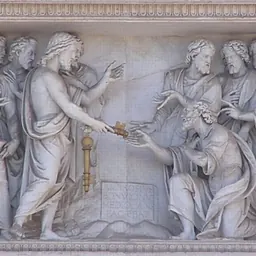
Alabaster was one of his favorite materials in which he executed small-scale statuettes as well as larger religious reliefs. Characteristic of these reliefs is that the three-dimensional figures in the foreground are almost completely set off from the pronounced bas-relief of the background. His relief technique was likely gained mostly from his contact with the work of Andrea Sansovino and his pupil Jacopo Sansovino. In his reliefs he quoted antique and Italian motifs he would have seen in Italy. In his view of Jerusalem in the background of the Crucifixion of 1562 (Maximilian Museum in Augsburg) he depicted buildings of a specific city, Florence. His oldest alabaster relief is the Crucifixion of Christ, dated 1560 (Maximilian Museum in Augsburg).
It is recorded that the artists made portraits in wax but no works of this kind are currently attributed to him.
Don’t just read it —
keep it.
Full-length biographies made to live with: read them, listen on the way to work, watch them tonight.
- E-book
- Audio
- Video
Instant download · yours to keep · every purchase keeps this site free
Important facts
more
Willem Paludanus, Guliellomo Paludano, Palidanus, Buillaume van den Broecke, Guillermo Paludano, Guilielmus PaludanusPeople in Willem van den Broecke's life
Named in this biography and alive at the same time

Related people
Same field, nearest in time

Contemporaries
People whose lives overlapped Willem van den Broecke's





Frequently asked questions
Who was Willem van den Broecke?
Flemish painter, wax-modeller and sculptor
When was Willem van den Broecke born?
Willem van den Broecke was born in 1530 in Mechelen.
When did Willem van den Broecke die?
Willem van den Broecke died in 1580 in Antwerp.
What was Willem van den Broecke's occupation?
Willem van den Broecke was a sculptor.
What nationality was Willem van den Broecke?
Willem van den Broecke's recorded nationality: Habsburg Netherlands.
Sources & further reading
· Wikipedia: Willem van den Broecke
· DBpedia: Willem van den Broecke
Cite this page
APA: Biography.guide. (2026). Willem van den Broecke. https://biography.guide/willem-van-den-broecke/
MLA: "Willem van den Broecke." Biography.guide, https://biography.guide/willem-van-den-broecke/.
Chicago: "Willem van den Broecke." Biography.guide. https://biography.guide/willem-van-den-broecke/.
Data last updated: 2026-09-20 · Spot an error? Report a correction.
Page generated 2026-09-27 05:31 UTC