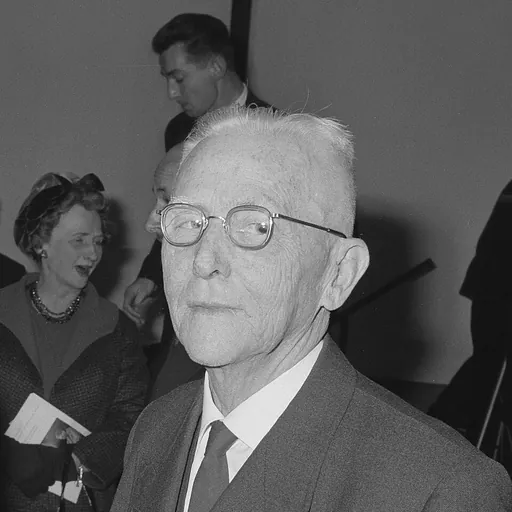
About Willem Banning
Lived 1888 – 1971 (aged 82). Willem Banning was a Dutch politician, university teacher, theologian and writer.
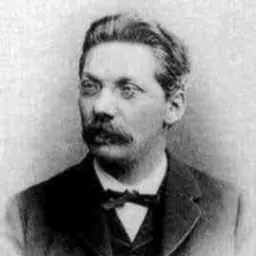
Willem Banning (21 February 1888 in Makkum – 7 January 1971 in Driebergen) was a Dutch theologian, philosopher, sociologist and politician, who played an important role in Dutch 20th-century politics.
Personal life Banning was born the son of Jan Banning, a herring fisherman, and Aafke Canrinus.
Thanks to his school teacher in elementary school he was able to attend a teachers college (Rijksnormaalschool) in Haarlem, where he received his teachers certificate in 1907. During his study he became involved in the movement to politically organise the college students, and in publishing a periodical, the Kweekelingenbode, of which he became the editor in 1908. He was also active in the Kweekelingen Geheelonthoudersbond (a temperance society). He was hired as a home teacher by a Hoorn notary public to educate his son in the years 1907-1909. During this period he came under the influence of a local clergyman with socialist sympathies, J. Th. Tenthoff, who introduced him to the circle around the Christian Socialist periodical De Blijde Wereld. He also met his future wife, the teacher Henriëtta Johanna Wilhelmina Schoemaker, whom he married on 9 October 1915. They had three daughters. After a few stints as an elementary-school teacher in the period 1909-1911 his former employer enabled him financially to prepare for the Staatsexamen. He started his studies in theology at Leiden university in 1913. There he was a student of P.D. Chantepie de la Sausaye and K.H. Roessingh.
Early career Banning had not been politically active before the outbreak of the First World War, but that event motivated him and his future wife to start studying the works of Karl Marx and Karl Kautsky, as he blamed capitalism for the war. He also became a member of the SDAP in 1914. He remained a member of the governing body until 1939 when he became editor of the party's ideological publication Socialisme en Democratie (Socialism and Democracy).
After the German invasion of the Netherlands in 1940 the German occupation authorities soon made his work impossible, also because he published a number of anti-German pamphlets. In 1942 he was arrested and interned as a hostage in the Gymnasium Beekvliet in Kamp Sint-Michielsgestel, together with a number of other prominent Dutchmen. This group of anti-Nazi politicians used their internment to plan a political reform of the Dutch party system for the post-war period. The pre-war system was characterised as a system of Pillarisation that fragmented the Dutch political landscape. The internees resolved to bring an end to this fragmentation.
Immediately after Liberation in 1945 Banning, together with a number of other politicians of different parties, such as Willem Schermerhorn, Piet Lieftinck, Jan de Quay, E.M.J.A. Sassen, and Hendrik Brugmans, formed the Nederlandse Volksbeweging as a movement to bring about what was called the Doorbraak (Breakthrough) of the Pillarisation system. This movement was a main force in bringing about the fusion of the SDAP with two other pre-war political parties, the Free-thinking Democratic League and the Christian Democratic Union, to form the Labour Party (PvdA). Banning was chairman of the founding Congress of this party on 9 February 1946, and he also gave the main address.
Though the hoped for doorbraak did not take place, the PvdA played a major role in the post-war part of Dutch 20th-century political history, and Banning for a while became its "house ideologue" as editor of Socialisme en Democratie. He coordinated the formulation of several of the PvdA's political manifests in 1947 and 1959, and drafted the official reaction of the party to the Dutch bishops' 1954 advice to Dutch Roman Catholics to vote for the Catholic People's Party.
Academic career Already during his internment in the Second World War Banning, under the influence of his fellow hostage Brugmans, had become interested in the philosophy of personalism, as developed by the circle around the French literary periodical Esprit. He wrote a book that he published after the war under the title De dag van morgen. Schets van een personalistisch socialisme, richtpunt voor de vernieuwing van ons volksleven (The day of tomorrow. Design of a personalistic socialism, target for the renewal of our popular life) in which his own version of this philosophy was expounded. He also took the initiative to the foundation of an institute for the promotion of the renewal of the Dutch Reformed Church that received the name Kerk en Wereld (Church and World); he became its director for many years. He also was appointed in a chair for Sociology of Religion at Leiden University.
Declining health forced him to resign many of his functions after 1958. The last ten years of his life he drifted into an isolated position. He died on 6 January 1971 in Driebergen.
Other works
Notes and references
Don’t just read it —
keep it.
Full-length biographies made to live with: read them, listen on the way to work, watch them tonight.
- E-book
- Audio
- Video
Instant download · yours to keep · every purchase keeps this site free
Important facts
People in Willem Banning's life
Named in this biography and alive at the same time



Related people
Same field, nearest in time





Contemporaries
People whose lives overlapped Willem Banning's



Frequently asked questions
Who was Willem Banning?
Dutch politician (1888–1971)
When was Willem Banning born?
Willem Banning was born on 21 February 1888 in Makkum.
When did Willem Banning die?
Willem Banning died on 7 January 1971 in Driebergen.
What was Willem Banning's occupation?
Willem Banning was a politician, university teacher, theologian and writer.
What nationality was Willem Banning?
Willem Banning was Dutch.
Sources & further reading
Cite this page
APA: Biography.guide. (2026). Willem Banning. https://biography.guide/willem-banning/
MLA: "Willem Banning." Biography.guide, https://biography.guide/willem-banning/.
Chicago: "Willem Banning." Biography.guide. https://biography.guide/willem-banning/.
Data last updated: 2026-09-23 · Spot an error? Report a correction.
Portrait: Wikimedia Commons · author & licence
Page generated 2026-09-27 05:07 UTC