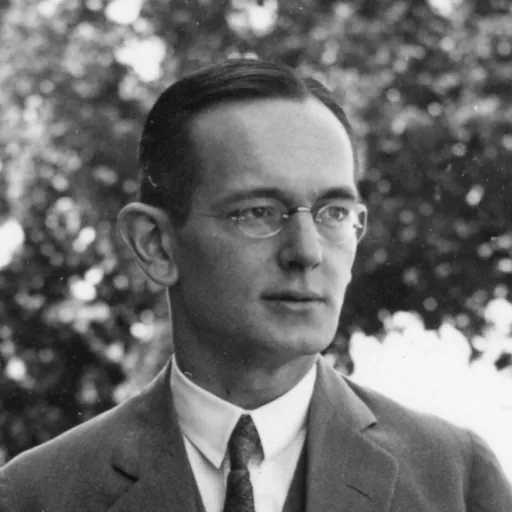
Wilhelm Cauer
German mathematician and scientist
About Wilhelm Cauer
Lived 1900 – 1945 (aged 44). Wilhelm Cauer was a German mathematician, physicist and electrical engineer.
Wilhelm Cauer (24 June 1900 – 22 April 1945 because he had a remote Jewish ancestor. Cauer was murdered during the fall of Berlin by Soviet soldiers.
The manuscripts for some of Cauer's most important unpublished works were destroyed during the war. However, his family succeeded in reconstructing much of this from his notes and volume II of Theorie der linearen Wechselstromschaltungen was published after his death. Cauer's legacy continues today, with network synthesis being the method of choice for network design.
Life and career
Early life and family
Wilhelm Adolf Eduard Cauer was born in Berlin, Germany, on 24 June 1900. He came from a long line of academics. His early grammar school (gymnasium) was the Kaiserin Augusta Gymnasium, an institution founded by his great-grandfather, Ludwig Cauer. This school was located on Cauerstrasse, named after Ludwig, in the Charlottenburg district of Berlin. The building still exists, but is now a primary school, the Ludwig Cauer Grundschule. He later attended the Mommsen Gymnasium, Berlin. His father, also Wilhelm Cauer, was a Privy Councillor and a professor of railway engineering at the Technische Hochschule in Charlottenburg (now Technische Universität Berlin). Cauer became interested in mathematics at the age of thirteen and continued to demonstrate that he was academically inclined as he grew.
Briefly, Cauer served in the German army in the final stages of World War I. He married Karoline Cauer (a relation) in 1925 and eventually fathered six children. However, it was with Ronald M. Foster that Cauer had much correspondence and it was his work that Cauer recognised as being of such importance. His paper, A reactance theorem, is a milestone in filter theory and inspired Cauer to generalise this approach into what has now become the field of network synthesis.
In 1927 Cauer went to work as a research assistant at Richard Courant's Institute of Mathematics at the University of Göttingen. In 1928 he obtained his habilitation and became an external university lecturer.
For a short while, Cauer worked for the Wired Radio Company in Newark, New Jersey but then returned to Göttingen with the intention of building a fast analogue computer there. However, he was unable to obtain funding due to the depression. This correspondence went beyond his American contacts and included A.C. Bartlett of the General Electric Company in Wembley, Roger Julia of Lignes Télégraphiques et Téléphoniques in Paris, mathematicians Gustav Herglotz, Georg Pick and Hungarian graph theorist Dénes Kőnig.
By 1935 Cauer had three children whom he was finding increasingly difficult to support, which prompted him to return to industry. In 1936 he temporarily worked for the aircraft manufacturer Fieseler at their Fi 156 Storch works in Kassel and then became director of the laboratory of Mix & Genest in Berlin. Nevertheless, he did continue to lecture at the Technische Hochschule Berlin from 1939. as a hostage. Soviet intelligence was actively looking for scientists they could use in their own researches and Cauer was on their list of people to find but it would seem that this was unknown to his executioners. Prior to network synthesis, networks, especially filters, were designed using the image impedance method. The accuracy of predictions of response from such designs depended on accurate impedance matching between sections. This could be achieved with sections entirely internal to the filter but it was not possible to perfectly match to the end terminations. For this reason, image filter designers incorporated end sections in their designs of a different form optimised for an improved match rather than filtering response. The choice of form of such sections was more a matter of designer experience than design calculation. Network synthesis entirely did away with the need for this. It directly predicted the response of the filter and included the terminations in the synthesis.
Cauer treated network synthesis as being the inverse problem of network analysis. Whereas network analysis asks what is the response of a given network, network synthesis on the other hand asks what are the networks that can produce a given desired response. Cauer solved this problem by comparing electrical quantities and functions to their mechanical equivalents. Then, realising that they were completely analogous, applying the known Lagrangian mechanics to the problem.
According to Cauer, there are three major tasks that network synthesis has to address. The first is the ability to determine whether a given transfer function is realisable as an impedance network. The second is to find the canonical (minimal) forms of these functions and the relationships (transforms) between different forms representing the same transfer function. Finally, it is not, in general, possible to find an exact finite-element solution to an ideal transfer function - such as zero attenuation at all frequencies below a given cutoff frequency and infinite attenuation above. The third task is therefore to find approximation techniques for achieving the desired responses. He discovered the necessary and sufficient condition for realisability of a one-port impedance. That is, those impedance expressions that could actually be built as a real circuit.
Transformation Cauer discovered that all solutions for the realisation of a given impedance expression could be obtained from one given solution by a group of affine transformations. He generalised Foster's ladder realisation to filters which included resistors (Foster's were reactance only) and discovered an isomorphism between all two-element kind networks. He identified the canonical forms of filter realisation. That is, the minimal forms, which includes the ladder networks obtained by Stieltjes's continued fraction expansion.
Cauer's work was initially ignored because his canonical forms made use of ideal transformers. This made his circuits of less practical use to engineers. However, it was soon realised that Cauer's Tchebyscheff approximation could just as easily be applied to the rather more useful ladder topology and ideal transformers could be dispensed with. From then on network synthesis began to supplant image design as the method of choice.
Cauer extended the work of Bartlett and Brune on geometrically symmetric 2-ports to all symmetric 2-ports, that is 2-ports which are electrically symmetrical but not necessarily topologically symmetrical, finding a number of canonical circuits. He also studied antimetric 2-ports. He also extended Foster's theorem to 2-element LC n-ports (1931) and showed that all equivalent LC networks could be derived from each other by linear transformations.
Publications Cauer, W, "Die Verwirklichung der Wechselstromwiderstände vorgeschriebener Frequenzabhängigkeit", Archiv für Elektrotechnik, vol 17, pp355–388, 1926. The realisation of impedances of prescribed frequency dependence (in German) Cauer, W, "Über die Variablen eines passiven Vierpols", Sitzungsberichte d. Preuß. Akademie d.Wissenschaften, phys-math Klasse, pp268–274, 1927. On the variables of some passive quadripoles (in German) Cauer, W, "Über eine Klasse von Funktionen, die die Stieljesschen Kettenbrüche als Sonderfall enthält", Jahresberichte der Dt. Mathematikervereinigung (DMV), vol 38, pp63–72, 1929. On a class of functions represented by truncated Stieltjes continued fractions (in German) Cauer, W, "Vierpole", Elektrische Nachrichtentechnik (ENT), vol 6, pp272–282, 1929. Quadripoles (in German) Cauer, W, "Die Siebschaltungen der Fernmeldetechnik", Journal of Applied Mathematics and Mechanics, vol 10, pp425–433, 1930. Telephony filter circuits (in German) Cauer, W, "Ein Reaktanztheorem", Sitzungsberichte d. Preuß. Akademie d. Wissenschaften, phys-math. Klasse, pp673–681, 1931. A reactance theorem (in German) *Cauer, W, Siebschaltungen, VDI-Verlag, Berlin, 1931. Filter circuits (in German) *Cauer, W, "Untersuchungen über ein Problem, das drei positiv definite quadratische Formen mit Streckenkomplexen in Beziehung setzt", Mathematische Annalen, vol 105, pp86–132, 1931. On a problem where three positive definite quadratic forms are related to one-dimensional complexes (in German) Cauer, W, "Ideale Transformatoren und lineare Transformationen", Elektrische Nachrichtentechnik (ENT), vol 9, pp157–174, 1932. Ideal transformers and linear transformations (in German) Cauer, W, "The Poisson integral for functions with positive real part", Bull. Amer. Math. Soc., vol 38, pp713–717, 1932. Cauer, W, "Über Funktionen mit positivem Realteil", Mathematische Annalen, vol 106, pp369–394, 1932. On positive-real functions (in German) Cauer, W, "Ein Interpolationsproblem mit Funktionen mit positivem Realteil", Mathematische Zeitschrift, vol 38, pp1–44, 1933. An interpolation problem of positive-real functions (in German) Cauer, W, "Äquivalenz von 2n-Polen ohne Ohmsche Widerstände", Nachrichten d. Gesellschaft d. Wissenschaften Göttingen, math-phys. Kl., vol 1, N.F., pp1–33, 1934. Equivalence of 2-poles without resistors (in German) Cauer, W, "Vierpole mit vorgeschriebenem Dämpfungsverhalten", Telegraphen-, Fernsprech-, Funk- und Fernsehtechnik, vol 29, pp185–192, 228–235, 1940. Quadripoles with prescribed insertion loss (in German) Cauer, W, Theorie der linearen Wechselstromschaltungen, Vol.I, Akad. Verlags-Gesellschaft Becker und Erler, Leipzig, 1941. Theory of Linear AC Circuits, Vol I (in German) Cauer, W, Synthesis of Linear Communication Networks, McGraw-Hill, New York, 1958. (published posthumously) Cauer, W, Theorie der linearen Wechselstromschaltungen, Vol. II, Akademie-Verlag, Berlin, 1960. Theory of Linear AC Circuits, Vol II (published posthumously in German) Brune, O, "Synthesis of a finite two-terminal network whose driving-point impedance is a prescribed function of frequency", J. Math. and Phys., vol 10, pp191–236, 1931.
Don’t just read it —
keep it.
Full-length biographies made to live with: read them, listen on the way to work, watch them tonight.
- E-book
- Audio
- Video
Instant download · yours to keep · every purchase keeps this site free
Important facts
People in Wilhelm Cauer's life
Named in this biography and alive at the same time

Related people
Same field, nearest in time

Contemporaries
People whose lives overlapped Wilhelm Cauer's


Frequently asked questions
Who was Wilhelm Cauer?
German mathematician and scientist (1900–1945)
When was Wilhelm Cauer born?
Wilhelm Cauer was born on 24 June 1900 in Berlin.
When did Wilhelm Cauer die?
Wilhelm Cauer died on 22 April 1945 in Berlin.
What was Wilhelm Cauer's occupation?
Wilhelm Cauer was a mathematician, physicist and electrical engineer.
What nationality was Wilhelm Cauer?
Wilhelm Cauer was German.
Sources & further reading
Cite this page
APA: Biography.guide. (2026). Wilhelm Cauer. https://biography.guide/wilhelm-cauer/
MLA: "Wilhelm Cauer." Biography.guide, https://biography.guide/wilhelm-cauer/.
Chicago: "Wilhelm Cauer." Biography.guide. https://biography.guide/wilhelm-cauer/.
Data last updated: 2026-09-22 · Spot an error? Report a correction.
Portrait: Wikimedia Commons · author & licence
Page generated 2026-09-27 05:04 UTC