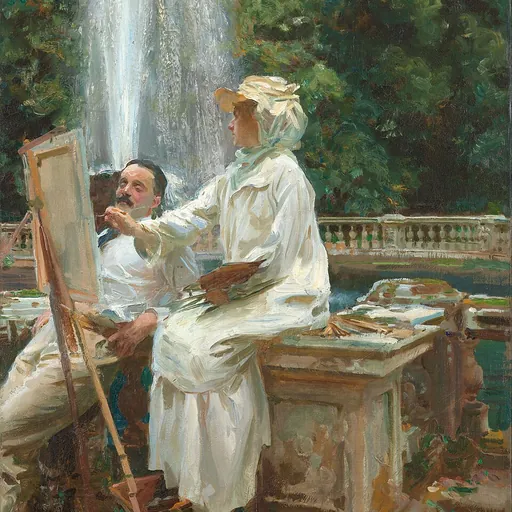
About Wilfrid de Glehn
Lived 1870 – 1951 (aged 80). Wilfrid de Glehn was a British painter.
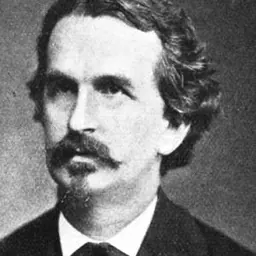
Wilfrid Gabriel de Glehn (sometimes 'Wilfried') (1870 – 11 May 1951) was a British Impressionist painter, elected to the Royal Academy in 1932.
Biography
De Glehn's father was Alexander de Glenn of Sydenham, London, himself the son of Robert von Glehn, a Baltic baron with estates near Tallinn in Estonia, who had become a naturalised British subject following his marriage to a Scottish woman. Wilfrid's mother was French. Louise Creighton, a women's rights activist and author, and Alfred de Glehn, a French steam locomotive designer, were Alexander's sister and brother.
Wilfried von Glehn (he changed his name in May 1917 ) was born in Sydenham, south-east London. After schooling at Brighton College with his brother Louis, he studied art briefly at the Royal Academy Schools in South Kensington before going on to the École des Beaux-Arts in Paris, where for a time he lived with his French cousin, the artist Lucien Monod (1867–1957). In 1891, he was hired by Edwin Austin Abbey and John Singer Sargent to assist them on their Boston Public Library mural project at Morgan Hall.
De Glehn exhibited his own work first in Rome in 1894 and then in Paris in 1895; he was also elected an Associetaire of the Société des Artistes Français. He first exhibited at the Royal Academy in 1896.
De Glehn met American-born artist Jane Erin Emmet in New Rochelle, New York in 1903, and they were married there the following year. Following their wedding, the couple honeymooned in Cornwall, England, vacationed in Paris and Venice, and made a permanent home in Chelsea, London. The following year, de Glehn was commissioned and served with the Royal Garrison Artillery. He was seconded to the front in Italy in 1917. In May 1917, his family shed the Germanic 'von Glehn' surname. Because of his fluent French, he spent the last part of the war as an interpreter. After the war, de Glehn held solo exhibitions at the Leicester Galleries and in New York (1920). For the next decade the couple would spend summers in Cornwall and winters in France.
Although some experts rank de Glehn alongside Sargent, he is considered as something of a late British Renoir, for his deft use of sunlight and shadow.
He died on 11 May 1951, at the age of 80, at his home, the Manor House in Stratford Tony, Wiltshire, to which he had moved in 1942 after the Chelsea house had been destroyed in the Blitz. An oil painting of Venice featured on the BBC's Antiques Roadshow in December 2014 and was valued at £20–30,000.
Gallery
Don’t just read it —
keep it.
Full-length biographies made to live with: read them, listen on the way to work, watch them tonight.
- E-book
- Audio
- Video
Instant download · yours to keep · every purchase keeps this site free
Important facts
more
w.g. von glehn, Van Glehn, de glehn w.g., w.g. de glehn, Wilfred de GlehnPeople in Wilfrid de Glehn's life
Named in this biography and alive at the same time





Related people
Same field, nearest in time



Contemporaries
People whose lives overlapped Wilfrid de Glehn's



Frequently asked questions
Who was Wilfrid de Glehn?
British artist (1870-1951)
When was Wilfrid de Glehn born?
Wilfrid de Glehn was born on 9 October 1870 in Sydenham.
When did Wilfrid de Glehn die?
Wilfrid de Glehn died on 11 May 1951 in Wiltshire.
What was Wilfrid de Glehn's occupation?
Wilfrid de Glehn was a painter.
What nationality was Wilfrid de Glehn?
Wilfrid de Glehn was British.
Sources & further reading
Cite this page
APA: Biography.guide. (2026). Wilfrid de Glehn. https://biography.guide/wilfrid-de-glehn/
MLA: "Wilfrid de Glehn." Biography.guide, https://biography.guide/wilfrid-de-glehn/.
Chicago: "Wilfrid de Glehn." Biography.guide. https://biography.guide/wilfrid-de-glehn/.
Data last updated: 2026-09-23 · Spot an error? Report a correction.
Portrait: Wikimedia Commons · author & licence
Page generated 2026-09-27 05:05 UTC