
Wi-jún-jon
Best known for appearing the painting by George Catlin, depicting what happened after he was assimilated into white culture following a trip to Washington, DC in 1832
About Wi-jún-jon
Lived 1796 – 1872 (aged 75–76). Wi-jún-jon was a traditional leader or chief.
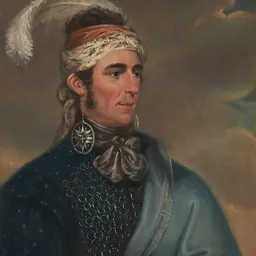
Wi-jún-jon, also called Pigeon's Egg Head or The Light (c. 1796–1835) was a leader of the Assiniboine tribe, which was located in the Great Plains at that time. He is best known as the subject of a painting by George Catlin, a dual portrait portraying him on the left side of the portrait in traditional garb and on the right side in contemporary Anglo-American garb after he was assimilated following an 18-month visit to Washington, D.C. and other cities in 1831 and 1832.
Wi-jún-jon before and after his trip to Washington, DC by George Catlin, c. 1837-39
Catlin wrote that Wi-jún-jon "exchanged his beautifully garnished and classic costume" for a suit of "broadcloth, of finest blue, trimmed with lace of gold; on his shoulders were mounted two immense epaulets; his neck was strangled with a shining black stock and his feet were pinioned in a pair of water-proof boots, with high heels which made him 'step like a yoked hog'."
A print based on the painting, showing Wi-jún-jon wearing Assiniboine dress and a Western suit, titled Wi-jún-jon, Pigeon's Egg Head, Going to Washington, returning to his house, became quite popular, appearing in a German magazine, Die Gartenlaube in 1853.
When Wi-jún-jon returned to his tribe on the Missouri River steamboat Yellow Stone, his fellow Assiboine initially were interested in and amused by his descriptions of the power of the United States. Soon, though, they considered him a nuisance, and eventually, "an evil magician and an outrageous liar". Three years after his return, a tribesmen murdered and scalped him.
Don’t just read it —
keep it.
Full-length biographies made to live with: read them, listen on the way to work, watch them tonight.
- E-book
- Audio
- Video
Instant download · yours to keep · every purchase keeps this site free
Important facts
People in Wi-jún-jon's life
Named in this biography and alive at the same time

Related people
Same field, nearest in time




Contemporaries
People whose lives overlapped Wi-jún-jon's






Frequently asked questions
Who was Wi-jún-jon?
Best known for appearing the painting by George Catlin, depicting what happened after he was assimilated into white culture following a trip to Washington, DC in 1832
When was Wi-jún-jon born?
Wi-jún-jon was born in 1796.
When did Wi-jún-jon die?
Wi-jún-jon died in 1872.
What was Wi-jún-jon's occupation?
Wi-jún-jon was a traditional leader or chief.
Sources & further reading
Cite this page
APA: Biography.guide. (2026). Wi-jún-jon. https://biography.guide/wi-jun-jon/
MLA: "Wi-jún-jon." Biography.guide, https://biography.guide/wi-jun-jon/.
Chicago: "Wi-jún-jon." Biography.guide. https://biography.guide/wi-jun-jon/.
Data last updated: 2026-09-20 · Spot an error? Report a correction.
Page generated 2026-09-27 05:23 UTC