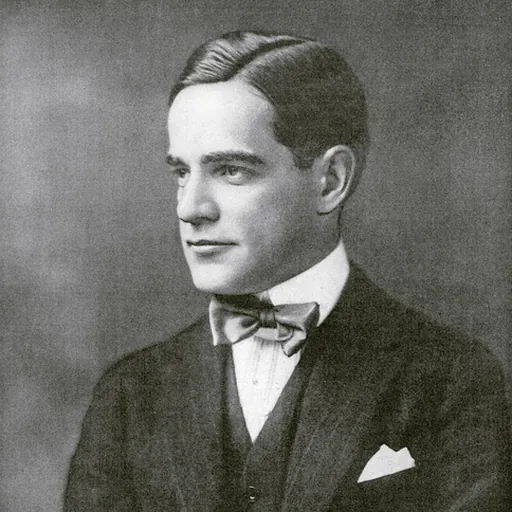
Whiting Williams
American writer (1878–1975); co-founder of the Welfare Federation of Cleveland
About Whiting Williams
Lived 1878 – 1975 (aged 97). Whiting Williams was an American social worker, business consultant, assistant, insurance broker, vice president and director.
Whiting Williams (March 11, 1878 – April 14, 1975) was co-founder of the Welfare Federation of Cleveland, a predecessor to the Community Chest and United Way charitable organizations, as well as an author of popular books and articles about labor relations during the early 20th century. He was one of a number of social investigators who gathered information by going "undercover" to live as a worker.
Biography
Overview Whiting Williams was born Charles Whiting Williams on March 11,1878 in Shelby, Ohio to Benjamin J. Williams and Ida Whiting. He is best known as the management consultant who went undercover to study various working conditions in the early twentieth century. He disguised himself as a laborer in coal mines, railroad shops, shipyards, and oil refineries in the United States, Europe, and Central and South America. At the commencement of his research in 1920, he wrote a book, What's on the Workers Mind, Put On Coveralls To Find Out, followed by several other writings which documented the findings of his research.
Education In 1899, Whiting Williams graduated from Oberlin College after which he continued his education at the University of Berlin for a year (1899–1900), and then the University of Chicago (1900–1901). Thereafter, he managed the Bureau of University Travel (1901–1904) and became the Assistant to the President at Oberlin College (1904–1912). In the meantime, he earned a master's degree in 1909.
Early career (1904–1918) Williams career started when he took a position as manager of the University Travel Bureau. He held this job until 1904, when he wrote a letter to the President of Oberlin College, Henry C. King, during his trip to Europe. In this, he suggested that a college president needed a full-time assistant to look after the less academic problems facing a school. In November of that same year Williams received a reply to his letter in which he was appointed assistant to the President. He held this position until 1912, and within this time period he met and married his first wife, Caroline Harter.
In 1912, Williams moved to Cleveland, Ohio to co-found the Cleveland Federation for Charity and Philanthropy. This organization was based on the premise that the competition of charitable organizations with each other for contributions was detrimental to their best interests.
Later career (1918–1960)
Williams took a leave of absence in 1920 to study working conditions and workers' attitudes firsthand, first in the United States, and later in various countries. Speaking multiple languages, French, German, Spanish, and Italian, enabled Williams to work as laborer in coal mines, railroad shops, shipyards, and oil refineries in the U.S., Europe, and Central and South America. Based on his research, he gave lectures and wrote several books, such as What's on the Worker's Mind (1920), Full Up and Fed Up (1921), Horny Hands and Hampered Elbows (1922), and Mainsprings of Men (1925).
Based on his work as a common laborer in the steel mills and in a rolling mill, as a coal miner in two towns, as a shipbuilder, as an oil man in a refinery, and as a worker in the iron mines, Williams wrote a 1920 book entitled What's on the Worker's Mind, subtitled By One Who Put On Overalls To Find Out. Much of these experiences are presented in a journal-like format throughout the book. In the preface, Williams argues that "the daily job as the axle of the entire world". The book is divided into two parts; part 1 "Overalls" and part 2 "Findings." In part 1, these topics are explored within the following chapters: "Hunting a Job", "In a Ten-Thousand-Man-Power Steel Plant", "In a Rolling-Mill", "Steel Slow-Miner's Wanted", "A Second Coal Town", "The Circle of the Hiring Gates", "With the Builders of Ships", "In an Oil Refinery", "In The Iron Mines", and "Among the Ignonts and Billets Again". The latter portion, "Findings," includes "Some Outstanding Impressions", "Some Deeper Factors", "The Way Out-and Management", and "The Way Out and The Public." While conducting his research, Williams adopted the idea that "no half measures in the manner of disguise." Moreover, he presented himself with "a different name, a slim pocketbook, rough clothes, an unshaven face and a grammerless lingo". Williams refrained from including any explicit details about companies within his book, including their geographic locations "because neither commendation nor criticism of communities or companies is intended or desired". His collected papers are in the Western Reserve Historical Society.
Personal life Williams married Caroline Harter in 1906. They had two children, Carol R. and Harter Whiting.
Publications What's on the Worker's Mind (1920) Full Up and Fed Up: The Worker's Mind in Crowded Britain (1921)
Don’t just read it —
keep it.
Full-length biographies made to live with: read them, listen on the way to work, watch them tonight.
- E-book
- Audio
- Video
Instant download · yours to keep · every purchase keeps this site free
Important facts
People in Whiting Williams's life
Named in this biography and alive at the same time


Related people
Same field, nearest in time


Contemporaries
People whose lives overlapped Whiting Williams's


Frequently asked questions
Who was Whiting Williams?
American writer (1878–1975); co-founder of the Welfare Federation of Cleveland
When was Whiting Williams born?
Whiting Williams was born on 11 March 1878 in Shelby.
When did Whiting Williams die?
Whiting Williams died on 14 April 1975 in Cleveland.
What was Whiting Williams's occupation?
Whiting Williams was a social worker, business consultant, assistant, insurance broker, vice president and director.
What nationality was Whiting Williams?
Whiting Williams was American.
Sources & further reading
Cite this page
APA: Biography.guide. (2026). Whiting Williams. https://biography.guide/whiting-williams/
MLA: "Whiting Williams." Biography.guide, https://biography.guide/whiting-williams/.
Chicago: "Whiting Williams." Biography.guide. https://biography.guide/whiting-williams/.
Data last updated: 2026-09-22 · Spot an error? Report a correction.
Portrait: Wikimedia Commons · author & licence
Page generated 2026-09-27 05:04 UTC