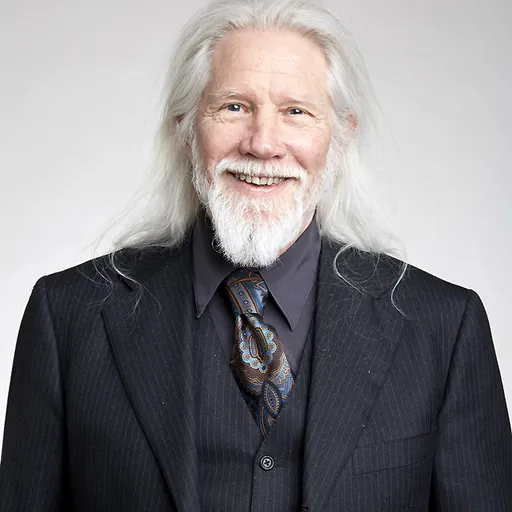
Whitfield Diffie
American cryptographer (born 1944)
About Whitfield Diffie
Born 1944. Whitfield Diffie is an American cryptographer, mathematician, computer scientist and cryptologist, known for Diffie–Hellman key exchange.
Early life and education Diffie was born in Washington, D.C. His mother is Justine Louise (Whitfield), a writer and scholar. His father is Bailey Wallys Diffie, who taught Iberian history and culture at the City College of New York. During the first two years of his undergraduate studies at MIT, he felt unengaged and seriously considered transferring to the University of California, Berkeley, which he perceived as a more hospitable academic environment. At MIT, he began to program computers (in an effort to cultivate a practical skill set) while continuing to perceive the devices "as very low class... I thought of myself as a pure mathematician and was very interested in partial differential equations and topology and things like that."
In the summer of 1974, Diffie and Fischer met with a friend at the Thomas J. Watson Research Center (headquarters of IBM Research) in Yorktown Heights, New York, which housed one of the only nongovernmental cryptographic research groups in the United States. While group director Alan Konheim "couldn't tell [Diffie] very much because of a secrecy order," he advised him to meet with Martin Hellman, a young electrical engineering professor at Stanford University who was also pursuing a cryptographic research program. A planned half-hour meeting between Diffie and Hellman extended over many hours as they shared ideas and information.
In 1975–76, Diffie and Hellman criticized the NBS proposed Data Encryption Standard, largely because its 56-bit key length was too short to prevent brute-force attack. An audio recording survives of their review of DES at Stanford in 1976 with Dennis Branstad of NBS and representatives of the National Security Agency. Their concern was well-founded: subsequent history has shown not only that NSA actively intervened with IBM and NBS to shorten the key size, but also that the short key size enabled exactly the kind of massively parallel key crackers that Hellman and Diffie sketched out. When these were ultimately built outside the classified world (EFF DES cracker), they made it clear that DES was insecure and obsolete.
From 1978 to 1991, Diffie was Manager of Secure Systems Research for Northern Telecom in Mountain View, California, where he designed the key management architecture for the PDSO security system for X.25 networks. He was named an IEEE fellow in 2025 for the development of public key cryptography and its applications.
In 1991, he joined Sun Microsystems Laboratories in Menlo Park, California, as a distinguished engineer, working primarily on public policy aspects of cryptography. Diffie remained with Sun, serving as its chief security officer and as a vice president until November 2009. He was also a Sun Fellow.
, Diffie was a visiting professor at the Information Security Group based at Royal Holloway, University of London.
In May 2010, Diffie joined the Internet Corporation for Assigned Names and Numbers (ICANN) as vice president for information security and cryptography, a position he left in October 2012.
Diffie is a member of the technical advisory boards of BlackRidge Technology, and Cryptomathic where he collaborates with researchers such as Vincent Rijmen, Ivan Damgård and Peter Landrock.
In 2018, he joined Zhejiang University, China, as a visiting professor, Cryptic Labs generated 2 months course in Zhejiang University.
Public key cryptography In the early 1970s, Diffie worked with Martin Hellman to develop the fundamental ideas of dual-key, or public key, cryptography. They published their results in 1976—solving one of the fundamental problems of cryptography, key distribution—and essentially broke the monopoly that had previously existed where government entities controlled cryptographic technology and the terms on which other individuals could have access to it. "From the moment Diffie and Hellman published their findings..., the National Security Agency's crypto monopoly was effectively terminated. ... Every company, every citizen now had routine access to the sorts of cryptographic technology that not many years ago ranked alongside the atom bomb as a source of power." The solution has become known as Diffie–Hellman key exchange.
Publications Privacy on the Line with Susan Landau in 1998. An updated and expanded edition was published in 2007. New directions in cryptography in 1976 with Martin Hellman.
Awards and honors Together with Martin Hellman, Diffie won the 2015 Turing Award, widely considered the most prestigious award in the field of computer science. The citation for the award was: "For fundamental contributions to modern cryptography. Diffie and Hellman's groundbreaking 1976 paper, 'New Directions in Cryptography', introduced the ideas of public-key cryptography and digital signatures, which are the foundation for most regularly-used security protocols on the internet today."
Diffie received an honorary doctorate from the Swiss Federal Institute of Technology in 1992.
He was also awarded the IEEE Donald G. Fink Prize Paper Award in 1981 (together with Martin E. Hellman), The Franklin Institute's Louis E. Levy Medal in 1997 a Golden Jubilee Award for Technological Innovation from the IEEE Information Theory Society in 1998, and the IEEE Richard W. Hamming Medal in 2010. In 2011, Diffie was inducted into the National Inventors Hall of Fame and named a Fellow of the Computer History Museum "for his work, with Martin Hellman and Ralph Merkle, on public key cryptography." Diffie was elected a Foreign Member of the Royal Society (ForMemRS) in 2017. Diffie was also elected a member of the National Academy of Engineering in 2017 for the invention of public key cryptography and for broader contributions to privacy.
Personal life Diffie self-identifies as an iconoclast. He has stated that he "was always concerned about individuals, an individual's privacy as opposed to government secrecy."
Don’t just read it —
keep it.
Full-length biographies made to live with: read them, listen on the way to work, watch them tonight.
- E-book
- Audio
- Video
Instant download · yours to keep · every purchase keeps this site free
Important facts
People in Whitfield Diffie's life
Named in this biography and alive at the same time






Related people
Same field, nearest in time


Contemporaries
People whose lives overlapped Whitfield Diffie's



Frequently asked questions
Who is Whitfield Diffie?
American cryptographer (born 1944)
When was Whitfield Diffie born?
Whitfield Diffie was born on 5 June 1944 in New York City.
What is Whitfield Diffie's occupation?
Whitfield Diffie is a cryptographer, mathematician, computer scientist and cryptologist.
What is Whitfield Diffie known for?
Whitfield Diffie is known for Diffie–Hellman key exchange.
What nationality is Whitfield Diffie?
Whitfield Diffie is American.
Sources & further reading
Cite this page
APA: Biography.guide. (2026). Whitfield Diffie. https://biography.guide/whitfield-diffie/
MLA: "Whitfield Diffie." Biography.guide, https://biography.guide/whitfield-diffie/.
Chicago: "Whitfield Diffie." Biography.guide. https://biography.guide/whitfield-diffie/.
Data last updated: 2026-09-23 · Spot an error? Report a correction.
Portrait: Wikimedia Commons · author & licence
Page generated 2026-09-27 05:05 UTC