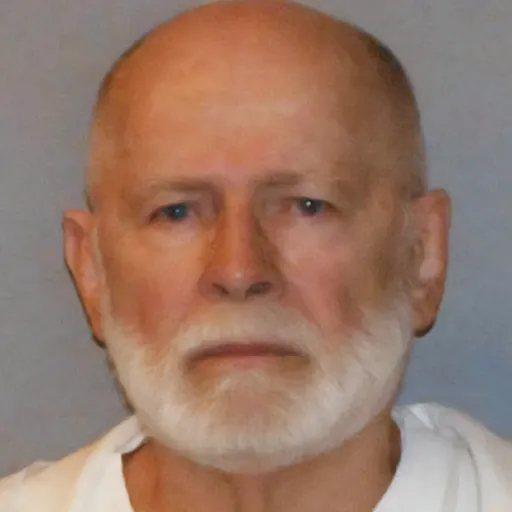
About Whitey Bulger
Lived 1929 – 2018 (aged 89). Whitey Bulger was an American criminal, gangster and serial killer.
Early life
Whitey Bulger's father, James Joseph Bulger Sr., hailed from Harbour Grace, Newfoundland, the son of Irish parents. After settling in Everett, Massachusetts, he married Jane Veronica "Jean" McCarthy, a first-generation Irish immigrant. The second of six children, James Joseph Bulger Jr., was born on September 3, 1929. The Bulger family moved into the housing project and the children grew up there. While his younger siblings, William Bulger and John P. Bulger, excelled at school, James Bulger Jr. was drawn into street life.
Early in his criminal career, local police gave Bulger the nickname "Whitey" because of his blond hair. The nickname stuck, even though Bulger hated it; to his closest friends, he was known as "Jim", "Jimmy" or even "Boots". The last nickname came from his habit of wearing cowboy boots, in which he used to hide a switchblade.
Early criminal career Bulger developed a reputation as a thief and street fighter fiercely loyal to South Boston. This led to him meeting more experienced criminals and finding more lucrative opportunities. In 1943, fourteen-year-old Bulger was arrested and charged with larceny. By then he had joined a street gang known as the "Shamrocks" and would eventually be arrested for assault, forgery and armed robbery. Bulger was sentenced to a juvenile reformatory for these offenses.
Shortly after his release in April 1948, Bulger joined the United States Air Force, where he earned his high school diploma and trained as a mechanic. Despite the regimented military life, he had not reformed. Bulger did time in military prison for several assaults and was arrested by Air Force police in 1950 for going absent without leave. In June 1951, while stationed at Malmstrom Air Force Base in Great Falls, Montana, he was arrested and charged with rape after being caught in a hotel with a fifteen-year-old girl. He had also been arrested several months prior after getting into bar fights. Nevertheless, Bulger received an honorable discharge in 1952 and returned to Massachusetts. that while there, he was used as a human test subject in the CIA-sponsored MKUltra program. Bulger later complained that the inmates had been "recruited by deception" and were told they were helping to find "a cure for schizophrenia", when in fact they were being used for research into mind control. His story was later confirmed when CIA documentation emerged.
Bulger and eighteen other inmates, all of whom had volunteered in exchange for reduced sentences, were given LSD and other drugs over an eighteen-month period. Bulger later described his experience as "nightmarish" and said it took him "to the depths of insanity", writing in his notebooks that he heard voices and feared being "committed for life" if he divulged his ordeal to anyone.
Killeen–Mullen War After his release from prison, Bulger worked as a janitor and construction worker before becoming a bookmaker and loan shark under mobster Donald Killeen, whose gang, the Killeens, had dominated South Boston for over twenty years. The Killeens were led by three brothers—Donnie, Kenny and Eddie—along with Billy O'Sullivan and Jack Curran. Their base was the Transit Café in South Boston, which later became Whitey's Triple O's.
In 1971, Kenny Killeen, the youngest of the Killeen brothers, allegedly shot and mauled Michael "Mickey" Dwyer, a member of the rival Mullen Gang, during a brawl at the Transit Café. A gang war resulted, leading to a string of killings throughout Boston and the surrounding suburbs. The Killeens quickly found themselves outgunned and outmaneuvered by the younger Mullens. It was during the war that Bulger set out to commit what Weeks describes as Bulger's first murder, of Mullen member Paul McGonagle. However, Bulger instead executed McGonagle's law-abiding brother Donald in a case of mistaken identity.
According to former Mullen boss Patrick Nee, McGonagle ambushed and murdered O'Sullivan on the assumption that he was the one responsible for his brother's killing. Bulger, realizing he was on the losing side, is alleged to have secretly approached Howie Winter, the leader of the Winter Hill Gang, and claimed he could end the war by murdering the Killeen leadership. Shortly thereafter, on May 13, 1972, Donald Killeen was gunned down outside his home in Framingham, Massachusetts.
Bulger and the Killeens fled Boston, fearing they would be next. Nee arranged for the war to be mediated by Winter and Joseph "J.R." Russo, a caporegime in the Patriarca crime family. In a sit-down at Chandler's nightclub in Boston's South End, the Mullens were represented by Nee and King, and the Killeens by Bulger. The two gangs joined forces, with Winter as overall boss. Kenny later testified that Winter Hill enforcers Stephen Flemmi and John Martorano were in the car with Bulger.
Winter Hill Gang
After the 1972 truce, Bulger and the Mullens were in control of South Boston's criminal underworld. FBI Special Agent Dennis Condon noted in his log in September 1973 that Bulger and Nee had been heavily shaking down the neighborhood's bookmakers and loan sharks. Over the years that followed, Bulger began to remove opposition by persuading Winter to sanction the killings of those who "stepped out of line." In a 2004 interview, Winter recalled that the highly intelligent Bulger "could teach the devil tricks." During this era, Bulger's victims included Mullen veterans McGonagle, King and James "Spike" O'Toole.
According to Weeks: As a criminal, he made a point of only preying upon criminals... And when things couldn't be worked out to his satisfaction with these people, after all the other options had been explored, he wouldn't hesitate to use violence. ... Tommy King, in 1975, was one example. ... Tommy's problems began when he and Jimmy had worked in Triple O's. Tommy, who was a Mullins, made a fist. And Jimmy saw it. ... A week later, Tommy was dead. Tommy's second and last mistake had been getting into the car with Jimmy, Stevie, and Johnny Martorano. ... Later that same night, Jimmy killed Buddy Leonard and left him in Tommy's car on Pilsudski Way in the Old Colony projects to confuse the authorities. As the 1970s progressed, the gang partnered with Anthony "Fat Tony" Ciulla in a lucrative horse race-fixing scheme, in which mobsters bribed and threatened jockeys and drugged horses in order to predetermine the outcomes of races across the East Coast. Bulger and Flemmi's role in the scheme involved placing bets with bookmakers around the country.
Anti-busing attacks In late August or early September 1974, Bulger and an accomplice reportedly set fire to an elementary school in Wellesley to intimidate U.S. District Court Judge Wendell Arthur Garrity Jr. over his mandated plan to desegregate schools in the city of Boston by means of busing. One year later, on September 8, 1975, Bulger and an unidentified person tossed a Molotov cocktail into the John F. Kennedy birthplace in Brookline in retaliation for Senator Ted Kennedy's vocal support for Boston school desegregation. Bulger then used black spray paint to scrawl "Bus Teddy" on the sidewalk outside of the national historic site.
FBI informant An FBI surveillance photograph of Bulger with Stephen Flemmi, c. 1980 In 1971, the Federal Bureau of Investigation (FBI) approached Bulger and attempted to recruit him as an informant in an ongoing effort to gain information on the Patriarca crime family. FBI Special Agent John Connolly, who like Bulger had grown up in South Boston, was assigned to make the pitch. However, Connolly failed to win Bulger's trust.
Weeks considers it more likely that Flemmi had betrayed Bulger to the FBI after being threatened with the loss of his informant status.
In the 1970s and 1980s, the Organized Crime Program of the FBI considered the Mafia a greater threat than all other organized crime groups in the United States combined and targeted the Mafia as a national priority. The Boston field office of the FBI perceived the Winter Hill Gang to be significantly less dangerous than the Patriarca family, particularly after several Winter Hill members were imprisoned or became fugitives as a result of a horse race-fixing case in 1979.
FBI supervisor John Morris was put in charge of the Organized Crime Squad at the Boston field office in December 1977. In reality, however, Bulger and Flemmi were far less valuable as informants than their handlers purported them to be. By 1982, Morris was "thoroughly compromised" to the point of having Bulger purchase plane tickets for his then-girlfriend, Debbie Noseworthy, to visit him in Georgia while he was being trained for drug investigations. Even after 1983, when Morris was transferred to head up the Boston FBI's anti-drug task force, he remained an accomplice to Bulger and Connolly. Prompted by his guilty conscience, Morris, speaking as an anonymous source, told the Globe of the "special relationship" between Bulger and the FBI which helped the Bureau infiltrate the Patriarca family. Bulger denied that there was any truth to the articles, telling his underlings that the Globe had fabricated the story. Given his street credibility, Bulger's gang dismissed the articles as false.
Consolidating power In February 1979, federal prosecutors indicted twenty-one members of the Winter Hill Gang, including Winter and numerous members of his inner circle, for fixing horse races. Bulger and Flemmi were originally going to be part of this indictment, but Connolly and Morris were able to persuade prosecutor Jeremiah T. O'Sullivan to drop the charges against them at the last minute. Bulger and Flemmi were instead named as unindicted co-conspirators. The Massachusetts State Police (MSP) discovered the location by chance while investigating an auto theft ring, finding that Bulger and Flemmi would openly associate with other organized crime figures, including Donato "Danny" Angiulo, Vincent "the Animal" Ferrara and Ilario "Larry" Zannino, at the garage. The MSP subsequently targeted Bulger and Flemmi in an investigation into illegal gambling and loan sharking.
Between March and July 1980, MSP troopers carried out surveillance from an adjacent flophouse before being granted a warrant to install covert listening devices on the premises in the summer of 1980. The electronic eavesdropping gathered no evidence, as Connolly alerted Bulger and Flemmi that troopers had bugged the garage. The gang ceased using the garage for a time after learning that the meeting place was compromised.
The MSP resumed surveillance on Bulger and Flemmi in September 1980, frequently following the pair to a bank of payphones outside a Howard Johnson's restaurant in Dorchester. The MSP investigation ended unsuccessfully in March 1981. Although Bulger and Flemmi were just two of nine informants used by the FBI to obtain court approval to plant the device, Connolly and Morris exaggerated their role in the investigation in reports to their superiors in order to insulate themselves from complaints by senior officials in the MSP accusing the FBI of corruption in its handling of the duo. After the 1983 federal racketeering indictments of Angiulo and his associates, the Patriarca family's Boston operations were in shambles. Bulger and Flemmi stepped into the ensuing vacuum to take control of organized crime in the Boston area.
Halloran and Donahue murders In 1982, Edward Brian Halloran, a South Boston cocaine dealer known as "Balloonhead" because of his large cranium, approached the FBI and stated that he had witnessed Bulger and Flemmi murdering Litif. Connolly kept Bulger and Flemmi closely briefed on what Halloran was saying, specifically his claims of having participated in the murder of Tulsa businessman Roger Wheeler (which were false according to Weeks). Connolly reported that Halloran was shopping this information to the FBI in exchange for him and his family being placed in witness protection. After arriving at the scene, Weeks staked out the Anthony's Pier 4 restaurant, where Halloran was dining. Michael Donahue, a friend of Halloran, incidentally ran into him at the restaurant. In a decision that would prove costly, Donahue offered Halloran a ride home.
As Donahue and Halloran drove out of the parking lot in a blue Datsun, Weeks signaled Bulger by stating, "The balloon is in the air" over a walkie-talkie. Bulger then pulled alongside the Datsun in a 1975 Chevrolet Malibu with an accomplice armed with a silenced MAC-10 submachine gun; Bulger himself carried a .30 carbine rifle. Both gunmen were disguised; Bulger with an Afro wig and a fake moustache, and the accomplice in a ski mask. In the disguise, Bulger apparently resembled Jimmy Flynn, a Winter Hill associate with whom Halloran had been feuding.
After Bulger shouted to Halloran, both gunmen opened fire and sprayed the Datsun with bullets. Donahue was shot in the head and killed instantly. The accomplice's firearm allegedly jammed after the initial volley of shots. As Halloran stumbled out of the car in an attempt to flee, Bulger performed a U-turn and continued shooting Halloran until his body was "bouncing off the ground," according to Weeks.
Although he was shot approximately twenty times, Halloran lived long enough to incorrectly identify his attacker as Flynn, who was later tried and acquitted. who denies the allegation and has never been charged.
Shortly after the shootings, Bulger and Weeks returned to the scene to recover one of the Malibu's hub caps while police were still present.
Donahue was survived by his wife and three sons. The families of Donahue and Halloran eventually filed a civil lawsuit against the U.S. government after learning that Connolly had informed Bulger of Halloran's informant status. Both families were awarded several million dollars in damages. However, the verdict was overturned on appeal due to the late filing of the claims. Thomas Donahue, who was eight years old when his father was murdered, has become a spokesman for the families of those allegedly murdered by the Winter Hill Gang.
Peak years Throughout the 1980s, Bulger, Flemmi and Weeks operated rackets throughout Eastern Massachusetts including loansharking, bookmaking, truck hijacking, arms trafficking and extortion. State and federal agencies were repeatedly stymied in their attempts to build cases against Bulger and his inner circle. Among the reasons for this was the trio's fear of wiretaps and their strict protocol of never discussing business over the telephone or in vehicles. Other reasons included South Boston's code of silence and corruption within the FBI, the MSP and the BPD. Although Connolly was Bulger's most infamous source inside law enforcement, Weeks has stated that MSP lieutenant Richard J. Schneiderhan, the crew's only source inside that agency, was valued more highly.
Bulger formed alliances with members of the Patriarca family who had escaped the conviction that sent the Angiulo brothers to prison.
In 1984, Bulger acquired Stippo's Liquor Mart adjacent to the Old Colony Housing Project by forcing the proprietor, Stephen "Stippo" Rakes, to sell him the business at gunpoint for $67,000. Bulger renamed the business the South Boston Liquor Mart and used the backroom as his gang's primary headquarters. He also forced local bars to buy alcohol from this business.
World Jai Alai
Winter Hill associate John "Jack" Callahan was fired from his role as president of World Jai Alai (WJA), a parimutuel betting company which operated in Connecticut and Florida, after he lost his gaming license in Connecticut due to his associations with organized crime. Callahan subsequently conspired with former FBI agent H. Paul Rico, who had served as Callahan's head of security at WJA, and Richard P. Donovan, another former WJA president, to regain control of the company by purchasing the business from its owner, Tulsa businessman Roger Wheeler. Callahan offered Bulger, Flemmi and Martorano a $10,000 per week "skim" from the parking and concession proceeds at WJA's fronton in Hartford, Connecticut, if the Winter Hill Gang would protect WJA against interference by the Mafia, to which the gangsters agreed. Wheeler refused to sell WJA to Callahan and his associates, who agreed that Wheeler had to be killed. Fearing that Wheeler was on the verge of reporting the skimming operation to authorities, Bulger ordered his murder. On May 27, a disguised Martorano, using guns shipped by bus from Bulger and Flemmi, killed Wheeler by shooting him in the face in the parking lot of the Southern Hills Country Club in Tulsa.
After Connolly told Bulger in July 1982 that the FBI wanted to question Callahan in connection with Wheeler's murder, he and Flemmi decided to kill Callahan. On August 1, Martorano lured Callahan into a car and shot him in the head during a meeting at Fort Lauderdale International Airport. With the assistance of Joe McDonald, Martorano left the body in the trunk of Callahan's leased Cadillac in a garage at Miami International Airport. Allowing Callahan's body to be discovered went against Bulger's plans, however, leading him to complain about Martorano: "There's plenty of sand down there. He should have got off his fat ass and buried him!" Michael Solimando, Callahan's business partner, was summoned to Triple O's and told by Bulger that he was now responsible for a fictitious debt that Callahan had purportedly owed him. Bulger threatened Solimando, a bodybuilder, with a replica Thompson submachine gun and said: "Your muscles aren't going to do you any good now." After flying to Switzerland and emptying Callahan's accounts, Solimando delivered $480,000 to the Winter Hill Gang, he made "a ton of money selling drugs," according to federal prosecutor Brian Kelly. Bulger became involved in drug trafficking in 1981, While he profited from the distribution of marijuana and cocaine, Bulger prohibited dealers from selling heroin in South Boston. In April 1983, he learned that Charlestown drug smuggler Joseph "Joe" Murray was importing marijuana into South Boston without the approval of the Winter Hill Gang and, in retaliation, tipped off Connolly about Murray's operations. Afterwards, Murray commenced monthly payments to Bulger for the privilege of warehousing his contraband in South Boston and for protection from the Winter Hill Gang. Bulger, Flemmi and Weeks were subjected to intense DEA surveillance in 1989 and 1990 but escaped being charged in the investigation. The DEA crackdown—which targeted three separate drug rings led by Shea, Paul Moore and Hobart Willis, each of whom reported to Bulger—effectively put Bulger's drug operations out of business. Shea quietly served a long prison sentence and refused to admit to having paid protection money to Bulger, Flemmi and Weeks. Shea repeatedly got into fights with other inmates who accused Bulger of being "a rat," earning him a legendary reputation in South Boston. One such criminal was Arthur "Bucky" Barrett, a safecracker and thief who allegedly participated in the theft of $1.5 million from the Depositors Trust bank in Medford on Memorial Day Weekend of 1980. Barrett had refused to give Bulger a cut of the money from the heist,
Immediately following the murder, Bulger reclined in a couch. Meanwhile, in the basement, Flemmi removed Barrett's teeth in the belief it would prevent later identification while Weeks and Patrick Nee dug a grave in the basement's dirt floor. Afterwards, Nee expressed anger that Barrett had been killed, expecting only an extortion to take place.
Arms trafficking
During the most violent period of the Troubles, sympathy for Irish nationalism and the Provisional Irish Republican Army (IRA) was common in South Boston, as were efforts to raise money and smuggle weapons for the IRA's campaign against the British military occupation in Northern Ireland. From the start of his involvement with the FBI, Bulger emphatically refused to betray the IRA. Valhalla departed Gloucester and rendezvoused off the west coast of Ireland with Marita Ann, an IRA ship that had sailed from Tralee. During the return voyage, the Irish Navy stopped Marita Ann and seized the hidden arsenal, arresting IRA members Martin Ferris, Mike Browne and John Crawley. The operation had been compromised by IRA member Sean O'Callaghan, an informant for the Irish National Police. The seizure marked the complete end of any major attempt by the IRA to smuggle guns out of the U.S., which had largely ceased three years earlier with the arrest of their primary gunrunner, George Harrison, by the FBI.
The United States Customs Service received notice of the weapons transfer and seized Valhalla when it stopped in Boston on October 16, en route back to Gloucester. No weapons were found on the trawler, Quincy police then arranged for the FBI, the DEA and the Customs Service to participate in McIntyre's debriefing.
McIntyre implicated Bulger in the botched gunrunning to FBI Agent Roderick Kennedy, who was friendly with Connolly. After hearing of Kennedy's interview with a Valhalla crew member, Connolly told Bulger of the cooperation. After McIntyre's disappearance, an FBI agent named Philip Brady told his family that he was likely murdered by the IRA.
On September 5, 2006, Judge Reginald C. Lindsay ruled that the mishandling of Bulger and Flemmi caused the murder of McIntyre, awarding his family $3.1 million in damages. Lindsay stated the FBI failed to properly supervise Connolly and "stuck its head in the sand" regarding numerous allegations that Bulger and Flemmi were involved in drug trafficking, murder and other crimes for decades.
Murder of Deborah Hussey In 1985, Bulger decided to kill Flemmi's 26-year-old stepdaughter, Deborah Hussey, who he regarded as a liability. Hussey knew about the Winter Hill Gang's dealings and had started going to a bar they frequented, where she indiscriminately named Bulger and Flemmi in conversation to acquire money from low-level gangsters who feared her stepfather.
On January 14, 1985, Flemmi drove Hussey to East Third Street, which Bulger now nicknamed "the Hauntey," where Bulger strangled Hussey in the kitchen.
Massachusetts Lottery In the summer of 1991, Bulger and Weeks, along with associates Patrick and Michael Linskey, came into possession of a winning Massachusetts Lottery ticket which had been bought at a store he owned. The four men shared a prize of around US$14 million. Bulger was widely thought to have obtained his share of the jackpot illegitimately.
Downfall
After Connolly retired from the FBI in December 1990, Bulger and Flemmi were "closed" as informants as the Bureau no longer desired their services. In April 1994, a joint task force of the DEA, the MSP and the BPD launched a probe of Bulger's illegal gambling operations. The FBI, by this time considered compromised, was not informed. After a number of bookmakers agreed to testify to having paid protection money to Bulger, a federal case was built against him under the Racketeer Influenced and Corrupt Organizations Act (RICO).
According to Weeks:
In 1995, Bulger and Flemmi were indicted on racketeering charges along with two prominent Boston mafiosi, Frank Salemme and Bobby DeLuca. During the discovery phase, Salemme and DeLuca were listening to a tape from a roving bug, which is normally authorized when the FBI has no advance knowledge of where criminal activity will take place. They overheard two of the agents who were listening in on the bug mention offhandedly that they should have told one of their informants to give "a list of questions" while speaking to the mobsters. When their lawyer, Tony Cardinale, learned about this, he realized that the FBI had lied about the basis for the bug in order to protect an informant. Suspecting that this was not the first time such a thing had happened, Cardinale sought to force prosecutors to reveal the identities of any informants used in connection with the case. On May 23, 2001, Bulger, along with Stephen and Michael Flemmi, were charged in a forty-eight-count federal indictment with racketeering, murder and other crimes.
On November 17, 1999, Weeks was arrested by a combined force of the DEA and the MSP. Although by this time he was aware of Bulger's FBI deal, he was determined to remain faithful to South Boston's code of silence even though he potentially faced dying in prison if convicted. However, while awaiting trial in Rhode Island's Wyatt Detention Facility, Weeks was approached by a fellow inmate, a "made man" in the Patriarca family, who suggested that Weeks turn informer. The Patriarca soldier told him, "Kid, what are you doing? Are you going to take it up the ass for these guys? Remember, you can't rat on a rat. Those guys have been giving up everyone for thirty years." when a businessman watching Hannibal (2001) recognized Bulger in a photograph during a scene featuring the website of the FBI's most wanted fugitives. However, there were unconfirmed sightings elsewhere. At one point, FBI agents were sent to Uruguay to investigate a lead. Other agents were sent to stake out the 60th anniversary celebrations of the Battle of Normandy, as Bulger was reportedly an enthusiastic fan of military history. Later reports of a sighting in Italy in April 2007 proved false. Two people on video footage shot in Taormina, Sicily, formerly thought to be Bulger and Greig walking in the streets of the city center, were later identified as a tourist couple from Germany.
In 2010, the FBI turned its focus to Victoria, British Columbia, on Vancouver Island. In pursuit of Bulger, a known book lover, the FBI visited bookstores in the area, questioned employees and distributed wanted posters. Following his arrest, Bulger revealed that instead of being reclusive, he had in fact traveled frequently, with witnesses coming forward to say they had seen him on the Santa Monica Pier and elsewhere in southern California. A confirmed report by an off-duty Boston police officer after a San Diego screening of The Departed also led to a search in southern California that lasted "a few weeks".
Capture The apartment building in Santa Monica, California, where Bulger lived as a fugitive for at least 15 years. Bulger's residence is the top right room.
After 16 years at large and 12 years on the FBI Ten Most Wanted Fugitives list, Bulger was arrested in Santa Monica, California, on June 22, 2011. He was 81 years old at the time of the arrest.
Bulger was captured as a result of the work of the Bulger Fugitive Task Force, which consisted of FBI agents and a Deputy U.S. Marshal. According to retired FBI agent Scott Bakken, "Here you have somebody who is far more sophisticated than some 18-year-old who killed someone in a drive-by. To be a successful fugitive you have to cut all contacts from your previous life. He had the means and kept a low profile."
A reward of US$2 million had been offered for information leading to his capture. This amount was second only to Osama bin Laden's capture reward on the FBI's Ten Most Wanted Fugitives list. Bulger had been featured on the television show America's Most Wanted 16 times, first in 1995, and finally on October 2, 2010. According to authorities, the arrests were a "direct result" of the media campaign launched by the FBI in 14 television markets across the country where Bulger and Greig reportedly had ties. The campaign focused on Greig, describing her as an animal lover who frequently went to beauty salons. The Boston Globe identified the tipster as Anna Björnsdóttir, a former model, actress, and Miss Iceland 1974, who lived in Bulger's neighborhood. A day later, "using a ruse, agents and other task force members lured Mr. Bulger out of his apartment", "arrested him 'without incident', then went in the house and arrested Greig". During the raid the FBI found "Weapons all over the apartment" and "loaded shotguns, mini rugers, rifles."
Bulger was charged with murder, "conspiracy to commit murder, extortion, narcotics distribution and money-laundering". Agents found "more than $800,000 in cash, 30 firearms, and fake IDs" at the apartment. In Oklahoma, where Bulger is alleged to have ordered the killing of businessman Roger Wheeler Sr., in 1981, Tulsa County District Attorney Tim Harris said, "It is our intention to bring Bulger to justice and to be held accountable for the murder of Mr. Wheeler". In Florida, Miami-Dade State Attorney Katherine Fernandez Rundle said, "After a 16-year delay, I will be working to ensure that a Miami jury has the opportunity to look [Bulger] in the eyes and determine his fate". Many anticipated that Bulger, in exchange for favorable treatment in sentencing, would have much to tell authorities about corruption at the local, state and federal levels, which allowed him to operate his criminal enterprise for so long.
In a 2011 interview, Kevin Weeks expressed surprise at Bulger's decision to cooperate after his arrest. Weeks said, "I don't understand because he's not the same as I remember him. I can't believe he's so chatty right now. So I don't know what he's doing". Weeks added that he is not afraid of Bulger, and that the residents of Boston should not be either: "I don't think he's Pablo Escobar where he can just walk out of his prison cell and come to South Boston or anywhere. No, no one's worried about him." Greig's identical twin sister, Margaret, married Robert McGonagle's brother, Paul. The McGonagle brothers were from a family that led the Mullen Gang. Robert McGonagle was injured during a mob gunfight in 1969. Before his 1987 death by drug overdose, Robert McGonagle reportedly held Bulger responsible for the murders of his twin brothers, Donald and Paul, who were killed in the fighting which occurred during the Mullen-Killeen gang war. Paul's body was hidden and buried for 25 years on Tenean Beach in Dorchester. In 1982, they began sharing a condominium in Quincy's Louisburg Square South apartment complex. In 2000, the FBI received a tip of a sighting of Greig in Fountain Valley, California. She was represented in the criminal proceedings by the prominent criminal attorney Kevin Reddington of Brockton, Massachusetts. After being captured with Bulger, Greig sought release on bail and home confinement, a request that was denied.
Greig initially indicated that she would go to trial rather than accept a plea bargain. In March 2012, however, Greig pleaded guilty to conspiracy to harbor a fugitive, identity fraud, and conspiracy to commit identity fraud. On June 12, 2012, she was sentenced to eight years in federal prison. She declined to speak during her sentencing.
In September 2015, Greig was indicted on a charge of criminal contempt stemming from her refusal to testify before a grand jury about whether other people aided Bulger while he was a fugitive. In February 2016, Greig pleaded guilty to this charge.
Greig served much of her eight-year sentence at the Federal Correctional Institution, Waseca in Minnesota, but was also detained at various points in Rhode Island ahead of proceedings in the criminal contempt case.
Final detention
According to an excerpt of a book on Bulger published by Boston magazine, Bulger only made one friend during his post-sentencing detention,
On August 12, the jury convicted Bulger of 31 out of 32 counts in the indictment. As part of the racketeering charges, the jury convicted Bulger of the murders of 11 victims—Paul McGonagle, Edward Connors, Thomas King, Richard Castucci, Roger Wheeler, Brian Halloran, Michael Donahue, John Callahan, Arthur "Bucky" Barrett, John McIntyre, and Deborah Hussey.
The jury acquitted Bulger of killing Michael Milano, Al Plummer, William O'Brien, James O'Toole, Al Notorangeli, James Sousa and Francis Leonard. They reported themselves unable to agree about the murder of Debra Davis, though Bulger had already been found liable for her death in a civil suit. Following the verdict, Bulger's attorneys J. W. Carney Jr. and Hank Brennan vowed to appeal, citing Casper's ruling which prevented Bulger from claiming he had been given immunity.
On November 14, 2013, Bulger was sentenced to two terms of life imprisonment, plus five years. Casper told Bulger that such a sentence was necessary given his "unfathomable" crimes, some of which inflicted "agonizing" suffering on his victims. He was also ordered to forfeit $25.2 million and pay $19.5 million in restitution. Prosecutors in Florida and Oklahoma announced after Bulger's conviction that they would wait until after sentencing concluded before deciding whether or not to prosecute Bulger in their states. Bulger was indicted in Florida for the murder of Callahan and in Oklahoma for the murder of Roger Wheeler, and could have received the death penalty in those states. and then a few days later to the Federal Penitentiary in West Virginia. According to prison documents obtained by The New York Times, Bulger gained a reputation for disconcerting behavior during his time in prison: "At the Coleman prison complex in Florida in September 2014, he was disciplined multiple times, including once for masturbating in front of a male staff member and once, in February, for threatening a female medical staff member".
Death
Bulger was transferred from the Federal Transfer Center in Oklahoma City to United States Penitentiary, Hazelton, in West Virginia on October 29, 2018. At 8:20 a.m. on October 30, the 89-year-old Bulger was found dead. Bulger was in a wheelchair and had been beaten to death by multiple inmates armed with a sock-wrapped padlock and a shiv. His eyes had nearly been gouged out and his tongue almost cut off; a law enforcement official described Bulger as "unrecognizable". Correctional officers had warned Congress just days before his death that facilities were being dangerously understaffed. Geas, 51, and his brother were sentenced to life in prison in 2011 for their roles in several violent crimes, including the 2003 killing of Adolfo "Big Al" Bruno, a Genovese family capo who was shot in a Springfield, Massachusetts parking lot. Bulger's medical status had been lowered on October 8, 2018, shortly before he was transferred.
On November 8, 2018, a funeral Mass was held for Bulger at Saint Monica – Saint Augustine Church in South Boston. Family members, including his brother, former Massachusetts state Senate president William M. Bulger, and the twin sister of Catherine Greig attended. Bulger's death came as a relief to many Bostonians, especially for family members of his victims; In September 2019, the Bulger family filed a wrongful death lawsuit against the Justice Department, alleging that, by lowering Bulger's medical status and transferring him to Hazelton, he "was deliberately placed in harm's way. There is simply no other explanation for the transfer of someone in his condition and inmate status to be placed in the general population of one of the country's most violent federal penitentiaries."
The Bulger family sought 200,000 in damages.
On August 18, 2022, Geas was indicted in connection with the beating death of Bulger, along with Paul J. DeCologero and Sean McKinnon. On May 14, 2024, the Department of Justice announced that plea agreements with the three had been accepted. On 6 September 2024, Fotios Geas was sentenced to 25 years imprisonment for voluntary manslaughter in Bulger's killing.
Family Bulger had two younger brothers, William Michael "Billy" Bulger (born 1934) and John "Jackie" P. Bulger (1938–2026). William Bulger served in the military during the Korean War but was never posted to Korea. He was formerly an influential leader of the Democratic Party in Massachusetts. In a long political career, William rose to become President of the Massachusetts Senate. After his retirement he was appointed President of the University of Massachusetts system.
In December 2002, William Bulger appeared before the House Committee on Oversight and Government Reform and refused to testify, citing his Fifth Amendment right against self-incrimination. In April 2003, the committee voted "to grant William Bulger immunity to obtain information concerning Whitey's whereabouts and the FBI's misuse of informants."
John "Jackie" Bulger, a retired Massachusetts court clerk magistrate, was convicted in April 2003 of committing perjury in front of two grand juries regarding sworn statements he gave concerning contacts with his fugitive brother.
Personal life Bulger fathered one child, Douglas Glenn Cyr (1967–1973), during a 12-year relationship with Lindsey Cyr (1945–2019), a waitress and former fashion model living in North Weymouth, Massachusetts. Bulger and Cyr began living together in 1966, when Cyr was 21 and a waitress at a North Quincy café. According to Cyr, "He used to say that there were four people he would turn up on a street corner for: Douglas, me, Billy, or his mother. And we all made him vulnerable." At six years of age, Douglas died from Reye syndrome after having a severe allergic reaction to an aspirin injection. Lindsey Cyr later recalled it as:
quote|An absolute nightmare, and it was very difficult for Jimmy because, no matter what, there was nothing that could save this. Money didn't matter, his power didn't matter. [...] I remember that we were walking out of the hospital the night that he died, and he was holding my hand. And Jimmy said, "I'm never going to hurt like this again." stating: quote|If he wanted to see me, I'd be happy to. If he needs help getting attorneys and what have you, I'd be happy to help him. Part of me does [still love him]. I still care for him. I would always help him. I certainly always stand by him. He is the father of my child. He is 12 years of my life. I want to see him well protected. [...] And I'm not particularly sympathetic to some of the people involved, some of the victims' families. Bulger bought her an expensive house in suburban Quincy, Massachusetts, and acted as father to her children while commuting to "work" in South Boston. However, he was repeatedly unfaithful to her with a host of other women, and was often absent while overseeing the running of his organization. In a 2004 interview, Stanley stated that she was planning to publish her memoirs;
Child molestation accusations Stephen Flemmi and Whitey Bulger are alleged to have committed statutory rape against numerous underage girls, some as young as 13, during the 1970s and 80s, deliberately getting them hooked on heroin and then sexually exploiting them for years.
Press relations According to Weeks: The film's screenplay is based on the 2001 non-fiction book Black Mass: The True Story of an Unholy Alliance Between the FBI and the Irish Mob, by Dick Lehr and Gerard O'Neill.
Characters based on Whitey Bulger The character of Frank Costello (played by Jack Nicholson) in the 2006 Martin Scorsese film The Departed is loosely based on Bulger. The 2006–2008 Showtime TV series Brotherhood, about two Irish-American brothers on opposite sides of the law, was inspired by the relationship between Whitey and Billy Bulger, although the show takes place not in Boston but in nearby Providence, Rhode Island. The 2013 television drama The Blacklist starring James Spader, as career criminal & former Naval Intelligence Officer Raymond Reddington, who turns himself in to work with the FBI on his own terms. His character was inspired by Bulger's arrest and trial. The character Marty Butler in Dennis Lehane's novel Small Mercies was heavily inspired by Bulger. While the DC Comics villain Carmine Falcone was inspired by Vito Corleone from The Godfather trilogy in the source material, director Matt Reeves claimed to have patterned his iteration of the character after Bulger in The Batman film released in 2022, portrayed by John Turturro. A younger version of Falcone is portrayed by Mark Strong in The Penguin spin-off miniseries which premiered in 2024.
Don’t just read it —
keep it.
Full-length biographies made to live with: read them, listen on the way to work, watch them tonight.
- E-book
- Audio
- Video
Instant download · yours to keep · every purchase keeps this site free
Important facts
People in Whitey Bulger's life
Named in this biography and alive at the same time







Related people
Same field, nearest in time

Contemporaries
People whose lives overlapped Whitey Bulger's



Frequently asked questions
Who was Whitey Bulger?
Irish-American gangster and crime boss (1929-2018)
When was Whitey Bulger born?
Whitey Bulger was born on 3 September 1929 in Boston.
When did Whitey Bulger die?
Whitey Bulger died on 30 October 2018 in United States Penitentiary, Hazelton.
What was Whitey Bulger's occupation?
Whitey Bulger was a criminal, gangster and serial killer.
What nationality was Whitey Bulger?
Whitey Bulger was American.
Sources & further reading
Cite this page
APA: Biography.guide. (2026). Whitey Bulger. https://biography.guide/whitey-bulger/
MLA: "Whitey Bulger." Biography.guide, https://biography.guide/whitey-bulger/.
Chicago: "Whitey Bulger." Biography.guide. https://biography.guide/whitey-bulger/.
Data last updated: 2026-09-22 · Spot an error? Report a correction.
Portrait: Wikimedia Commons · author & licence
Page generated 2026-09-27 05:02 UTC