
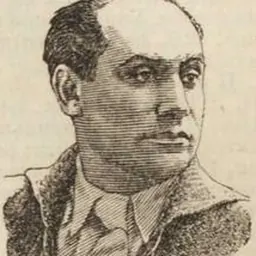
Werner Koch
German journalist and theologian
About Werner Koch
Lived 1910 – 1994 (aged 83). Werner Koch was a German journalist, resistance fighter, protestant theologian, religious education teacher and parson, known for Resistance during World War II.
Werner Koch (26 December 1910 – 31 July 1994) was a German pastor, evangelical-reformed theologian and journalist. Through his early involvement with the Confessing Church ("Bekennende Kirche") he came to wider prominence as an opponent of the Nazi government, spending time in Sachsenhausen concentration camp.
Biography Early years Werner Koch was born in Bielefeld. On leaving school he moved on to study Lutheran Theology at Marburg, Tübingen, Paris and finally (and most intensively) Bonn. At Bonn he formed a firm friendship with his professor, the influential scholar-theologian Karl Barth. He was still an undergraduate student in July 1931 when he first met Dietrich Bonhoeffer. Like Barth and Bonhoeffer, Werner Koch was hugely critical of the political developments in Germany during the early 1930s. which can be seen as a movement within German Protestantism that arose during the Nazi years in opposition to government-sponsored efforts to unify all Protestant churches into a single pro-Nazi Protestant Reich Church. He supplied his reports, under a pseudonym, to newspapers in Switzerland and Britain. First it appeared in the London-based The Morning Post on 17 July and then, on 23 July, in the Basler Nachrichten. including Weißler and Tillich . Paperwork accompanying the three men identified Friedrich Weißler as Jewish, and when they reached the camp he was separated from the "Aryan" detainees. Friedrich Weißler died at Sachsenhausenon 19 February 1937 as a result of the torture to which he had been subjected. Himmler had been invited as a guest of von Schertel to a private dinner party which he held on 1 December 1938 at the elegant resort of Wiesbaden. Late in the evening the host ventured to ask Himmler to arrange for the release from the concentration camp of the youngest son of his friend, Maximilian Koch. The father had taken the further precaution of preparing a detailed account of his son's arrest, which was handed to Himmler. Himmler evidently read the note, and later that same evening ordered his minions to set in motion the necessary arrangements.
War years Until his conscription in November 1939 Koch now worked for the Evangelical Press Association for the Rhineland. In July 1939 he married Gerritdina Stokmann whose family came from the north-west of the country, close to the Dutch border. His first assignment after he had been conscripted involved work as an overseer and simultaneous translator in Emsland, working with French-speaking prisoners of war. In the summer of 1942 he was redeployed to the Eastern Front as a member of a punishment battalion. He was soon wounded and returned to the west where early in 1943 he was assigned to a battalion of French Prisoners of war at Mülheim an der Ruhr employed, as before, as a simultaneous translator. Other sources state that he handed himself over to American forces, but it was in any event as a British prisoner of War that he spent the next couple of years.
Postwar years Immediately after the war ended, in May 1945, The British created a prisoner of war camp at Ascot Racecourse adapted, it seems, from a training facility that had been made available to Free French forces during the years of fighting. According to at least one source the Ascot camp was set aside for those German prisoners of war who had been identified as opponents of National Socialism. It was here that Werner Koch served as a camp pastor during 1945/46. However, the focus of the book is on his time as an anti-Nazi activist, and there is relatively little information available on his later years. In 1946 or 1947 he was appointed a pastor in the Wedding quarter of Berlin, then in the French sector of the city and, after 1949, part of West Berlin. He moved briefly back to Bielefeld in 1952/53 and then took a pastoral appointment at Espelkamp, a short distance further north. He moved again in 1958, this time to nearby Netphen, where he served till 1969. He was also, over many years, a president of the Sachsenhausen Committee for West Germany.
In 1972 Werner Koch received his doctorate from the Protestant Faculty of Theology in Paris. His dissertation, also published in book form, concerned Gustav Heinemann.
Honours 1991: Order of Merit of the Federal Republic of Germany
Don’t just read it —
keep it.
Full-length biographies made to live with: read them, listen on the way to work, watch them tonight.
- E-book
- Audio
- Video
Instant download · yours to keep · every purchase keeps this site free
Important facts
People in Werner Koch's life
Named in this biography and alive at the same time


Related people
Same field, nearest in time



Contemporaries
People whose lives overlapped Werner Koch's




Frequently asked questions
Who was Werner Koch?
German journalist and theologian (1910-1994)
When was Werner Koch born?
Werner Koch was born on 26 December 1910 in Bielefeld.
When did Werner Koch die?
Werner Koch died on 31 July 1994 in Emlichheim.
What was Werner Koch's occupation?
Werner Koch was a journalist, resistance fighter, protestant theologian, religious education teacher and parson.
What was Werner Koch known for?
Werner Koch was known for Resistance during World War II.
What nationality was Werner Koch?
Werner Koch was German.
Sources & further reading
· DBpedia: Werner Koch (pastor)
Cite this page
APA: Biography.guide. (2026). Werner Koch. https://biography.guide/werner-koch-journalist/
MLA: "Werner Koch." Biography.guide, https://biography.guide/werner-koch-journalist/.
Chicago: "Werner Koch." Biography.guide. https://biography.guide/werner-koch-journalist/.
Data last updated: 2026-09-22 · Spot an error? Report a correction.
Page generated 2026-09-27 05:21 UTC