
About Werner Hoffmann
Lived 1918 – 2011 (aged 93). Werner Hoffmann was a flying ace.
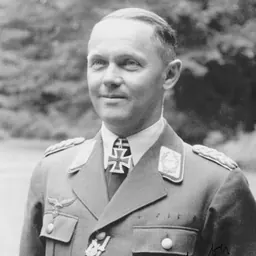
Werner Hoffmann (13 January 1918 – 8 July 2011) was a German Luftwaffe night fighter ace and recipient of the Knight's Cross of the Iron Cross, the highest award in the military and paramilitary forces of Nazi Germany during World War II. Hoffmann was credited 51 aerial victories, 50 of them at night, claimed in 192 combat missions.
Early life and career Hoffmann was born on 13 January 1918 in Stettin, present-day Szczecin in the West Pomeranian Voivodeship in Poland, at the time in the Province of Pomerania of the German Empire. He was the only child of Walter, a ship building engineer, and Gertrud Hoffmann. In 1924, Hoffmann began his schooling at the Volksschule, a primary school, in Stettin. A year later, the family moved to Berlin, settling in Wilmersdorf. There, in 1928, he attended a Gymnasium, a secondary school.
Hoffmann began flying gliders in 1932 and joined the Luftwaffe in December 1936, learning to fly with the Luftkriegsschule 3 (LKS 3—3rd air war school), Wildpark-West near Werder. He was awarded his pilot's badge in June 1938 and was then posted to 7. Staffel of Jagdgeschwader 234 (JG 234—234th Fighter Wing), a squadron of III. Gruppe. III. Gruppe of JG 234 was eventually redesignated I. Gruppe of Zerstörergeschwader 52 (ZG 2—52nd Destroyer Wing) in May 1939 and was equipped with the new Messerschmitt Bf 110 heavy fighter.
World War II World War II in Europe began on Friday 1 September 1939 when German forces invaded Poland. Hoffmann was assigned to 4. Staffel of Zerstörergeschwader 2 (ZG 2—2nd Destroyer Wing) in early 1940 and participated in the Battle of France. He claimed his aerial first aerial victory, a Royal Air Force (RAF) Hawker Hurricane fighter over Dunkirk, on 24 May 1940. That day, he also shot down Flying Officer Peter Cazenove in his Supermarine Spitfire from No. 92 Squadron. On 19 June, he hit by ground fire during a ground attack mission on French troops but returned to his airfield. Hoffmann sustained injuries in his left elbow, requiring weeks of convalescence.
In July 1940, Hoffmann was transferred to Ergänzungs-Zerstörergruppe Værløse as an instructor with the rank of Oberleutnant and appointed Staffelkapitän (squadron leader). He remained with the unit until 3 August 1941, when the unit was disbanded. He then underwent conversion training as a night fighter pilot.
Night fighter career A map of part of the Kammhuber Line. The 'belt' and night fighter 'boxes' are shown. Following the 1939 aerial Battle of the Heligoland Bight, RAF attacks shifted to the cover of darkness, initiating the Defence of the Reich campaign. By mid-1940, Generalmajor (Brigadier General) Josef Kammhuber had established a night air defense system dubbed the Kammhuber Line. It consisted of a series of control sectors equipped with radars and searchlights and an associated night fighter. Each sector named a Himmelbett (canopy bed) would direct the night fighter into visual range with target bombers. In 1941, the Luftwaffe started equipping night fighters with airborne radar such as the Lichtenstein radar. This airborne radar did not come into general use until early 1942.
Hoffmann was posted as Staffelkapitän to 5. Staffel of Nachtjagdgeschwader 3 (NJG 3—3rd Night Fighter Wing) based at Schleswig. On the night of 25/26 June 1942, Hoffmann shot down two twin-engine bombers during the 1,000-bomber raid on Bremen. Hoffmann was appointed Staffelkapitän of 4. Staffel of Nachtjagdgeschwader 5 (NJG 5—5th Night Fighter Wing) on 11 February 1943.
Group commander Hoffmann then served with I./NJG 1, based at Sint-Truiden, Saint-Trond in French pronunciation. On 4 July 1943, he was appointed Gruppenkommandeur (group commander) of I. Gruppe of NJG 5, succeeding Hauptmann Siegfried Wandam in this capacity.
On 15 November, Hoffmann was awarded the German Cross in Gold for 15 victories and by the end of 1943 had a victory total of 18. On 20 January 1944 Hoffmann had to bail out over Berlin when his aircraft was damaged by return fire from an RAF Lancaster. On the night of 28/29 January he shot down three Halifax bombers raiding Berlin and claimed two Lancaster bombers shot down the next night.
Hoffmann was awarded the Knight's Cross of the Iron Cross for 31 victories on 4 May 1944. On 29 June, Hoffmann shot down a four-engine bomber but again bailed out when his aircraft received hits from defensive fire from the bomber. On the night of 7/8 July he shot down three RAF bombers. In late July 1944 I./NJG 5 was withdrawn to Stendal for re-equipment with the Ju 88 G-6. Deployed to East Prussia, Hoffmann claimed four victories over Soviet-flown aircraft around Libau during December 1944.
By early 1945 Hoffmann had 44 victories. Following the Soviet offensive on 12 January 1945, Major Hoffmann flew ground-attack operations against ground forces. Hoffmann claimed a further seven victories during 1945. On the night of 16/17 March 1945, Hoffmann claimed three aerial victories but was himself shot down. His first claim, a Lancaster bomber, was shot down southwest of Schwäbisch-Hall, a Halifax bomber was destroyed near Ansbach, and a Lancaster bomber was claimed east of Ansbach. Near Nuremberg, his Ju 88 G-6 came under attack from a No. 239 Squadron De Havilland Mosquito night-fighter flown by Squadron Leader Dennis Hughes and Flight Lieutenant 'Dickie' Percks. His entire crew bailed out with Hoffmann suffered severe bruising to his chest.
On 1 May 1945, Hoffmann joined 7./NJG 3, based at Husum. Hoffmann was recommended for the Knight's Cross of the Iron Cross with Oak Leaves , a presentation was never made.
Later life Following three months internment in the POW camp at Wiedelah, Hoffmann was released. After the war he studied pharmacy and opened a dispensary in Goslar. In 1957, Hoffmann was engaged by Hoechst AG in Bremen in an advisory role.
Aerial victory claims Hoffmann was credited with 52 aerial victories, 51 of which by night, claimed in 192 combat missions. He filed four nocturnal aerial victories on the Eastern Front. Foreman, Parry and Mathews, authors of Luftwaffe Night Fighter Claims 1939 – 1945, researched the German Federal Archives and found records for 51 nocturnal victory claims. Mathews and Foreman also published Luftwaffe Aces — Biographies and Victory Claims, listing Hoffmann with 51 claims, including one as a Zerstörer pilot by day, plus one further unconfirmed claim, also by day.
In some instances, aerial victories were claimed and logged in a Planquadrat (PQ—grid reference). The Luftwaffe grid map map was composed of rectangles measuring 15 minutes of latitude by 30 minutes of longitude, an area of about .
Chronicle of aerial victories Claim(total) Claim(nocturnal) Date Time Type Location Serial No./Squadron No. – 1. Staffel of Zerstörergeschwader 52 – 24 May 1940 Hurricane Dunkirk 1 24 May 1940 20:30 Spitfire Dunkirk – 5. Staffel of Nachtjagdgeschwader 3 – 2 1 26 June 1942 02:26 Hudson southeast of Heide 3 2 26 June 1942 03:24 Whitley north of Busum – 4. Staffel of Nachtjagdgeschwader 5 – 4 3 21 April 1943 00:45 Halifax east of Eggesin Halifax JB912/No. 419 Bomber Squadron RCAF 5 4 21 April 1943 00:50 Halifax south of Gut-Borkum Halifax JB804/No. 77 Squadron RAF 6? 30 May 1943 01:45 Halifax 5 25 June 1943 01:21 Lancaster southwest of Erkelenz 7 6 25 June 1943 01:24? Lancaster PQ 6278vicinity of Erkelenz Lancaster ED858/No. 156 Squadron RAF 8 7 25 June 1943 01:54 Wellington south of Brasel Wellington HF594/No. 166 Squadron RAF 9 8 29 June 1943 02:18 Stirling northwest of Lommelvicinity of Leopoldsburg Stirling BK694/No. 15 Squadron RAF – Stab I. Gruppe of Nachtjagdgeschwader 5 – 10 9 4 September 1943 00:32 Lancaster center of Berlin 11 10 7 September 1943 00:24 four-engined bomber east of Munich 12 11 7 September 1943 00:45 Lancaster south of Munich Halifax HR943/No. 158 Squadron RAF 13 12 27 September 1943 23:18 Lancaster Hanover Lancaster JA704/No. 166 Squadron RAF 14 13 18 October 1943 20:25 Halifax northeast of Hanover Lancaster ED499/No. 9 Squadron RAF 15 14 22 October 1943 21:14 Lancaster north of Kassel 16 15 22 October 1943 21:32 Lancaster Bückeburg 17 16 23 November 1943 20:08 Lancaster southwest of Berlin Lancaster JB223/No. 156 Squadron RAF 18 17 2 December 1943 20:23 Lancaster Berlin 19 18 2 December 1943 20:34 Lancaster Berlin 20 19 2 January 1944 03:06 Lancaster Berlin Lancaster JB703/No. 156 Squadron RAF 21 20 20 January 1944 19:20 Lancaster north-northeast of Rathenow 22 21 29 January 1944 03:12 Halifax north of Neuruppin 23 22 29 January 1944 03:27 Halifax northeast of Berlin 24 23 29 January 1944 03:55 Halifax northeast of Berlin 25 24 30 January 1944 20:15 Lancaster center of Berlin 26 25 30 January 1944 20:35 Lancaster center of Berlin 27 26 15 February 1944 20:48 Halifax northwest of Rostock 28 27 20 February 1944 02:51 Lancaster east of Braunschweig 29 28 20 February 1944 03:17 Halifax vicinity of Stendal Halifax LV816/No. 78 Squadron RAF 30 29 4 May 1944 00:36 Lancaster south of Mailly-le-Camp Lancaster LL743/No. 166 Squadron RAF 31 30 4 May 1944 00:36 Lancaster south of Mailly-le-Camp 32 31 3 June 1944 01:24 four-engined bomber south of Elbeuf 33 32 28 June 1944 03:50 Halifax northwest of Reims 34 33 29 June 1944 00:58 Halifax northwest of Reims Lancaster PA980/No. 405 Squadron RCAF 35 34 8 July 1944 01:31 Lancaster south of Gisors 36 35 8 July 1944 01:40 Lancaster north of Foucarmont 37 36 8 July 1944 01:50 Lancaster southeast of Dieppe 38 37 13 July 1944 02:12 Lancaster west of Neufchâteau 39 38 13 July 1944 02:18 Lancaster southeast of Joinville 40 39 15 July 1944 02:10 Lancaster east of Thonnance 41 30 August 1944 01:37 Lancaster northwest of Königsberg 42 41 14 December 1944 16:54 DB-3 vicinity of Libau 43 42 20 December 1944 17:19 PS-84 east of Libau 44 43 20 December 1944 18:09 DB-3 east of Libau 45 44 20 December 1944 18:28 DB-3 east of Libau 46 45 6 January 1945 21:12 Halifax Gdańsk Bay Halifax PB637/No. 103 Squadron RAF 47 46 14 February 1945 21:58 B-17 southwest of Bad Kissingen 48 47 14 February 1945 22:11 Lancaster southwest of Bad Kissingen 49 48 16 March 1945 21:18 Lancaster southwest of Schwäbisch Hall 50 49 16 March 1945 21:26 Lancaster Ansbach 51 50 16 March 1945 21:30 Lancaster east of Ansbach 51 8 April 1945 23:00 Lancaster Weissenfels
Awards Aviator badge (2 June 1938) Iron Cross (1939) 2nd Class (15 June 1940) 1st Class (10 July 1940) Front Flying Clasp of the Luftwaffe for Night Fighter Pilots in Bronze on 21 May 1941 in Silver on 16 February 1942 in Gold on 8 July 1943 German Cross in Gold on 15 November 1943 with I./Nachtjagdgeschwader 5 Honour Goblet of the Luftwaffe (Ehrenpokal der Luftwaffe) on 28 February 1944 as Hauptmann and pilot Knight's Cross of the Iron Cross on 4 May 1944 as Hauptmann and Gruppenkommandeur of the I./Nachtjagdgeschwader 5
Don’t just read it —
keep it.
Full-length biographies made to live with: read them, listen on the way to work, watch them tonight.
- E-book
- Audio
- Video
Instant download · yours to keep · every purchase keeps this site free
Important facts
People in Werner Hoffmann's life
Named in this biography and alive at the same time

Related people
Same field, nearest in time

Contemporaries
People whose lives overlapped Werner Hoffmann's


Frequently asked questions
Who was Werner Hoffmann?
German fighter ace and Knight's Cross recipient (1918-2011)
When was Werner Hoffmann born?
Werner Hoffmann was born on 13 January 1918 in Szczecin.
When did Werner Hoffmann die?
Werner Hoffmann died on 8 July 2011 in Bremen.
What was Werner Hoffmann's occupation?
Werner Hoffmann was a flying ace.
Sources & further reading
· DBpedia: Werner Hoffmann (nightfighter pilot)
Cite this page
APA: Biography.guide. (2026). Werner Hoffmann. https://biography.guide/werner-hoffmann-flying-ace/
MLA: "Werner Hoffmann." Biography.guide, https://biography.guide/werner-hoffmann-flying-ace/.
Chicago: "Werner Hoffmann." Biography.guide. https://biography.guide/werner-hoffmann-flying-ace/.
Data last updated: 2026-09-20 · Spot an error? Report a correction.
Page generated 2026-09-27 05:01 UTC