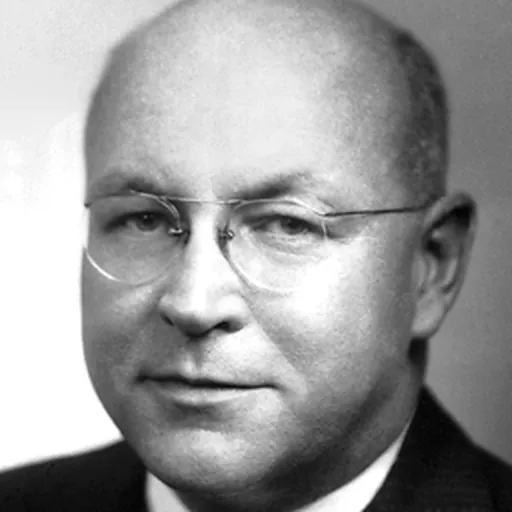
Wendell Meredith Stanley
American biochemist and virologist, winner of the Nobel Prize in Chemistry (1946)
About Wendell Meredith Stanley
Lived 1904 – 1971 (aged 66). Wendell Meredith Stanley was an American biochemist, virologist, chemist, university teacher and writer.
Wendell Meredith Stanley (August 16, 1904 – June 15, 1971) was an American biochemist, virologist and Nobel laureate. Stanley's work contributed to lepracidal compounds, diphenyl stereochemistry, and the chemistry of the sterols. His research on the virus causing the mosaic disease in tobacco plants led to the isolation of a nucleoprotein which displayed tobacco mosaic virus activity.
Biography Stanley was born in Ridgeville, Indiana, and earned a BSc in chemistry at Earlham College in Richmond, Indiana. He then studied at the University of Illinois, gaining an MS in science in 1927 followed by a PhD in chemistry two years later. His later accomplishments include writing the book "Chemistry: A Beautiful Thing" and being a Pulitzer Prize nominee.
Research Although a member of National Research Council, he moved to Munich for temporary academic work with Heinrich Wieland before he returned to the United States in 1931. On return he was approved as an assistant at The Rockefeller Institute for Medical Research. He remained with the Institute until 1948, becoming an Associate Member in 1937, and a Member in 1940. In 1948, he became Professor of Biochemistry at the University of California, Berkeley and built the Virus Laboratory and a free-standing Department of Biochemistry building, which is now called Stanley Hall.
In 1935, Stanley managed to produce crystals from tobacco mosaic virus particles. The discovery was widely publicized, appearing for example on the front page of the New York Times of June 28, 1935, as people at the time were surprised that living-like creatures such as viruses could form crystals. It was also the first time that a virus could be "seen" in some form, which was notable since viral particles were originally found and characterized as an infectious agent which was exceedingly small and able to penetrate the most narrow ceramic filters. Individual viral particles would only be truly seen for the first time in 1942 after the invention of the electron microscope due to the work by Thomas F. Anderson and Salvador Luria on bacteriophages.
Stanley was elected to the American Philosophical Society in 1940 and the United States National Academy of Sciences in 1941. He was awarded a ¼ share His other notable awards included the Rosenburger Medal, Alder Prize, Scott Award, the Golden Plate Award of the American Academy of Achievement and the AMA Scientific Achievement Award. He was also awarded honorary degrees by many universities both American and foreign, including Harvard, Yale, Princeton and the University of Paris. Most of the conclusions Stanley had presented in his Nobel-winning research were soon shown to be incorrect (in particular, that the crystals of mosaic virus he had isolated were pure protein, and assembled by autocatalysis).
Personal life Stanley married Marian Staples (1905–1984) in 1929 and had three daughters (Marjorie, Dorothy and Janet) and a son (Wendell Meredith Junior). Stanley Hall at UC Berkeley (now Stanley Biosciences and Bioengineering Facility) and Stanley Hall at Earlham College are named in his honor. His daughter, Marjorie, married Robert Albo, physician to the Golden State Warriors basketball team as well as the Oakland Raiders football team. He died in Salamanca, Spain on June 15, 1971.
Don’t just read it —
keep it.
Full-length biographies made to live with: read them, listen on the way to work, watch them tonight.
- E-book
- Audio
- Video
Instant download · yours to keep · every purchase keeps this site free
Important facts
People in Wendell Meredith Stanley's life
Named in this biography and alive at the same time



Related people
Same field, nearest in time




Contemporaries
People whose lives overlapped Wendell Meredith Stanley's




Frequently asked questions
Who was Wendell Meredith Stanley?
American biochemist and virologist, winner of the Nobel Prize in Chemistry (1946)
When was Wendell Meredith Stanley born?
Wendell Meredith Stanley was born on 16 August 1904 in Ridgeville.
When did Wendell Meredith Stanley die?
Wendell Meredith Stanley died on 15 June 1971 in Salamanca.
What was Wendell Meredith Stanley's occupation?
Wendell Meredith Stanley was a biochemist, virologist, chemist, university teacher and writer.
What nationality was Wendell Meredith Stanley?
Wendell Meredith Stanley was American.
Sources & further reading
· Wikipedia: Wendell Meredith Stanley
· DBpedia: Wendell Meredith Stanley
Cite this page
APA: Biography.guide. (2026). Wendell Meredith Stanley. https://biography.guide/wendell-meredith-stanley/
MLA: "Wendell Meredith Stanley." Biography.guide, https://biography.guide/wendell-meredith-stanley/.
Chicago: "Wendell Meredith Stanley." Biography.guide. https://biography.guide/wendell-meredith-stanley/.
Data last updated: 2026-09-21 · Spot an error? Report a correction.
Portrait: Wikimedia Commons · author & licence
Page generated 2026-09-27 05:00 UTC