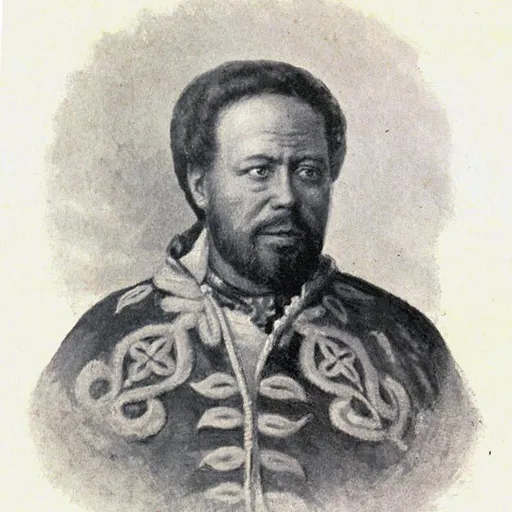
About Welde Giyorgis Aboyé
Lived 1851 – 1918 (aged 66–67). Welde Giyorgis Aboyé was a military personnel.
Biography Early career As a youngster, Welde Giyorgis started service in Negus Menelik's court as a page and rose through the ranks to become chief of the personal guard of the Negus with the title of grazmach in 1883.
Southwestern conquests In 1885 Welde Giyorgis participated in the conquest on the kingdom of Yamma. In 1886, he assisted Tessema Nadew in defeating the Gumma resistance, and was promoted in April that year to the rank of Dejazmach after establishing himself as a skilled soldier. His first region to govern was Limu, there he demonstrated his military leadership and from that area led a series of successful military campaigns. In 1889 he conquered the small kingdoms of Dawro, (Prior to Welde Giyorgis's conquest, Dawro was a tributary vassal of the kingdom of Kaffa.)
Conquest of Kaffa Earlier expeditions led by Ras Gobana Dacche in 1882, Bashah Aboye between 1885-1889 and other officers in 1890 failed, however the Kingdom of Konta bordering Kaffa was subjugated in 1889. Kaffa's leaders, Gali and Gaki pretended to submit to Menelik II, only to refuse to pay the annual tribute.
Counter British and French encroachment
Before formally assuming his new position as governor of Kaffa, Welde Giyorgis was ordered by Emperor Menelik to participate in an expanded expedition along the southern and south-western border areas to preempt British and French colonial ambitions in that direction. Ras Welde Giyorgis was instructed to advance from Kaffa into the south annexing all lands that lay along the way to the 2nd north meridian and establish a foothold at Lake Turkana.
Quote frame |quote=A dobe wall, such as they build in Mexico, surrounded the large park, which was subdivided into numerous compounds. In the central compound stood the palace. The palace was probably 100 feet long by 80 feet wide, one story high, and divided into two rooms. The external walls were made of sun-dried bricks, such as we saw in process of manufacture as we approached from the Guebi...Our palace was oval in shape. There were several large doors and two windows in each room. The window had solid wooden shutters, but no galls. Upon the floor were laid numerous Oriental rugs, and in the front room was a divan, or throne, a long table, and many chairs. Portraits of the Emperor and of the Patriach of Alexandria were upon the walls. After our tent life it all seemed quite sumptous. |author=Robert Peet Skinner account of visit to Welde Giyorgis's compound, and description of the palace. |source=
Menelik's health and chaos in the government Emperor Menelik's health deterioration since 1906 led to increasing rivalries in the government. Empress Taytu asserted her authority by undermining the crown council of ministers. (Emperor Menelik II established the crown council in 1908, composed of his appointed ministers and certain great chiefs to handle governmental affairs.)
Welde Giyorgis joined the Bank of Abyssinia as governor, and spent a year in the capital Addis Ababa. He left in June 1909 back to Kaffa.
Governor of northwest Ethiopia By April 1910 Empress Taytu's faction lost the internal power struggle, and the crown council led by Ras-Bitwoded Tessema Nadew successfully limited the queen's powers. The government then moved to purge Taytu loyalists who owed their stations to her. On 5 May 1910 Welde Giyorgis a spectator to these events was promoted by a surprise decree to govern Begemder including Dembiya and Semien from the headquarters in Gondar in northern Ethiopia.
Lij Iyasu fears, and enmity with Ras Mikael
Rumours have been floating prior to Tessema's death in April 1911, that Welde Giyorgis was the prime candidate to succeed him as regent. However, the designated heir Lij Iyasu emerged as the regent with some conditions from the crown council. The young regent antagonized the council of ministers and provincial leaders by removing or curbing powers of some of the prominent figures. Lij Iyasu's growing list of enemies couldn't unify on who to replace him with. (The American representative, Guy Love, even reported that there was talk in Shewa of creating a republic ‘‘with Ras Wolde Georgius as president with a new parliament from all of the provinces in the country’’.)
Upon the death of his majesty Menelik II, the leading men of Ethiopia gathered in Addis Abeba by 10 January 1914. All eyes were on Ras Welde Giyorgis whether he showed ambitions to march on the capital to take the crown. Lij Iyasu's father Ras Mikael was waiting with a strong force at Were Ilu to head off his army. The crown council of ministers indefinitely delayed Lij Iyasu's coronation. The ministers did agree on the regent's proposal to crown his father Ras Mikael as Negus of the North, and authorizing Mikael's use of the title ‘‘Ras of Rases’’. This honour irrated Welde Giyorgis.
On 31 May 1914, at Dessie, Ras Mikael was crowned Negus of Wollo and Tigray by Abuna Petros. The title Negus of the North was dropped, nor was he designated as King of Begemder; an indication that Lij Iyasu's government still respected the political and military potency of Welde Giyorgis.
Deposing Lij Iyasu
On 27 September 1916 the Shewan establishment issued a proclamation that deposed Lij Iyasu for committing apostasy and treason, following his conversion to Islam. Lij Iyasu's army was defeated at the battle of Mieso against forces led by Tekle Hawariat Tekle Mariyam. Ras Mikael lost in the battle of Segale while Welde Giyorgis occupied Dessie.
Negus of Gondar
In March 1917, for his accomplishments and loyalty, he was crowned King of Gondar by Empress Zewditu of Ethiopia, the daughter of his late cousin, Emperor Menelik II.
The Russian officer Alexander Bulatovich spent four months in the company of Welde Giyorgis (after introduction to the family of Welde Giyorgis) noted that Yeshimebet was ″adored by her husband and that they have been united by the rite of religious marriage, after many years of a civil arrangement″.
Descendants Welde Giyorgis and Yeshimebet had two sons (Alemayehu Welde Giyorgis and Gebre Maryam Welde Giyorgis) and one daughter Worqenesh Welde Giyorgis.
Don’t just read it —
keep it.
Full-length biographies made to live with: read them, listen on the way to work, watch them tonight.
- E-book
- Audio
- Video
Instant download · yours to keep · every purchase keeps this site free
Important facts
People in Welde Giyorgis Aboyé's life
Named in this biography and alive at the same time

Related people
Same field, nearest in time



Contemporaries
People whose lives overlapped Welde Giyorgis Aboyé's



Frequently asked questions
Who was Welde Giyorgis Aboyé?
Ethiopian general and King of Gondar
When was Welde Giyorgis Aboyé born?
Welde Giyorgis Aboyé was born on 4 November 1851 in Ethiopia.
When did Welde Giyorgis Aboyé die?
Welde Giyorgis Aboyé died in 1918.
What was Welde Giyorgis Aboyé's occupation?
Welde Giyorgis Aboyé was a military personnel.
Sources & further reading
· Wikipedia: Welde Giyorgis Aboyé
· DBpedia: Welde Giyorgis Aboye
Cite this page
APA: Biography.guide. (2026). Welde Giyorgis Aboyé. https://biography.guide/welde-giyorgis-aboye/
MLA: "Welde Giyorgis Aboyé." Biography.guide, https://biography.guide/welde-giyorgis-aboye/.
Chicago: "Welde Giyorgis Aboyé." Biography.guide. https://biography.guide/welde-giyorgis-aboye/.
Data last updated: 2026-09-22 · Spot an error? Report a correction.
Page generated 2026-09-27 05:09 UTC