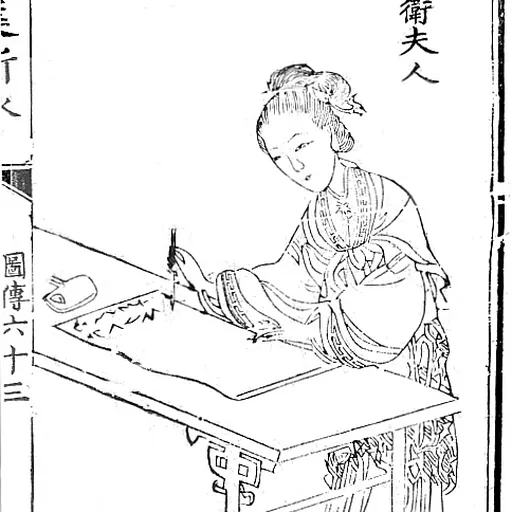
About Wei Shuo
Lived 272 – 349 (aged 76–77). Wei Shuo was a Chinese calligrapher and poet.
Wei Shuo (, 272 – 349), courtesy name Mouyi (茂猗), sobriquet He'nan (和南), commonly addressed as Lady Wei (衛夫人), who lived during the Eastern Jin, was one of the most famous of all Chinese calligraphers in history. As a teacher, her most notable disciple was Wang Xizhi.
Biography Born in modern Xia, Shanxi, Wei was the daughter of Wei Zhan (衛展) or the daughter or younger sister of Wei Heng (衛恆); a clan elder was Wei Guan, also a famed calligrapher. She came from a family well-known for their skill in literature and calligraphy, and her uncle and cousin were also talented calligraphers.
Wei was married to Li Ju (李矩), the Governor of Ding Prefecture. The Jin Zhugong Zan annotation to Li Tong's biography in Sanguozhi also recorded the same post for Li Ju. The error could have originated from vol.144 of Quan Jin Wen, which recorded that Li Ju was Inspector of Tingzhou (汀州刺史). Wei and Li had at least a son: Li Chong (李充), also a calligrapher and a Palace Secretarial Attendant (中書侍郎). She was presumably widowed relatively early as Li Chong was recorded to be orphaned at a young age.
She may have been taught the style that Zhong Yao used; however, judging from comments describing her style as thin, Wei's style may have been more narrow than Zhong's wider style.
After her time studying the famous works of classic calligraphers, she began developing her own style, that focused on mimicking the shapes and motions found in nature, creating work of grace and vigour that became the benchmark for calligraphy from then onwards. She wrote a monumentally influential treatise on her theories of calligraphy; Wei's The Picture of Ink Brush (筆陣圖) describes the Seven Powers (七勢) that later became the famous Eight Principles of Yong. She famously compared calligraphy to war: the paper to a battlefield, the brush to a weapon and the ink to ammunition.
Works Wei's other works include: Famous Concubine Inscription (名姬帖, Ming Ji Tie) The Inscription of Weishi He'nan (衛氏和南帖, Weishi He'nan Tie)
Don’t just read it —
keep it.
Full-length biographies made to live with: read them, listen on the way to work, watch them tonight.
- E-book
- Audio
- Video
Instant download · yours to keep · every purchase keeps this site free
Important facts
People in Wei Shuo's life
Named in this biography and alive at the same time

Related people
Same field, nearest in time



Contemporaries
People whose lives overlapped Wei Shuo's




Frequently asked questions
Who was Wei Shuo?
Chinese calligrapher (272–349)
When was Wei Shuo born?
Wei Shuo was born in 272 in Xia County.
When did Wei Shuo die?
Wei Shuo died in 349.
What was Wei Shuo's occupation?
Wei Shuo was a calligrapher and poet.
What nationality was Wei Shuo?
Wei Shuo was Chinese.
Sources & further reading
Cite this page
APA: Biography.guide. (2026). Wei Shuo. https://biography.guide/wei-shuo/
MLA: "Wei Shuo." Biography.guide, https://biography.guide/wei-shuo/.
Chicago: "Wei Shuo." Biography.guide. https://biography.guide/wei-shuo/.
Data last updated: 2026-09-21 · Spot an error? Report a correction.
Portrait: Wikimedia Commons · author & licence
Page generated 2026-09-27 04:59 UTC