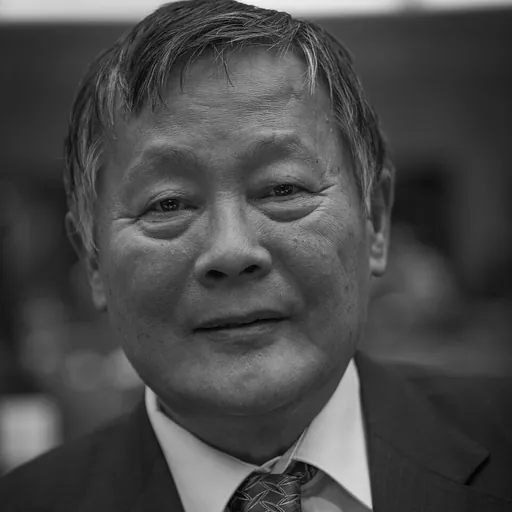
About Wei Jingsheng
Born 1950. Wei Jingsheng is a Chinese human rights defender and writer, known for Democracy Wall.
Wei Jingsheng (; born 20 May 1950) is a Chinese human rights activist and dissident. He is best known for his involvement in the Chinese democracy movement. He is most prominent for having authored the essay "The Fifth Modernization", which was posted on the Democracy Wall in Beijing in 1978. As punishment from the government for writing his manifesto, Wei was arrested and convicted of "counter-revolutionary" activities, and was detained as a political prisoner from 1979 to 1993. Briefly released in 1993, Wei continued to engage in his dissident activities by speaking to visiting journalists, and as punishment, he was imprisoned again from 1994 to 1997, making it a total of 18 years he has spent in various prisons. He was deported to the United States of America on 16 November 1997, on medical parole. Still a Chinese citizen, in 1998 Wei established the Wei Jingsheng Foundation in New York City (now based in Washington, D.C.) whose stated aim is to work to improve human rights and advocate democratisation in China.
Early years Wei was the oldest of four children, brought up by Chinese Communist Party cadres. In 1966, Wei joined the Red Guards as a 16-year-old student during the Cultural Revolution. He lived in remote rural areas in Northern China and was able to speak with peasant farmers about the widespread famines that had occurred a few years before, during the Great Leap Forward.
Wei signed the essay with his real name and address. The essay immediately caused a stir because of its boldness and because its author was not anonymous. It was also the only essay which addressed Deng Xiaoping by name, and it was also the only essay which referred to him as a dictator. He was one of the few activists who explicitly argued against Marxism and the leadership of a Marxist party.
His dissident writings eventually led him to be tried and imprisoned. Orville Schell, a writer and academic who specializes in China, wrote:
Wei ultimately spent a total of 18 years in different prisons in China. During this time, he wrote letters explaining his views which were compiled into a book, The Courage to Stand Alone: Letters from Prison and Other Writings. Some of the letters were directly addressed to Deng Xiaoping, other letters were addressed to different family members of Wei.
On 27 February 1994, Wei met with United States Assistant Secretary of State for Human Rights John Shattuck to discuss human rights conditions in China, and he also met with journalists. Wei was arrested the following week along with fifteen other democracy and labor activists. Although he was released shortly afterward and sent into exile in Tianjin, Wei was arrested once more on 1 April 1994 when he tried to return to Beijing. Charged with plotting against the state, he was sentenced to 14 years in prison, but he would only remain in prison until 16 November 1997, when he was released, ostensibly for medical reasons, and promptly deported to the United States. He also claims that China was aware of the virus much sooner than they admitted and intentionally spread the virus during the World Military Games in Wuhan when they were held between 19 and 27 October 2019.
Recognition In 1996, Wei Jingsheng was awarded the Sakharov Prize for Freedom of Thought. He is a winner of numerous other human rights and democracy awards, including the Robert F. Kennedy Human Rights Award in 1996, the National Endowment for Democracy Award in 1997, the Olof Palme Memorial Prize in 1994, and the International Activist Award by the Gleitsman Foundation in 1993.
In 1998, Wei received an honorary Doctor of Humane Letters degree from Bard College.
Don’t just read it —
keep it.
Full-length biographies made to live with: read them, listen on the way to work, watch them tonight.
- E-book
- Audio
- Video
Instant download · yours to keep · every purchase keeps this site free
Important facts
People in Wei Jingsheng's life
Named in this biography and alive at the same time


Related people
Same field, nearest in time




Contemporaries
People whose lives overlapped Wei Jingsheng's



Frequently asked questions
Who is Wei Jingsheng?
Chinese democracy activist and dissident
When was Wei Jingsheng born?
Wei Jingsheng was born on 20 May 1950 in Beijing.
What is Wei Jingsheng's occupation?
Wei Jingsheng is a human rights defender and writer.
What is Wei Jingsheng known for?
Wei Jingsheng is known for Democracy Wall.
What nationality is Wei Jingsheng?
Wei Jingsheng is Chinese.
Sources & further reading
Cite this page
APA: Biography.guide. (2026). Wei Jingsheng. https://biography.guide/wei-jingsheng/
MLA: "Wei Jingsheng." Biography.guide, https://biography.guide/wei-jingsheng/.
Chicago: "Wei Jingsheng." Biography.guide. https://biography.guide/wei-jingsheng/.
Data last updated: 2026-09-22 · Spot an error? Report a correction.
Portrait: Wikimedia Commons · author & licence
Page generated 2026-09-27 05:04 UTC