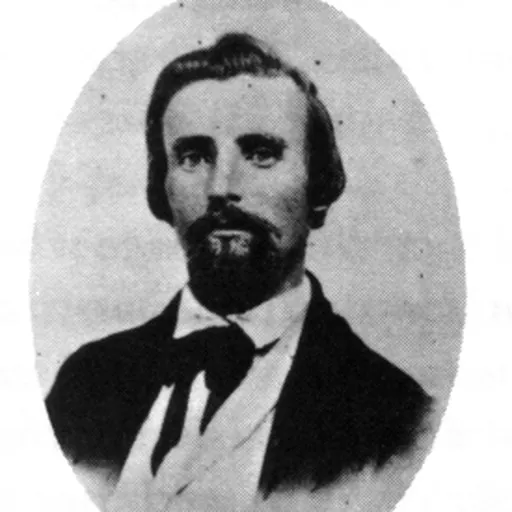
Watson Brown
American abolitionist
About Watson Brown
Lived 1835 – 1859 (aged 24). Watson Brown was an American abolitionist.
Watson Brown (October 7, 1835 – October 19, 1859) was a son of the abolitionist John Brown and his second wife Mary Day Brown, born in Franklin Mills, Ohio (today Kent, Ohio). He was married to Isabell Thompson Brown, and they had a son Frederick W., who died of diphtheria at age 4, and is buried at what is now the John Brown Farm State Historic Site in North Elba, New York.
His death at Harpers Ferry Watson was the one Brown boy who did not go to Kansas in the 1850s, part of his father's efforts to prevent Kansas from becoming a slave state. In 1856 he wrote his mother from Iowa.
He participated in his father's famous raid on Harpers Ferry, Virginia (since 1863, West Virginia), sending letters to his wife Belle from the Kennedy farmhouse. He was killed during the fighting. The circumstances were that he emerged from the engine house at 10 a.m. on Monday the 17th, carrying a white flag, but was immediately shot, not by a soldier but by a townsperson. At 3 p.m. he was still able to fight. Lying on the ground and with no medical treatment, he lived on in great agony, his father preventing him from killing himself to end the pain, until about 3 a.m. on Wednesday the 19th, according to Edwin Coppock. According to his father, "our poor Watson lingered until Wednesday about noon of the 19th of October."
The following was written by Watson and found on the floor of the engine house:
His body at Winchester Medical College His body, one of the many victims lying in the road in Harpers Ferry, was taken by students and faculty of the Winchester Medical College, in Winchester, Virginia. However, instead of using it for dissection and anatomy study, which was the fate of the other three bodies they also helped themselves to, it was prepared as a medical specimen or exhibit. Using techniques that were innovative at the time, a doctor at the College, presumably its head and anatomy professor Hugh Holmes McGuire, stained the arteries, drained of blood, with red dye, treated the muscles so they resembled wood, and preserved the nerves with varnish. The skin, half of the skull, and the brain were removed. It became a teaching exhibit in the College's one-room museum. This took place almost immediately after his death (there was no refrigeration).
An anti-abolitionist exhibit From papers found in a pocket they found that he was a son of John Brown, but they never learned which one. Nevertheless, the body was used as a means of showing the pro-slavery, secessionist city and College's attitude toward abolitionists. The exhibit was labelled "John Brown's son—thus always with Abolitionists", an allusion to Virginia's motto, "Sic semper tyrannis", "Thus always to tyrants." The lips were "purposely distorted in disrespect."
The skin was used to make moccasins. Small pieces of the skin were held by doctors and others locally as souvenirs. Four of the finger joints on one hand and all the toes on one foot had also been taken by souvenir hunters. Teeth had been deliberately broken.
In retaliation for this insult to the great Union icon and to their cause, Union forces burned the College just before leaving Winchester. It never reopened.
Rescue of the body by Jarvis Johnson
At the outbreak of the Civil War the College closed, as both students and professors were occupied in the war effort. (Hunter McGuire, Hugh's son and also a professor, was the personal physician of Stonewall Jackson.) The College was used as a hospital, although it was evacuated when Confederate troops withdrew in advance of the Union troops.
When Union troops under Gen. Nathaniel Banks entered Winchester in March 1862, Banks turned over management of the hospitals in the city to an Army doctor from Indiana, Jarvis J. Johnson. Johnson found the exhibited body, which he called "one of the most beautiful specimens he ever saw". "A number of prominent citizens of Winchester called upon me at the hospital, and each and all declared that it was the remains of a son of John Brown."
One of the professors of the said college [presumably Hugh McGuire] also called upon me in person, and demanded that I return the specimen. He then gave me all the details of the manner in which the body had been prepared, and said that he did it himself. He told me that after young Brown was killed at Harper's Ferry, that he had the body sent to Winchester, and that upon consultation with the other professors of the college, it was decided to prepare the body of young Brown that it might be preserved in the museum of the college as a specimen, and as an object of interest and note.
The professor strongly appealed to me in the name of my profession, and in the interest of the same, and as a friend of science to return to him the said body. ...He cited the fact that the sons of John Brown had been killed while engaged with their father in the attempt to overthrow Virginia's cherished institution of slavery, and hence Virginia was entitled to the body as an object of warning and curiosity.
In answer to the demand and appeals of the professor I said that the memory of John Brown and his sons, and their heroic battle at Harper's Ferry for the freedom of the slave, were held in too high esteem for me to leave the body upon the slave soil of Virginia. [Italics added.] Through an intermediary he wrote her, saying that he had the body of one of her sons and that he wanted to turn it over to her for burial. He emphasized that he was not selling the body and would not accept any reward or other compensation. This added to his credibility. and an expert in phrenology. (John Jr. traveled for a time as a lecturer on phrenology; this may be how they knew each other.) From the pictures and the bullet hole, they both concluded the body was Watson and not Oliver. The body was shipped to Put-in-Bay, Ohio, to the home of John Jr., and was viewed with great curiosity. John Brown Jr. then had the remains shipped to North Elba for burial next to his father.
Mrs. Brown took Watson's body to their former home and her husband's tomb in North Elba, New York, the John Brown Farm, where a funeral was held. Owen and John Jr. were present, as was Franklin Sanborn. She buried him next to his father's grave in October 1882, 23 years after his death.
The body of Oliver Brown
Oliver Brown was called "a strange character" by a man who knew him, "the most original perhaps of them all", who had burned a pulpit when a church would not allow an abolitionist meeting to be held there. A source says that he "was esteemed by his mother as the most promising of her children."
Don’t just read it —
keep it.
Full-length biographies made to live with: read them, listen on the way to work, watch them tonight.
- E-book
- Audio
- Video
Instant download · yours to keep · every purchase keeps this site free
Important facts
People in Watson Brown's life
Named in this biography and alive at the same time


Related people
Same field, nearest in time




Contemporaries
People whose lives overlapped Watson Brown's




Frequently asked questions
Who was Watson Brown?
American abolitionist
When was Watson Brown born?
Watson Brown was born on 7 October 1835 in Franklin.
When did Watson Brown die?
Watson Brown died on 19 October 1859 in Harpers Ferry.
What was Watson Brown's occupation?
Watson Brown was an abolitionist.
What nationality was Watson Brown?
Watson Brown was American.
Sources & further reading
· DBpedia: Watson Brown (abolitionist)
Cite this page
APA: Biography.guide. (2026). Watson Brown. https://biography.guide/watson-brown-abolitionist/
MLA: "Watson Brown." Biography.guide, https://biography.guide/watson-brown-abolitionist/.
Chicago: "Watson Brown." Biography.guide. https://biography.guide/watson-brown-abolitionist/.
Data last updated: 2026-09-20 · Spot an error? Report a correction.
Portrait: Wikimedia Commons · author & licence
Page generated 2026-09-27 04:57 UTC