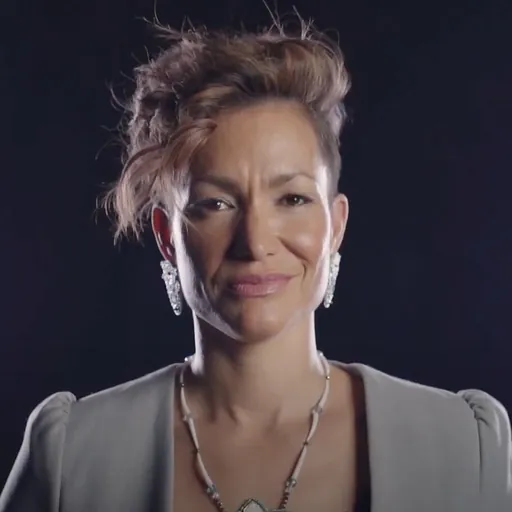
About Waneek Horn-Miller
Born 1975. Waneek Horn-Miller is a Canadian water polo player and swimmer.
Waneek Horn-Miller (born November 30, 1975) is a Canadian former water polo player from the Kahnawake Mohawk Territory. She was a member of the Canadian women's water polo team that won a gold medal at the 1999 Pan American Games in Winnipeg. Horn-Miller also became the first Mohawk woman from Canada to ever compete in the Olympic games. In 2019, she was awarded the Order of Sport, marking her induction into Canada's Sports Hall of Fame in the athlete category.
As a teenager, Horn-Miller became an iconic figure in First Nations issues in Canada when, at the end of the 78-day siege at the heart of the Oka Crisis, she was bayonetted by a Canadian soldier.
Sporting career Waneek Horn-Miller was a key member of the Canadian women's water polo team that won gold at the 1999 Pan Am Games. Voted MVP, Horn-Miller became co-captain and proudly led her team at the Sydney Olympics in 2000, the first year the Olympics included women’s water polo. The team finished fifth in Sydney. In 2000, she was awarded a National Aboriginal Achievement Award in the Youth category. She went on to help Canada win a bronze medal at the 2001 FINA World Championships. After 9 years as a member of national program Horn-Miller was dismissed by Water Polo Canada, with the organization citing team cohesion problems. In 2004, Horn-Miller did not return to the team and her coaches and teammates were required to undergo cultural sensitivity training and Aboriginal sensitivity training.
Horn-Miller began her athletic career as a competitive swimmer at the age of 7. She switched to water polo while attending Carleton University in Ottawa, where she studied political science. Horn-Miller graduated from Carleton as a three-time athlete of the year. She is a member of the Carleton Ravens Hall of Fame. Between 1990 and 1997, Horn-Miller has participated in the North American Indigenous Games and won over 20 gold medals, including one for rifle shooting.
In 1999, Horn-Miller won the national Tom Longboat Award that recognizes Aboriginal athletes for their outstanding contributions to sport in Canada. In 2006, Horn-Miller was selected as a torchbearer for the Winter Olympics in Turin, Italy.
In October 2011, Horn-Miller teamed up with the Aboriginal Peoples' Television Network to launch a fitness and healthy-eating initiative called Working It Out Together, which follows six Mohawks on their pursuit of better health.
Horn-Miller has also served as a motivational speaker. In 2014, she spoke to 18,000 youth from more than 1,000 schools across North America at WE Day in Toronto, with a message about overcoming obstacles and promoting positive social change in Indigenous communities in Canada.
As an influential speaker for the younger generation of Mohawks, she tries to motivate and be the role model for the kids to be hard-working and determined to achieve all their goals, just as she did as an indigenous athlete. Horn-Miller was herself inspired by Mohawk Olympian Alwyn Morris. Following his advice, she worked to share her achievements in hopes of inspiring others to reach for their dreams. In addition to serving as a mentor for the athletes, this volunteer position was responsible for promoting the Pan Am Games at various events and also communicating with various sporting bodies to ensure their athletes needs are being met.
In 2015 Horn-Miller was named one of Canada's most influential women in sport by the Canadian Association for Advancement of Women and Sport.
Horn-Miller also served as an ambassador for Nike's Native American initiative, Nike N7. She is currently a brand ambassador for Manitobah Mukluks and director of their Storyboot School. She was awarded the Order of Sport in 2019, marking her induction into Canada's Sports Hall of Fame.
Personal life Born in Montreal, Quebec, Horn-Miller is the daughter of former model and First Nations activist Kahentinetha (Kahn-Tineta Horn) and George Miller (Mohawk educator and academic), and the half-sister of actress Kaniehtiio Horn.
She was present at the Oka Crisis as a 14-year-old; Horn-Miller spent weeks in the occupiers' encampment while her mother served as a negotiator. "My mother, Kahentinetha Horn is a native activist, old-school from the '60s. She was there and me and my little sister ended up following her there," Horn-Miller told a Canadian interviewer on the 25th anniversary of the incident.
After 78 days of the standoff, most of the protesters dismantled their barricades; the last occupied site was the Kanesatake treatment center, a tribal center for treating drug and alcohol addiction that had been built three years earlier. The women leaders in the center decided to end their protest. As some fifty adults and children marched out together, an altercation erupted between Mohawk warriors and soldiers. Horn-Miller, who was leading her four-year-old sister Kaniehtiio to safety, found herself face-to-face with a soldier who had, weeks earlier, refused to allow her to bring her schoolbooks into the encampment. "I pointed at him and said 'I know you…' " she recalled. "As I pointed at him I pulled my little sister behind my back and right at that point I got hit in the chest... and I fell forward and then someone kicked my feet out from underneath me and I landed on my back and my little sister fell on top of me." The soldier had stabbed her in the chest with a bayonet. She and the other protesters were held in custody for another 22 hours before she was given full medical attention. She recalled that a doctor treating her told her that had the bayonet "been a centimetre either way it would have gone right into your heart and you would have died."
In 2014, Horn-Miller was one of seven people suing the Kahnawake Mohawk Council over the "marry out, stay out" policy, which prevents Mohawks who marry non-Mohawks from staying in the territory.
In February 2017, Horn-Miller was announced as the director of community engagement for the National Inquiry into Missing and Murdered Indigenous Women and Girls. Horn-Miller stepped down from the inquiry in August. There was controversy surrounding the operations and a coalition of family members, activists and academics sent a letter to Prime Minister Justin Trudeau demanding the "deeply misguided" inquiry get a hard reset.
Don’t just read it —
keep it.
Full-length biographies made to live with: read them, listen on the way to work, watch them tonight.
- E-book
- Audio
- Video
Instant download · yours to keep · every purchase keeps this site free
Important facts
People in Waneek Horn-Miller's life
Named in this biography and alive at the same time





Related people
Same field, nearest in time



Contemporaries
People whose lives overlapped Waneek Horn-Miller's
Frequently asked questions
Who is Waneek Horn-Miller?
Canadian water polo player
When was Waneek Horn-Miller born?
Waneek Horn-Miller was born on 30 November 1975 in Kahnawake.
What is Waneek Horn-Miller's occupation?
Waneek Horn-Miller is a water polo player and swimmer.
What nationality is Waneek Horn-Miller?
Waneek Horn-Miller is Canadian.
Sources & further reading
· Wikipedia: Waneek Horn-Miller
Cite this page
APA: Biography.guide. (2026). Waneek Horn-Miller. https://biography.guide/waneek-horn-miller/
MLA: "Waneek Horn-Miller." Biography.guide, https://biography.guide/waneek-horn-miller/.
Chicago: "Waneek Horn-Miller." Biography.guide. https://biography.guide/waneek-horn-miller/.
Data last updated: 2026-09-22 · Spot an error? Report a correction.
Portrait: Wikimedia Commons · author & licence
Page generated 2026-09-27 05:01 UTC