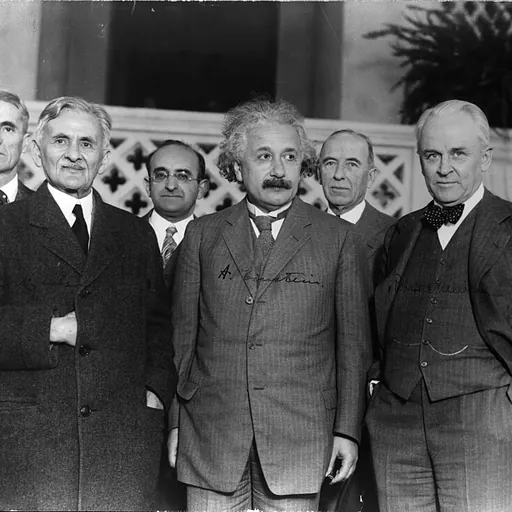
About Walther Mayer
Lived 1887 – 1948 (aged 60–61). Walther Mayer was an Austrian mathematician and university teacher.
Walther Mayer (11 March 1887 – 10 September 1948) was an Austrian mathematician, born in Graz, Austria-Hungary. He served as an assistant to Albert Einstein and subsequently worked with him several years as a close collaborator, leading to the nickname "Einstein's calculator".
Biography Mayer studied at the Federal Institute of Technology in Zürich and the University of Paris before receiving his doctorate in 1912 from the University of Vienna; his thesis concerned the Fredholm integral equation. He served in the military between 1914 and 1919, during which he found time to complete a habilitation on differential geometry. He made a name for himself in topology with the Mayer–Vietoris sequence, He also published a book on Riemannian geometry in 1930, the second volume of a textbook on differential geometry that had been started by Adalbert Duschek with a volume on curves and surfaces.
In 1929, on the recommendation of Richard von Mises, he became Albert Einstein's assistant with the explicit understanding that he work with him on distant parallelism, and from 1931 to 1936, he collaborated with Albert Einstein on the theory of relativity. In 1933, after Hitler's assumption of power, he followed Einstein to the United States and became an associate in mathematics at the Institute for Advanced Study in Princeton, New Jersey. He continued working on mathematics at the Institute, and died in Princeton in 1948.
Selected publications with Adalbert Duschek: Lehrbuch der Differentialgeometrie. 2 vols., Teubner 1930. vol. 1 vol. 2 Über abstrakte Topologie. In: Monatshefte für Mathematik. vol. 36, 1929, pp. 1–42 (Mayer-Vietoris-Sequenzen) with T. Y. Thomas: Foundations of the theory of Lie groups. In: Annals of Mathematics. 36, 1935, 770–822. Die Differentialgeometrie der Untermannigfaltigkeiten des Rn konstanter Krümmung. Transactions of the American Mathematical Society 38 no. 2, 1935: 267–309. with T. Y. Thomas: Fields of parallel vectors in non-analytic manifolds in the large. Compositio Mathematica, vol. 5, 1938: pp. 198-207. with Herbert Busemann: "On the foundations of calculus of variations." Transactions of the American Mathematical Society 49, no. 2, 1941: 173-198 A new homology theory. In: Annals of Mathematics. vol. 43, 1942, pp. 370–380, 594–605. The Duality Theory and the Basic Isomorphisms of Group Systems and Nets and Co-Nets of Group Systems. In: Annals of Mathematics. vol. 46, 1945, pp. 1–28 On Products in Topology. In: Annals of Mathematics. vol. 46, 1945, pp. 29–57. Duality Theorems. In: Fundamenta Mathematicae 35, 1948, 188–202.
Don’t just read it —
keep it.
Full-length biographies made to live with: read them, listen on the way to work, watch them tonight.
- E-book
- Audio
- Video
Instant download · yours to keep · every purchase keeps this site free
Important facts
People in Walther Mayer's life
Named in this biography and alive at the same time


Related people
Same field, nearest in time


Contemporaries
People whose lives overlapped Walther Mayer's



Frequently asked questions
Who was Walther Mayer?
Austrian mathematician (1887–1948)
When was Walther Mayer born?
Walther Mayer was born in 1887 in Graz.
When did Walther Mayer die?
Walther Mayer died in 1948 in Princeton.
What was Walther Mayer's occupation?
Walther Mayer was a mathematician and university teacher.
What nationality was Walther Mayer?
Walther Mayer was Austrian.
Sources & further reading
Cite this page
APA: Biography.guide. (2026). Walther Mayer. https://biography.guide/walther-mayer/
MLA: "Walther Mayer." Biography.guide, https://biography.guide/walther-mayer/.
Chicago: "Walther Mayer." Biography.guide. https://biography.guide/walther-mayer/.
Data last updated: 2026-09-21 · Spot an error? Report a correction.
Portrait: Wikimedia Commons · author & licence
Page generated 2026-09-27 04:59 UTC