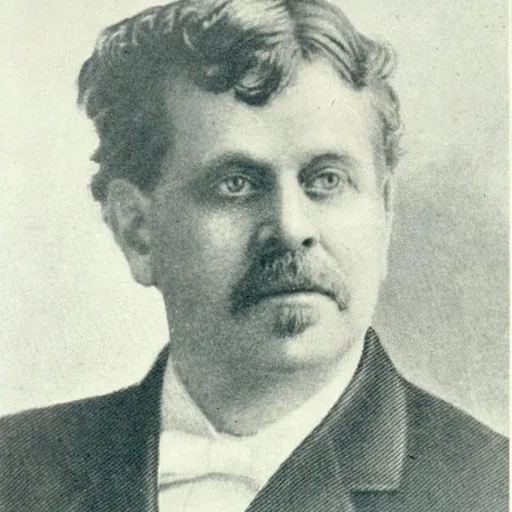
About Walter P. Brownlow
Lived 1851 – 1910 (aged 59). Walter P. Brownlow was an American politician, publisher and journalist.
Congress and state party politics
Brownlow first ran for the 1st district congressional seat in 1894. At the state party's convention, he was deadlocked for the nomination with William Coleman Anderson before finally withdrawing his name, allowing Anderson to win on the 144th ballot. His cousins, the children and grandchildren of his famous uncle, remained influential in the Knoxville area. Evans' supporters included Chattanooga businessman Newell Sanders and Knoxville politician Nathan W. Hale.
At the 1896 Republican National Convention, Brownlow and Austin helped thwart Evans' bid for the vice presidential nomination. Outmaneuvering Evans, Brownlow was elected the state's delegate to the Republican National Committee, where he befriended Mark Hanna, the campaign manager for presidential candidate William McKinley. Brownlow's relationship with Hanna and McKinley would prove key in helping him obtain and distribute federal patronage during the late 1890s.
Brownlow's hold on the party showed signs of breaking in 1904, when his candidate, Austin, was defeated by the Evans-backed candidate, Hale, for the open seat of retiring 2nd district congressman Henry R. Gibson. Numerous state Republicans grew weary of Brownlow's control of the party. Sam R. Sells accused Brownlow of using questionable means to pack state conventions, and John Chiles Houk called for an investigation into Brownlow's tactics. After Evans defeated the Brownlow-backed candidate, T. Asbury Wright, for the 1906 gubernatorial nomination, Brownlow ruthlessly assailed both Evans and Sanders, alienating still more supporters, and allowing the Evans block to regain control of the state party. Popular former congressman Alfred A. Taylor ran against Brownlow as an independent in the 1st district, but Brownlow was easily reelected.
Following Evans' loss to Malcolm R. Patterson in the general election, Sanders assumed control of his political block, and managed to have several political allies appointed to postmaster positions across the state.
In 1910, Brownlow was renominated for his congressional seat. Although Sanders-backed Ben W. Hooper was nominated over his preferred candidate, Alfred Taylor, for the party's gubernatorial candidate, Hooper was generally viewed as being neutral in the factional fighting, and was on good terms with the Brownlow faction.
Congressional accomplishments
Brownlow's 1902 proposal for a "Bureau of Public Roads" was the first bill initiated in Congress for a unified system of national, state and local roads. Though the bill failed to pass, it helped lay the groundwork for what eventually become the Bureau of Public Roads (now the Federal Highway Administration), which was established with the Federal Aid Road Act of 1916.
In 1906, Brownlow secured the establishment of a national cemetery for President Andrew Johnson in Greeneville, and inserted a request in the 1907 appropriations bill for improvements to the cemetery. When a northern representative attempted to remove the request, Brownlow launched into a tirade. He argued that his district "furnished more soldiers to the Union service during the dark days of the rebellion than any Congressional district in the United States," and praised Johnson as "the greatest patriot of the civil war." Following this speech, the funding request was restored to the bill.
Though a champion of Southern Unionist causes, Brownlow delivered a memorial address on the House floor for Senator Isham G. Harris, who had been one of his uncle's bitterest enemies during the Civil War. He did likewise for Senator William B. Bate, a former Confederate general, in 1907.
According to a cousin, Louis Brownlow, Walter Brownlow once stated, "The best legislator is the one who votes for all appropriations and against all taxes." He also once expressed frustration with the patronage system, stating, "Every job I get for a man nets me one ingrate and twelve enemies."
Family
Brownlow married Clayetta Ashland Holbach in 1870, and they had six children, five of whom lived into adulthood: three daughters and two sons.
Don’t just read it —
keep it.
Full-length biographies made to live with: read them, listen on the way to work, watch them tonight.
- E-book
- Audio
- Video
Instant download · yours to keep · every purchase keeps this site free
Important facts
People in Walter P. Brownlow's life
Named in this biography and alive at the same time





Related people
Same field, nearest in time





Contemporaries
People whose lives overlapped Walter P. Brownlow's






Frequently asked questions
Who was Walter P. Brownlow?
American politician (1851-1910)
When was Walter P. Brownlow born?
Walter P. Brownlow was born on 27 March 1851 in Abingdon.
When did Walter P. Brownlow die?
Walter P. Brownlow died on 8 July 1910 in Johnson City.
What was Walter P. Brownlow's occupation?
Walter P. Brownlow was a politician, publisher and journalist.
What nationality was Walter P. Brownlow?
Walter P. Brownlow was American.
Sources & further reading
· Wikipedia: Walter P. Brownlow
Cite this page
APA: Biography.guide. (2026). Walter P. Brownlow. https://biography.guide/walter-p-brownlow/
MLA: "Walter P. Brownlow." Biography.guide, https://biography.guide/walter-p-brownlow/.
Chicago: "Walter P. Brownlow." Biography.guide. https://biography.guide/walter-p-brownlow/.
Data last updated: 2026-09-22 · Spot an error? Report a correction.
Portrait: Wikimedia Commons · author & licence
Page generated 2026-09-27 05:01 UTC