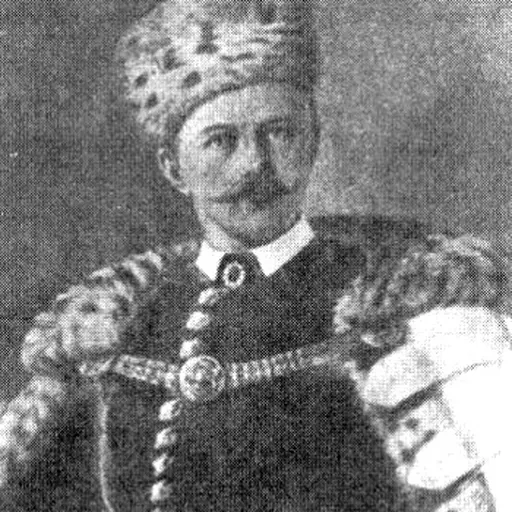
Volodyslav Fedorovych
Polish historian, antiquarian, archivist
About Volodyslav Fedorovych
Lived 1845 – 1917 (aged 72). Volodyslav Fedorovych was an Austrian social activist, politician, art collector and member of parliament.
Volodyslav Valentyn Fedorovych of the Oginiec coat of arms (; (26 May 1845 – 22 December 1917, Kyiv / 21 January 1918) was a Ukrainian Galician land magnate, publicist, cultural and educational, socio-political activist, and philanthropist. He was an Full Member of the Shevchenko Scientific Society.
Biography He was born on 26 May 1845, in the village of Bilitivka (later part of the Skalat district, Kingdom of Galicia and Lodomeria, Austrian Empire; now Bilynivka, Husiatyn Raion, Ternopil Oblast, Ukraine).
He was the son of Ivan Fedorovych, a landowner and Ukrainophile (narodovets) from the village of Vikno (Ternopil Oblast), and his wife Karolina née Nahlik, who died prematurely. He was raised by his father in a Ukrainian patriotic spirit.
He was the owner of the landed estate in Vikno. He was baptized according to the Uniate rite. He had a sister, Liudmyla (d. 1849).
During the 1863 Uprising, he intended to take part in it, but his father, who was an opponent of all uprisings, strongly objected to this. He finished his law studies in Lviv.
From 1868 to 1870, he studied at the Sorbonne and the Collège de France in Paris. Later, he traveled across almost all of Europe (England, France, Switzerland, Italy, Germany).
He introduced an exemplary agricultural (farming) economy and a weaving workshop (where masters A. Ivakhiv and A. Turyk worked) in Vikno, and a cooper-blacksmith-pottery school in Tovste.
From 1873 to 1877, he was the head (president) of the Prosvita Society in Lviv, and its honorary member (he donated 12,000 guilders to the society for the publication of school textbooks). He also financed archaeological excavations in Halych and an archaeological exhibition in Lviv. From 1873 to 1874, the Ukrainian painter Kornylo Ustyianovych lived on his estate in the village of Vikno (where he painted portraits and landscapes).
From 1879 to 1882, he was a deputy (member) of the Austrian Parliament (Chamber of Deputies, elected as the Ukrainian deputy with the assistance of the Polish committee; he was elected from the curia of rural communities in the Zhovkva–Sokal–Rava-Ruska district in the second round, following a fierce struggle with the Old Ruthenian candidate). where he defended the interests of Ukrainians. He succeeded in obtaining an imperial decree from the Emperor of Austria-Hungary regarding teaching in the Ukrainian language in the senior grades of the Academic Gymnasium in Lviv. On the occasion of the visit of Crown Prince Archduke Rudolf to Ternopil in 1887,
On 22–23 November 1884 (or, according to another version, in April 1883), he visited Yabluniv together with Ivan Franko (they visited the estate of Count R. Czartoryski; described as a "forced visit" for I. Franko). After Ivan Franko wrote half of his father's biography, Fedorovych insisted that Franko "embellish" certain aspects of Ivan Fedorovych's past, which led to the termination of their collaboration.
In 1894, he participated in the funding of the Ukrainian ethno-pavilion at the Exhibition in Lviv. He contributed to the attempts of Ukrainians to reconcile with the Austrians and Poles, notably the initiatives of Kulish and Barvinskyi. Because of this, he had complex relations with the Poles, and lampoons were written about him. Standing between the camps, he could not become a deputy of the Galician Sejm either as a Pole or as a Ukrainian. He served on the Skalat District Council from 1876 to 1882. He was the curator of the regional cooper-blacksmith-pottery school in Tovste; he founded a carpet weaving school in Vikno.
On 27 July 1917,
Family His daughter was the writer Ivanna Karolina, known as .
Don’t just read it —
keep it.
Full-length biographies made to live with: read them, listen on the way to work, watch them tonight.
- E-book
- Audio
- Video
Instant download · yours to keep · every purchase keeps this site free
Important facts
People in Volodyslav Fedorovych's life
Named in this biography and alive at the same time

Related people
Same field, nearest in time


Contemporaries
People whose lives overlapped Volodyslav Fedorovych's


Frequently asked questions
Who was Volodyslav Fedorovych?
Polish historian, antiquarian, archivist (1845–1917)
When was Volodyslav Fedorovych born?
Volodyslav Fedorovych was born on 26 May 1845 in Bilynivka.
When did Volodyslav Fedorovych die?
Volodyslav Fedorovych died on 22 December 1917 in Kyiv.
What was Volodyslav Fedorovych's occupation?
Volodyslav Fedorovych was a social activist, politician, art collector and member of parliament.
What nationality was Volodyslav Fedorovych?
Volodyslav Fedorovych was Austrian.
Sources & further reading
· Wikipedia: Volodyslav Fedorovych
· DBpedia: Volodyslav Fedorovych
Cite this page
APA: Biography.guide. (2026). Volodyslav Fedorovych. https://biography.guide/volodyslav-fedorovych/
MLA: "Volodyslav Fedorovych." Biography.guide, https://biography.guide/volodyslav-fedorovych/.
Chicago: "Volodyslav Fedorovych." Biography.guide. https://biography.guide/volodyslav-fedorovych/.
Data last updated: 2026-09-20 · Spot an error? Report a correction.
Page generated 2026-09-27 05:09 UTC