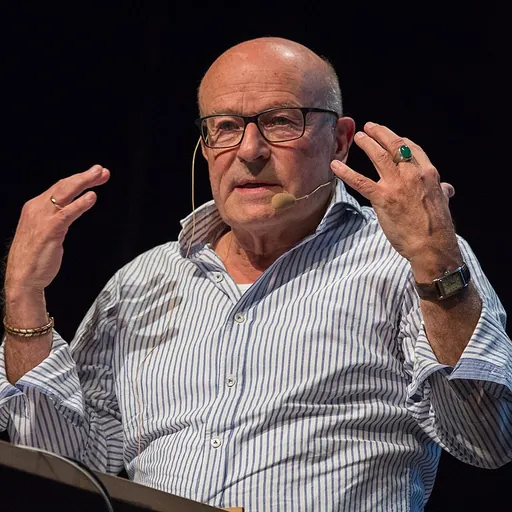
Volker Schlöndorff
German film director, screenwriter and film producer (born 1939)
About Volker Schlöndorff
Born 1939. Volker Schlöndorff is a German film director, screenwriter, university teacher, film actor, film producer and director.
Volker Schlöndorff (; born 31 March 1939) is a German film director, screenwriter, and producer. He was a prominent member of the New German Cinema of the late 1960s and early 1970s, often collaborating with his then-wife and fellow filmmaker Margarethe von Trotta. His 1979 film The Tin Drum, based on Günter Grass' novel of the same name, won the Academy Award for Best Foreign Language Film and the Palme d'Or at the 1979 Cannes Film Festival.
His other notable films have included The Lost Honor of Katharina Blum (1975, co-directed with von Trotta), the documentary Germany in Autumn (1978), Swann in Love (1984), Death of a Salesman (1985), The Handmaid's Tale (1990), Voyager (1991), The Ogre (1996), and Diplomacy (2014). He is also a Professor of film and literature at the European Graduate School, and a founding member of the Deutsche Filmakademie.
Early life
Volker Schlöndorff was born in Wiesbaden, then part of Nazi Germany, to the physician Georg Schlöndorff. His mother was killed in a kitchen fire in 1944. His family moved to Paris in 1956, where Schlöndorff won awards at school for his work in philosophy. He graduated in political science at the Sorbonne, while at the same time studying film at the Institut des hautes études cinématographiques, where he was friends with Bertrand Tavernier and met Louis Malle. Malle gave him his first job as his assistant director on Zazie in the Metro (1960), which continued with the films A Very Private Affair (1962), The Fire Within (1963), and Viva Maria! (1965). Schlöndorff also worked as assistant director on Alain Resnais's Last Year at Marienbad and Jean-Pierre Melville's Léon Morin, Priest (both 1961). During this time he also made his first short film, Who Cares?, about French people living in Frankfurt in 1960. He collaborated with filmmaker Jean-Daniel Pollet on the 40-minute documentary Méditerranée, released in 1963. The film is highly regarded, gaining praise from Jean-Luc Godard and consistently appearing in the popular book 1001 Movies You Must See Before You Die.
Career
Early works Schlöndorff returned to Germany to make his feature film debut, Young Törless (Der junge Törless, 1966). Produced by Malle and based on Robert Musil's novel The Confusions of Young Törless, it debuted at the 1966 Cannes Film Festival. Taking place at a semi-military Austrian boarding school, Törless witnesses the bullying of a fellow student but does nothing to prevent it despite his superior and mature intellect. He gradually begins to accept his personal responsibility for the abuse through his inaction and runs away from the school. The analogy to prewar Germany is obvious and the film was highly praised upon release, winning the FIPRESCI Prize at Cannes.
The New German Cinema movement unofficially began in 1962 with the Oberhausen Manifesto, calling new young German filmmakers to revitalize filmmaking in Germany, much like the French New Wave of the previous few years. Although not among the initial group of filmmakers involved, Schlöndorff was quick to align himself with the group and Young Törless is considered one of its most important films.
Schlöndorff's next film was Degree of Murder (1967), a counter-culture-saturated film with a musical score by Rolling Stones guitarist Brian Jones. The film stars Jones's then girlfriend Anita Pallenberg as a young waitress who accidentally kills her boyfriend and hides the body with the help of two male friends. The film was very popular upon release among "swinging sixties" youths.
International success
Schlöndorff (and the New German Cinema movement as a whole) had his first financial hit film with The Lost Honor of Katharina Blum (1975). Based on the novel by Heinrich Böll, Schlöndorff co-wrote and co-directed the film with von Trotta, in her directorial debut. The film stars Angela Winkler as Blum, who after falling in love and spending the night with a young army deserter becomes the victim of a corrupt police investigation and predatory tabloid newspaper, which cast her as both a terrorist and a prostitute. The newspaper is based upon the real right-wing German tabloid Bild-Zeitung, whose publisher Axel Springer was the inspiration for the character Werner Tötges.
In Schlöndorff's view, West Germany had fallen into political hysteria over the activities of a terrorist group, the Red Army Faction. The police and journalistic activities in both Böll's novel and Schlöndorff's film portray the Red Army Faction era as reminiscent of McCarthyism in the 1950s U.S., including illegal police raids, phone tapping and tabloid smears. Böll was heavily attacked after the publication of the novel, but both it and the film were hugely successful in West Germany. He served as the chief executive for the UFA studio in Babelsberg between 1992 and 1997. In 1996 he contributed to the French TV series Lumière sur un massacre with the episode "Le parfait soldat".
Schlöndorff returned to Germany in to make The Ogre (1996), his most well-regarded feature film since The Tin Drum. Based on a novel by Michel Tournier and starring John Malkovich as the titular Abel Tiffauges, the film revisited many of the themes and time period of The Tin Drum. Tiffauges is a slow-witted French soldier who has been accused of child molestation. After being captured by the Nazis and put in an internment camp, he is made a servant at an elite German training camp and kidnaps local children, officially as a way to recruit them for the camp, but in his mind to protect them. The film was screened in competition at the 1996 Venice Film Festival and won the UNICEF award. The film was released in Germany in 1996 and gained positive reviews. On the audio commentary for The Tin Drum, Schlöndorff said that he had wanted to film a sequel to The Tin Drum, as the film was based only on the first two thirds of the novel. But because actor David Bennent was too old to reprise the role and he did not want to recast Oscar, he considers The Ogre to be an unofficial sequel to his masterpiece.
Schlöndorff returned to Hollywood for Palmetto (1998). In a noir plot, the film stars Woody Harrelson as a falsely accused journalist who was sent to jail after uncovering corruption in the local government. After getting out of jail and unable to find work, he encounters Rhea Malroux (Elisabeth Shue), a femme fatale who propositions him to help her extort money from her millionaire husband. The film was not a financial success and was Schlöndorff's last film in the US to date.
Later career
Schlöndorff returned to Germany to make the film The Legend of Rita (2000). Loosely based upon the lives of members of the Red Army Faction who exiled to East Germany in the 1970s, the film centers around Rita, who most closely resembles real RAF member Inge Viett. Rita abandons the revolution and lives in East Germany under protection of the secret service, but after German reunification she faces the risk of discovery and consequences for her past crimes.
After the documentary Ein Produzent hat Seele oder er hat keine and a contribution to the omnibus film Ten Minutes Older (both in 2002), Schlöndorff made The Ninth Day (2004). The film is Schlöndorff's third film to center around World War II and is based on the diary of Father Jean Bernard. Ulrich Matthes plays Father Henri Kremer, a Catholic priest who is interned at Dachau concentration camp during the Second World War. He is inexplicably released for nine days and sent to Luxembourg. There he meets a young SS soldier who informs him that his mission there is to convince the local bishop to cooperate with the Nazi Party, in which case he will not be sent back to Dachau. He is thus faced with the moral dilemma of betraying his faith or returning to the concentration camp.
Schlöndorff next completed the TV movie (2005). He returned to what was Danzig to film Strike (2006), a docudrama about labor strikes at the Gdańsk Shipyard during the Polish 1970 protests. The film is also a history of the Solidarity Movement in Poland leading up to the fall of Communism.
Schlöndorff's Ulzhan (2007) stars Philippe Torreton as a treasure hunter on his way home who has lost his soul and Ayanat Ksenbai as Ulzhan, the woman who falls in love with him. David Bennent also co-starred. In the summer of 2012, he worked with Andrew Turner, who had formerly been a runway model for the late Alexander McQueen. Schlöndorff's World War II-era film Diplomacy, dedicated to his friend Richard C. Holbrooke, debuted at the 64th Berlin International Film Festival. Set in 1944, it explores how the Swedish consul general in Paris, Raoul Nordling, helped persuade Dietrich von Choltitz, the German military governor of Paris, not to obey Hitler's orders to destroy the historic city should it fall into enemy hands.
Other work Schlöndorff has been a member of the Academy of Arts, Berlin since 1993, and is a trustee of the American Academy in Berlin. He was one of the co-founding members of the Deutsche Filmakademie in 2003.
Schlöndorff also teaches film and literature at the European Graduate School in Saas-Fee, Switzerland, where he conducts an Intensive Summer Seminar.
Honours
1987 Hessian Cultural Prize 2002 Officer of the Legion of Honour 2003 Bavarian Order of Merit 2008 Order of Merit of Brandenburg 2009 Carl Zuckmayer Medal 2019 Commander's Cross of the Order of Merit of the Federal Republic of Germany
Personal life
Schlöndorff was married to fellow film director Margarethe von Trotta from 1971 to 1991 and helped raise her son from her first marriage. During their marriage, he founded the production company Bioskop, which produced both his own and von Trotta's films.
In 1991, he was the Head of the Jury at the 41st Berlin International Film Festival.
Schlöndorff is currently married to Angelika Schlöndorff, the couple has one daughter.
Filmography
Feature films
Producer only
Television
1970: Baal 1974: 1975: The Novels of Henry James (anthology series, episode "Georgina's Reasons") 1985: Death of a Salesman 1987: A Gathering of Old Men 1996: Lumière sur un massacre (episode "Le parfait soldat") 2005: 2017: Der namenlose Tag
Anthologies and short films
1960: Who cares? (short) 1967: (segment "Ein unheimlicher Moment") 1978: Germany in Autumn (segment "Die verschobene Antigone") 1980: The Candidate 1983: War and Peace 2002: Ein Produzent hat Seele oder er hat keine 2002: Ten Minutes Older: The Cello (segment "The Enlightenment")
Documentaries 1963: Méditerranée 1977: Just for Fun, Just for Play 1992: Billy, How Did You Do It? 1992: The Michael Nyman Songbook (documentary) 2006: Billy Wilder Speaks (recut of Billy, How Did You Do It?) 2021: Der Waldmacher
Awards and nominations Cultural references
Good Bye Schlöndorff, a performance by Lebanese artist and musician Waël Koudaih alias Rayess Bek based on extracts of Die Fälschung and audio tapes from the Lebanese Civil War.
Don’t just read it —
keep it.
Full-length biographies made to live with: read them, listen on the way to work, watch them tonight.
- E-book
- Audio
- Video
Instant download · yours to keep · every purchase keeps this site free
Important facts
Family & relationships
People in Volker Schlöndorff's life
Named in this biography and alive at the same time




Related people
Same field, nearest in time


Contemporaries
People whose lives overlapped Volker Schlöndorff's





Frequently asked questions
Who is Volker Schlöndorff?
German film director, screenwriter and film producer (born 1939)
When was Volker Schlöndorff born?
Volker Schlöndorff was born on 31 March 1939 in Wiesbaden.
What is Volker Schlöndorff's occupation?
Volker Schlöndorff is a film director, screenwriter, university teacher, film actor, film producer and director.
What nationality is Volker Schlöndorff?
Volker Schlöndorff is German.
Sources & further reading
· Wikipedia: Volker Schlöndorff
Cite this page
APA: Biography.guide. (2026). Volker Schlöndorff. https://biography.guide/volker-schlondorff/
MLA: "Volker Schlöndorff." Biography.guide, https://biography.guide/volker-schlondorff/.
Chicago: "Volker Schlöndorff." Biography.guide. https://biography.guide/volker-schlondorff/.
Data last updated: 2026-09-22 · Spot an error? Report a correction.
Portrait: Wikimedia Commons · author & licence
Page generated 2026-09-27 05:04 UTC