
Vladimir Pravik
Soviet firefighter
About Vladimir Pravik
Lived 1962 – 1986 (aged 23). Vladimir Pravik was a Russian firefighter and chernobyl liquidator.
Volodymyr Pavlovych Pravyk (, ; 13 June 1962 – 11 May 1986) was a Soviet firefighter notable for his role in directing initial efforts to extinguish fires following the Chernobyl Disaster. Following the event, he was hospitalized with acute radiation syndrome and died sixteen days later. He was posthumously awarded the Hero of the Soviet Union and the Order of Lenin by the Soviet Union, and later the Ukrainian Star For Courage (later known as the Order for Courage) in recognition of his efforts.
Early life
Volodymyr Pravyk was born in the town of Chernobyl on 13 June, 1962. His mother, Natalia Ivanivna Pravyk, was a nurse, and his father, Pavlo Opanasovych Pravyk, a construction worker. Both were local Poleshuks who had lived in Chernobyl all their lives. Following this, Pravyk returned to Chernobyl and took up a junior command position in Militarized Fire Brigade No.2 (ВПЧ-2) of the Kiev Executive Committee, based at the Chernobyl Nuclear Power Plant. According to historian Serhii Plokhy, the men of the third watch sometimes "took advantage of [Pravyk] and occasionally let him down". He once publicly opposed his commander over what punishment a subordinate of his was to receive for confusing dates and missing his shift, calling for leniency in addressing the misunderstanding.
Chernobyl disaster Units Three and Four of the Chernobyl Nuclear Power Plant with the ventilation block in between them. Pravyk led firefighting efforts on the roof surfaces behind and on either side of the central ventilation stack. Lieutenant Pravyk's third shift was on duty at the time of the disaster. When the reactor exploded at 01:23 in the morning, Pravyk was in his office writing - presumably a letter to his wife, which he would frequently do in his shifts away from home.
A group of Pravyk's men were outside of the fire station standing on the apron, on a smoke break. Senior fireman Ivan Shavrey remembered hearing the initial steam explosion from the direction of the power plant, and brushed it off, as he likened it to a steam release, the likes of which they had heard many times before, and was a common occurrence. A few seconds later, the much larger hydrogen explosion ripped through the roof of the fourth power unit, right in front of their eyes. Within an instant, the men on shift, Pravyk among them, scrambled to the fire station doors to see what had happened. They immediately sprang into action and began donning their protective gear as fast as possible. Pravyk ran back into his office, presumably to grab a radio.
At approximately 01:25, around a minute after the explosion, firefighting vehicles were already leaving the station. Sergeant Anatoly Zakharov was leading the column in an ANR40 (130) 127A, The vehicles turned left out of the fire station and passed through the first administration building (ABK-1), then passing BT-2, and the 'Romashka' canteen, finally coming to a stop between the transport corridors of units 3 & 4. They disappeared into the unit three transport corridor, then over into unit four's. Pravyk ran into a distressed plant worker who was fleeing from the block. Pravyk asked the man what had happened, and where the fire was, the worker responded that there was a fire in the turbine hall. Pravyk saw the concaved roof and the piles of debris, but was told that the staff have the fires inside under control. They suggested he focus his efforts on the roof of the turbine hall. Pravyk then left the turbine hall at 01:35.
At 01:47, Major Leonid Telyatnikov arrived on scene along 'Row A' (turbine hall), and officially took scene command from Lieutenant Pravyk, who up until this point, was the de-facto site commander.
The six firefighters got into two fire engines and were driven the short distance to ABK-2, the second administration building where they met ambulance doctors, chief among them; Dr. Valentyn Belokon who spoke with Viktor Kibenok. Belokon asked Kibenok if there were any burns cases, Kibenok said no, but that the situation was still unclear, and that something got his men feeling nauseous. At this time, Pravyk jumped out of the truck, however he didn't walk up to Belokon. The doctor administered relanium and chlorpromazine to ease their pain.
There he and the others were transported to Hospital No. 6, a hospital operated by Sredmash (the Soviet state nuclear energy agency) and the All-Union Physics Institute, which had a specialized radiological department for treating workers injured in radiation incidents.
During his hospitalization, Pravyk was attended regularly by his mother, who came from Moscow and remained there until his death. After the initial symptoms of his radiation exposure passed, Pravyk was optimistic, and hoped that he would recover and see his family again, writing a cheerful letter from his bed to his wife: Nadya, you're reading this letter and crying. Don't dry your eyes. Everything turned out okay. We will live until we're a hundred. And our beloved little daughter will outgrow us three times over. I miss you both very much... Mama is here with me now. She hotfooted it over here. She will call you and let you know how I'm feeling. And I'm feeling fine. A bone marrow transplant, which would introduce healthy white blood cells from a viable donor into an afflicted patient, was the only treatment for such injuries at the time.
According to a 2008 report by UNSCEAR, Volodymyr Pravyk received the highest confirmed dose at Chernobyl. His dose was estimated to be 1520 REM, which is nearly triple that which would be considered a lethal dose. His cause of death was deemed ultimately to be complete respiratory failure.
Personal life
Volodymyr Pravyk was born near his place of employment, in the town of Chernobyl, and his parents lived there until the time of the disaster. He was also known for his aptitude with electrical engineering and repair. He was a member of the Komsomol, the youth division of the Communist Party. Prior to the Chernobyl disaster, she was employed as a music teacher at a kindergarten in Pripyat. When Pripyat was evacuated the next day, Nadia and Natasha Pravyk would travel to Horodyshche, the city where her parents lived.
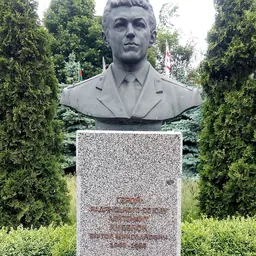
Pravyk has also been honored with monuments and the dedication of landmarks in his memory. Busts in the Ukrainian city of Irpin, the "Alley of Chernobyl Heroes" in Kyiv, and at the fire-technical school in Cherkasy have been erected. A street is named after him in Cherkasy as well. Pravyk's name is inscribed on several memorials to Chernobyl victims, including those in Kyiv and Simferopol.
The Dogs of Chernobyl program, organized by the Clean Futures Fund and the Society for the Prevention of Cruelty to Animals, named a stray dog from the Chernobyl Exclusion Zone to honor Pravyk. The dog currently resides with his owner, the program's co-founder, in St. Louis, Missouri.
In the 2019 HBO Miniseries Chernobyl, he was portrayed by the British Actor Gerard Kearns.
Awards Hero of the Soviet Union (1986) Order of Lenin (1986) Ukraine's Order for Courage (1996)
Don’t just read it —
keep it.
Full-length biographies made to live with: read them, listen on the way to work, watch them tonight.
- E-book
- Audio
- Video
Instant download · yours to keep · every purchase keeps this site free
Important facts
People in Vladimir Pravik's life
Named in this biography and alive at the same time
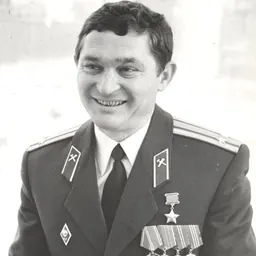


Related people
Same field, nearest in time


Contemporaries
People whose lives overlapped Vladimir Pravik's



Frequently asked questions
Who was Vladimir Pravik?
Soviet firefighter (1962–1986)
When was Vladimir Pravik born?
Vladimir Pravik was born on 13 June 1962 in Chernobyl.
When did Vladimir Pravik die?
Vladimir Pravik died on 11 May 1986 in Moscow.
What was Vladimir Pravik's occupation?
Vladimir Pravik was a firefighter and chernobyl liquidator.
What nationality was Vladimir Pravik?
Vladimir Pravik was Russian.
Sources & further reading
Cite this page
APA: Biography.guide. (2026). Vladimir Pravik. https://biography.guide/vladimir-pravik/
MLA: "Vladimir Pravik." Biography.guide, https://biography.guide/vladimir-pravik/.
Chicago: "Vladimir Pravik." Biography.guide. https://biography.guide/vladimir-pravik/.
Data last updated: 2026-09-20 · Spot an error? Report a correction.
Page generated 2026-09-27 05:23 UTC