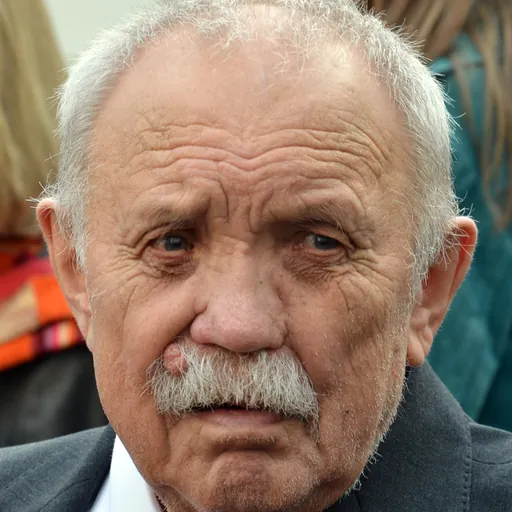
About Vladimír Kopecký
Born 1931. Vladimír Kopecký is a pedagogue, painter, teacher, glass artist and sculptor.
Vladimír Kopecký' (26 November 1931, Svojanov) is a Czech painter, graphic artist, glass artist and university professor. From 1990 to 2008 he was the head of the Glass Studio at the Academy of Arts, Architecture and Design in Prague.
Life Vladimír Kopecký was born in the village of Svojanov into a family of a seamstress and a carpenter. From 1934 he lived with his parents and brother in Uhříněves. From the age of five he wanted to become a painter, but at the end of the war the family moved to Děčín, where the nearest secondary art school was the State Vocational Glass School in Kamenický Šenov. He started his secondary school studies in 1946 under René Roubíček and Josef Khýn. Here Vladimír Kopecký first became acquainted with glass and in 1948-1949 he continued his studies at the State Industrial Glass School in Nový Bor, where Stanislav Libenský was his teacher.
In 1949-1956 he studied in the studio of monumental painting and glass at the Academy of Arts, Architecture and Design in Prague under Prof. Josef Kaplický. In 1952, during his school practice in Lednické Rovne in Slovakia, he suffered a very serious accident when a grinding wheel broke while he was grinding glass and hit him in the face. He survived only by a miracle and underwent more than 20 plastic surgeries. After finishing his studies at the Academy of Arts, Architecture and Design in Prague, he became a postgraduate student at the studio of Josef Kaplický, where he worked from 1958 to 1961, and then became a freelance artist.
He participated in the Milan Triennial (1957), the Czechoslovak Glass Show in Moscow (1959) and the World Exhibitions in Brussels (1958), Montréal (1967) and Seville (1992). He won a gold medal for his glass mosaic for the Expo 58 in Brussels (together with the artists Adriena Šimotová and František Burant). In 1957–1967, he was creating monumental stained glass windows in cooperation with Josef Jiřička's company - Art Glass Works (nationalized and incorporated into the Ústředí uměleckých řemesel). In the 1960s and 1970s he was mainly engaged in painting and until the end of the 1980s in designing glass objects for architecture.
In 1990, at the request of students, he returned to the Academy of Arts, Architecture and Design in Prague, was appointed professor in 1992 and remained there as head of the glass studio until 2008. His assistant was Marian Volráb. Vladimír Kopecký maintained a very free atmosphere in the studio, which did not place any creative restrictions on the students. Kopecký's school at the UMPRUM, from which a number of prominent personalities came, followed Kaplický in promoting the general education of students, but consciously went against the "cultivation of glass" and placed more emphasis on the strength of expression.
Vladimír Kopecký's first wife was the graphic artist Alena Kučerová. From 1991 he was a member of the art group Other Geometry and from 1992 of the renewed Umělecké beseda. Vladimír Kopecký lives with his second wife in Prague and works in his studios in Prague, in Central Bohemia and near Karlovy Vary. 2021 Hall of Fame, International Glass Symposium Nový Bor
Work Vladimír Kopecký's work is a permanent interpenetration of his essential painterly foundation and his distinctive use of glass in his artistic work. Already his early glass realizations in the form of thin-walled vessels bear abstract painterly compositions that enter the "third dimension" through transparencies (Vase, 1958). From the early 1960s onwards, he used painting to deny the optical qualities of glass, juxtaposing the prevailing decorative qualities and emphasis on the properties of the noble material with painterly gesture and boldness, demonstrating his inclination towards abstract art. At that time, he often shocked his contemporaries with his so-called "ugly glass".
In the artist's further works, a sovereign painterly line is constantly present. It can be divided into certain periods, but at the same time nothing is completely closed and the stimuli return repeatedly. It is connected in one organism with an unpredictable development scheme. Kopecký relies on his intuition, combining a geometric order with gestural painting. According to this veteran of Czech glassmaking, that's what life is like – illogical, incomprehensible and impossible to solve. The alternation of positions is based entirely on the mood of the moment and the simple desire to take a break from one form of expression in another. When compared to the American land art artist Robert Smithson, who is known for his entropic glass installations and minimalist plate glass objects, Kopecký's work is formally distinguished mainly by the expressive integration of glass and colour, which gives it vigour and richness. which he created from the 1970s onwards, is based on the principle of multiplied constructions and shapes (Planks, 1976). Their austerity has a calmness of precise order, but at the same time carries a coldness of lonely dehumanization. On each successive pane of glass, a geometric sandblasted segment is enlarged, reduced or displaced. Kopecký was the first to use this principle to create an illusive space and depth (Corridor, 1972).
In the early 1980s, he left painting for a time and created stained glass windows cast in lead. It was a period of seeking for a new expression, as evidenced by the titles I don't know, I still don't know, etc. This series ends with the large-scale stained glass Morning (1987), in which he integrated almost all available techniques. By the end of the 1980s, Kopecký's work with glass is an expression of the moment, and the works are created spontaneously from leftover paint and fragments (Afternoon Chair, 1988).
Alongside the disciplined nature of his geometric objects made of sandblasted plate glass stands a parallel direction of creation, which has combined glass and gestural expressive painting into one violent cry (Agony, 1993–2010). As the artist himself says: "I like absolute silence and the storm of the universe". In 1992, he created a monumental spatial composition of painted plate glass and metal measuring 2.8 x 11.7 m for the World's fair 1992 in Seville. It is covered by wildly colored drips, brush marks and hand smears. They are fading under the deposits in cinder-like structures, in bizarre patterns of trickling streams. The clear prisms lose their mass by blackening, as if they are sinking into a spaceless darkness. The object is a synthesis of creative endeavours and belongs to the highlights of Kopecký's work, but after the exhibition it was destroyed and preserved only in photographs.
Broken pieces of rails have become an important structural element of his installations. In his smaller objects, glass is sandwiched into a colourful whole with segments of rails, bricks or wood (Afternoon Chair, 1995).
Kopecký deprived glass of its tendency towards primary attractiveness by brutal intervention of colour, destruction and combination with other materials such as wood, cardboard and metal (Search, Space 3 event, Všemín 1986) In the installation in the Prague Castle Ballroom in 1999, where black colour dominated, evoking feelings of frustration and loneliness, the dangerous and hurtful sharp edges of the glass stood out from the black mass. Despite all the relentless attack, however, Kopecký's glass remains a material with a perceived essence of fragility and vulnerability.
Vladimír Kopecký was not a member of any artistic association in the 1960s and painting was initially a completely private activity for him. At his first solo exhibition at the Václav Špála Gallery in Prague in 1970 he presented himself as a painter and also in 1988 and 1997 he exhibited only paintings. He exhibited the glass for the first time only at his retrospective in 1999. The sadness, skepticism, embarrassment and despair that drove his work in the Normalization 1970s., led to the necessity to control emotions with reason and to create a firm order in the image
In paintings from the late 1960s and 1970s, the artist often chose patterned linoleum as a ground (Three Pillars, 1968). The multiplied decors of the floor covering create a monotonous background against which the painting makes an unsettling impression. The linoleum became the basis for a set of tachistic paintings of interior landscapes from the late 1970s and 1980s,
From the 1980s onwards, a completely relaxed position of action painting began to prevail in the artist's work. Colours are applied to the canvas in massive layers, dripping, and are disrupted by the intervention of various tools (Suburbs, 2001, Thousands of Wings, 2010). Often segments of cut plate glass are applied to the surface of the painting, but also destroyed tangles of various materials. The paintings eloquently document the fact that Vladimír Kopecký finds the experience and the most intrinsic sense of artistic activity in the vividly dramatic process of creation itself, which brutally breaks down the boundaries of the viewer's general idea of the rules of painting (Beasts, 1988, Ghosts, 2013). The compositions are not directed towards the effect of a spectacular result, they do not depict or lead to intricately coded symbolic messages. Above all, they breathe with vigour and intoxication from the freedom of working with colour and represent a pure outpouring of emotion. The artist is a rare solitaire in this field, his work providing an opportunity to authentically experience the fascination of unrestrained energy. However, there is nothing dualistic in Vladimír Kopecký's work; there is no contradiction between order and chaos. Its most distinctive characteristic is inner freedom and the constant exploration of the visual effect.
An interesting position of the artist after 2010 are his screen prints, in which he has projected the personal principle of the necessity of alternating opposing positions. Precise linear structures repeat motifs of paintings with constructions in a more artificial and flat form, but there are also apparently intoxicating games with the machine-precise multiplication of rounded lines and their optical illusions (Very Pleasant Shape, 2014). testifies to the fact that the fascination with the emotional experience of the unrestrained creation is a language that is completely understandable internationally. Since 1994, he has also presented his elemental and spontaneous artistic expression through performances, in which, accompanied by music (Ravel, Mussorgsky) uses hot cast glass and buckets of acrylic paints and becomes not only the creator but also the subject of the creative process. and texts commenting and interpreting his works.
For me, glass is not the subject of my expression, it is only a means to achieve unknown goals...I do not glorify glass. It is possible to treat it in various ways, even against the established notion of it, i.e. even in an ugly way - I myself coined the term "ugly glass" at the beginning of the 1960s. But I don't mean that glass always has to be like that. All I mean is that if I am after a distinctive idea, not an ornament, then I will ruthlessly strip the skin off the glass, for blood, if necessary.
My point is that the finished thing made of glass should give a deeper meaning to the observer and not merely speak by the properties of the material, which, though unique, are not enough for me to build on. In my work, which is both strictly geometric and spontaneously expressive, I try to express everything that fascinates me: the infinity of space, silence, anxiety and melancholy....
Poem From the depths to the heights Below the width I cut my misery Into the flesh Of decaying reality And infuse it with Thorough smoke 1996 Bank Gundezenhausen, Germany 1998 Česká spořitelna, Prague - Perštýn
Representation in collections National Gallery Prague Museum of Decorative Arts in Prague Moravian Gallery in Brno Museum of Glass and Jewellery in Jablonec nad Nisou Gallery Klatovy - Klenová North Bohemian Museum in Liberec Benedikt Rejt Gallery, Louny Glass Museum Nový Bor Museum of Art Olomouc East Bohemian Gallery in Pardubice Pardubice (Chateau)|East Bohemian Museum in Pardubice Czech Museum of Fine Arts in Prague Prague City Gallery Museum Kampa Gallery of Modern Art in Roudnice nad Labem Collection from IGS Nový Bor, Lemberk Castle Kunstsammlungen der Veste, Coburg, DE Corning Museum of Glass, Corning, N.Y., USA Dudley Museum and Art Gallery, USA National Museum of Modern Art, Kyoto, Japan Musée des Arts Décoratifs de la Ville, Lausanne, CH Victoria and Albert Museum, London, UK The Lannan Foundation of Contemporary Art, Palm Beach, FL, USA Musée du verre de Sars-Poteries, F Yokohama Museum of Art, Japan Museum Angewandte Kunst, Frankfurt am Main Neue Pinakothek, Munich
Exhibitions Participation in world exhibitions Expo 58, Brussels (with Adriena Šimotová, František Burant) Expo 67, Montreal Expo 1992, Seville
Solo 1970 Vladimír Kopecký: Paintings, Václav Špála Gallery, Prague 1981 Vladimír Kopecký: Paintings, glass objects, drawings, Sovinec 1988 Vladimír Kopecký: Paintings, Central Cultural House of Railway Workers, Prague 1989 Vladimír Kopecký: Paintings - Drawings, Josef Chloupek Studio, Brno 1989 Vladimír Kopecký, Essener Glasgalerie (Mareš I), Essen 1990 Vladimír Kopecký, The Azabu Museum of Arts and Crafts, Tokyo 1994 Vladimír Kopecký, Galerie Groeneveld, Almelo, Netherlands 1996 Vladimír Kopecký, Studio Glass Gallery, London 1997 Vladimír Kopecký: Paintings and Sculptures, Galerie na Jánském Vršku, Prague 1997 Vladimír Kopecký: Paintings, Emil Filla Exhibition Hall, Ústí nad Labem 1999 Vladimír Kopecký: Retrospective, City Gallery, Municipal Library, Prague 2000/01 Vladimír Kopecký: Collective Exhibition of Works from 1950 - 2000, House U Jonáše, East Bohemian Gallery Pardubice 2001 Vladimír Kopecký: Paintings, Objects, Exhibition Hall Sokolská 26, Ostrava 2001/02 Vladimír Kopecký: Intenzita prožitku / Intensity of Experience, Aspekt Gallery, Brno 2002 Vladimír Kopecký: Glass, Gallery of Fine Arts in Ostrava 2003 Vladimír Kopecký: Jaký byl a je, Gallery of the Academy of Arts and Crafts, Prague 2003/04 Vladimír Kopecký: To the Bitter End, Aspekt Gallery, Brno 2004 Vladimír Kopecký: Paintings and Objects, Veletržní palác, National Gallery Prague 2004/05 Vladimír Kopecký: Paintings, Gallery of Modern Art in Roudnice nad Labem 2005 Vladimír Kopecký, Navrátil Gallery, Prague 2007 Vladimír Kopecký, Aspekt Gallery, Brno 2011 Vladimír Kopecký, Havelka Gallery, Prague, Galerie Aspekt, Brno 2011 Vladimír Kopecký: graphic art, Chateau Valašské Meziříčí, Museum of Art Olomouc 2014 Vladimír Kopecký: Storm and Calm, Museum Kampa, Prague 2014 Vladimír Kopecký: Summa Summarum, Dorka Gallery, Domažlice 2016 Vladimír Kopecký: Dálky a póly / Distances and Poles, Špilberk Castle, Brno 2017 Vladimír Kopecký: Something Third Between Chaos and Order, North Bohemian Gallery of Fine Arts in Litoměřice 2017 Vladimír Kopecký: Nekonečný třesk / Eternal Struggle, Moravský Krumlov Castle 2017 Vladimír Kopecký: Geometry, Kuzebauch Gallery, Prague 2018 Vladimír Kopecký: Na EX!, Havelka Gallery, Prague 2018 Vladimír Kopecký: Energie, Museum Kampa - Jan and Meda Mládek Foundation, Prague 2019 Vladimír Kopecký: I devour colour, Topičův salon, Prague 2021/2022 Vladimír Kopecký: Gloria, Museum Kampa - Jan and Meda Mládkov Foundation, Prague
Collective See abART Information System: Kopecký Vladimír - exhibitions
Don’t just read it —
keep it.
Full-length biographies made to live with: read them, listen on the way to work, watch them tonight.
- E-book
- Audio
- Video
Instant download · yours to keep · every purchase keeps this site free
Important facts
People in Vladimír Kopecký's life
Named in this biography and alive at the same time



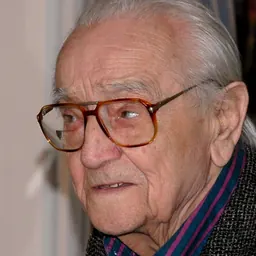
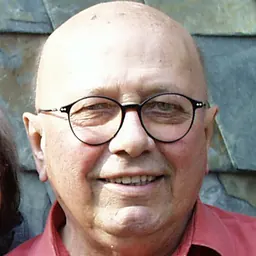


Related people
Same field, nearest in time

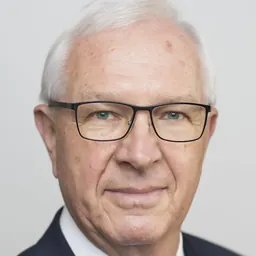
Contemporaries
People whose lives overlapped Vladimír Kopecký's
Frequently asked questions
Who is Vladimír Kopecký?
Czech graphic, painter, glassmaker and artist
When was Vladimír Kopecký born?
Vladimír Kopecký was born on 26 November 1931 in Svojanov.
What is Vladimír Kopecký's occupation?
Vladimír Kopecký is a pedagogue, painter, teacher, glass artist and sculptor.
Sources & further reading
Cite this page
APA: Biography.guide. (2026). Vladimír Kopecký. https://biography.guide/vladimir-kopecky/
MLA: "Vladimír Kopecký." Biography.guide, https://biography.guide/vladimir-kopecky/.
Chicago: "Vladimír Kopecký." Biography.guide. https://biography.guide/vladimir-kopecky/.
Data last updated: 2026-09-22 · Spot an error? Report a correction.
Portrait: Wikimedia Commons · author & licence
Page generated 2026-09-27 05:03 UTC