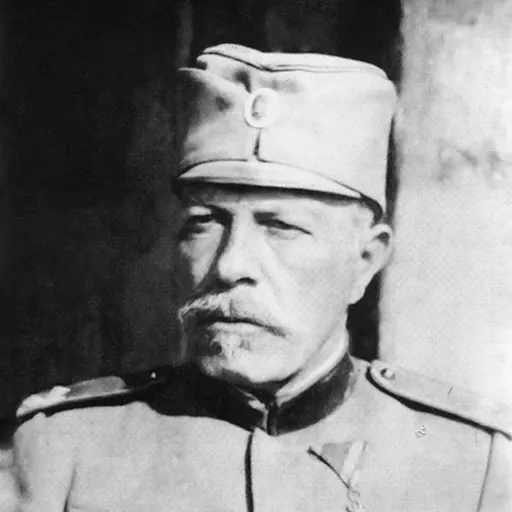
About Vladimir Kondić
Lived 1863 – 1940 (aged 77). Vladimir Kondić was a military personnel.
Vladimir Kondić (April 24, 1863 – May 27, 1940) was a 20th-century Serbian general. He is notable for his participation in the Serbo-Bulgarian War, First Balkan War, Second Balkan War and the First World War.
Biography Early life He was born on April 24, 1863, in Belgrade. He is a descendant of Konda Bimbaša, Karađorđe's comrade-in-arms from the First Serbian Uprising. He finished elementary school and seven grades of high school in Belgrade. He enrolled in the lower school of the military academy in 1883 as part of the 16th class, and ended with a break due to the war with Bulgaria, on September 12, 1886. Of the ten graduated cadets of this class, he was third in rank. He attended the Academy's high school from 1888 (2nd class). He finished 1890, as the tenth in the rank of nineteen cadets. He spent time between March 1891 and 1892 as a state cadet in Russia, serving in the 7th Grenadier Regiment. He married Anna Walter (1879-1961), the daughter of the famous industrialist Adolf Walter. He had two daughters, Jelena (1907–1962) and Mara (1909–1991). He was grazed with the medical brigadier general Aleksandar Markovic.
Military service In the Serbo-Bulgarian War, as an unfinished cadet of the Academy, he was on duty in the headquarters of the 2nd Infantry Regiment. After the war he held various positions - he was a naval officer in the 7th Battalion, and from April 1890. He became a teacher at the Infantry Non-Commissioned Officer School. Between 1892 and 1896 he was a company commander in the institution. Then, from March 1896 until March of the following year, he was the adjutant of two military ministers: General Dragutin Franasović and Jovan Mišković. He was returned from that duty in the troupe, first as an acting duty officer, and then as the commander of the 1st Battalion of the 6th Regiment. In March 1897, with the corps command, he became the acting commander of the infantry non-commissioned officer school. He held this position until March 1900 when he became acting commander of the 1st Infantry Regiment. In the same year, he was appointed adjutant of Alexander I. He remained in that position until April 1902 . From January 31, 1903, he was a deputy in the Examination Commission for the rank of major. The May Coup and found him in the position of acting commander of the 8th Regiment. On the day of the coup, he was relieved of his duties and made available. Over the next two months, he changed two command positions. He was first appointed Commander of the 11th Regiment, and soon afterwards Commander of the 3rd Regiment. At the beginning of July 1903, he was appointed assistant commander of the Drina divisional area. He remained in this position for a long time until the beginning of the Balkan wars.
The Second Balkan War found Colonel Kondic in the same position. The Timok division was located in the vicinity of Pirot. From these positions, he managed to keep the penetration of General Rache Petrov's 3rd Bulgarian Army and thus contribute to a favorable outcome of the war. For his services in both of these wars, Vladimir Kondić was promoted to the rank of general on November 12, 1913. Between the Balkans and the First World War, he was the commander of the newly formed Vardar divisional area. General Vladimir Kondic was not allowed to express his command abilities until the end of the war. During the fighting, his command was taken away in 1915 as well as being placed under military court. He retired the same year at his own request. He was also convicted for the trial at Chevrntija. After the First World War, at a repeated trial on October 14, 1920, by the decision of the military court s.br. 5658, Kondić was acquitted of all charges, pardoned and fully rehabilitated. He was transferred to the reserve by promotion to a higher rank on August 26, 1930 . years. As the only cadet of the 16th class of the Military Academy, he lived to a very old age.
He died on May 27, 1940. He was buried in the Belgrade New Cemetery.
For his merits, both in peace and in war, General Kondić was decorated with numerous domestic and foreign decorations.
Awards Order of Karađorđe's Star, 4th Order with Swords Order of the White Eagle, 4th and 5th order Order of the Cross of Takovo, 4th and 5th order Order of the Yugoslav Crown, 3rd Order Medal of military virtues
Foreign Awards Order of the Redeemer, 3rd order
Don’t just read it —
keep it.
Full-length biographies made to live with: read them, listen on the way to work, watch them tonight.
- E-book
- Audio
- Video
Instant download · yours to keep · every purchase keeps this site free
Important facts
People in Vladimir Kondić's life
Named in this biography and alive at the same time

Related people
Same field, nearest in time




Contemporaries
People whose lives overlapped Vladimir Kondić's




Frequently asked questions
Who was Vladimir Kondić?
Serbian general
When was Vladimir Kondić born?
Vladimir Kondić was born on 24 April 1863 in Belgrade.
When did Vladimir Kondić die?
Vladimir Kondić died on 27 May 1940 in Belgrade.
What was Vladimir Kondić's occupation?
Vladimir Kondić was a military personnel.
Sources & further reading
Cite this page
APA: Biography.guide. (2026). Vladimir Kondić. https://biography.guide/vladimir-kondic/
MLA: "Vladimir Kondić." Biography.guide, https://biography.guide/vladimir-kondic/.
Chicago: "Vladimir Kondić." Biography.guide. https://biography.guide/vladimir-kondic/.
Data last updated: 2026-09-21 · Spot an error? Report a correction.
Portrait: Wikimedia Commons · author & licence
Page generated 2026-09-27 05:00 UTC