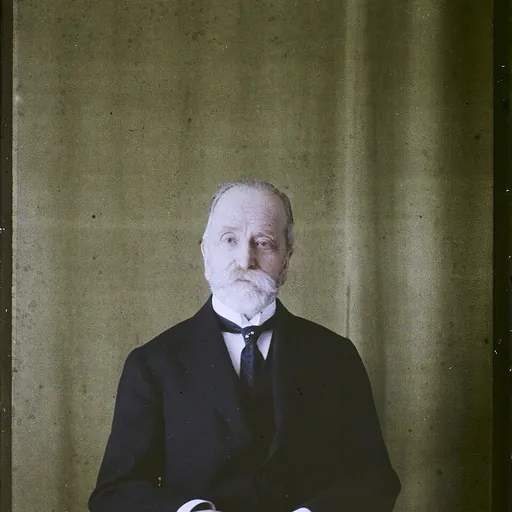
About Vladimir Kokovtsov
Lived 1853 – 1943 (aged 89). Vladimir Kokovtsov was a Russian politician, statesperson, banker, head of government and finance minister.
Count Vladimir Nikolayevich Kokovtsov (; – 29 January 1943) was a Russian politician who served as the fourth prime minister of Russia from 1911 to 1914, during the reign of Nicholas II.
Early life He was born in Borovichi, Borovichsky Uyezd, in the Novgorod Governorate on .
Following graduation from the Imperial Alexander Lyceum in December 1872 Kokovtsov applied for admittance to Saint Petersburg State University to study law on the recommendation of Aleksandr Gradovsky, Nikolai Tagantsev and S. Pakhman, all notable legal authorities of the time. However, his father, who had promised to pay for his education suddenly died leaving the family in strained financial circumstances. As a result, instead of attending university he entered the civil service to provide him and his family an additional income.
Civil service Kokovtsov was admitted as a candidate for a civil service position in the Imperial Ministry of Justice serving first in the statistical, then the legislative and finally in the criminal office. From 1879 to 1890 he served as Senior Inspector and Assistant Head of the Central Administration of Prisons. This period is noted for its prison reforms formulated by State Secretary K.K. Grot, a senior member of the Imperial State Council. From 1890 to 1896, he served in the State Council as Assistant State Secretary, State Secretary and finally as Assistant Imperial Secretary where he worked primarily on matters reviewed by the Russian Imperial State Council's Department of State Economy.
From 1896 to 1902, he served in one of the three Assistant Minister of Finance positions under Sergei Witte.
After resigning from the position, he served as Imperial Secretary until his appointment as Minister of Finance in 1904.
He resigned the following year, when his former superior in the Finance Ministry, Witte, assumed the Chairmanship of the Council of Ministers. Although not a minister, he then played a substantial role in securing a loan that did nothing less than keep the imperial government from having to devalue its currency and leave the gold standard, then the basis of almost all financially stable, secure and modern countries. Kokovtsov returned as Minister of Finance in the cabinets of Ivan Goremykin (1906) and Peter Stolypin (1906–11). Kokovstov was an anti-Semite who believed the problem with Jews was not their 'backwardness' but the fact that they were 'so clever'.
Kokovtsov succeeded Stolypin as Chairman of the Council of Ministers after Stolypin's assassination in 1911, while also maintaining his post as Minister of Finance, and held both offices until his retirement in 1914. Kokovtsov opposed to the appointment of Alexei Khvostov.
In 1912, Kokovtsov asked the tsar to authorize Grigori Rasputin's exile to Tobolsk. Nicholas refused: "I know Rasputin too well to believe all the tittle-tattle about him." Kokovtsov had offered Rasputin a substantial amount of money to leave for Siberia and ordered the newspapers not to mention his name in connection with the Empress. The tsar dismissed Kokovtsov on 29 January 1914 for a "lack of control over the press".
In domestic policy, Kokovtsov's time as prime minister saw the passage of two laws in 1912 that provided accident and sickness insurance to about 20% of workers. and the Grand Cross of the Swedish Royal Order of the Polar Star (1897).
Don’t just read it —
keep it.
Full-length biographies made to live with: read them, listen on the way to work, watch them tonight.
- E-book
- Audio
- Video
Instant download · yours to keep · every purchase keeps this site free
Important facts
People in Vladimir Kokovtsov's life
Named in this biography and alive at the same time




Related people
Same field, nearest in time




Contemporaries
People whose lives overlapped Vladimir Kokovtsov's



Frequently asked questions
Who was Vladimir Kokovtsov?
Russian politician
When was Vladimir Kokovtsov born?
Vladimir Kokovtsov was born on 18 April 1853 in Gorny.
When did Vladimir Kokovtsov die?
Vladimir Kokovtsov died on 29 January 1943 in 8th arrondissement of Paris.
What was Vladimir Kokovtsov's occupation?
Vladimir Kokovtsov was a politician, statesperson, banker, head of government and finance minister.
What nationality was Vladimir Kokovtsov?
Vladimir Kokovtsov was Russian.
Sources & further reading
· Wikipedia: Vladimir Kokovtsov
Cite this page
APA: Biography.guide. (2026). Vladimir Kokovtsov. https://biography.guide/vladimir-kokovtsov/
MLA: "Vladimir Kokovtsov." Biography.guide, https://biography.guide/vladimir-kokovtsov/.
Chicago: "Vladimir Kokovtsov." Biography.guide. https://biography.guide/vladimir-kokovtsov/.
Data last updated: 2026-09-22 · Spot an error? Report a correction.
Portrait: Wikimedia Commons · author & licence
Page generated 2026-09-27 05:03 UTC