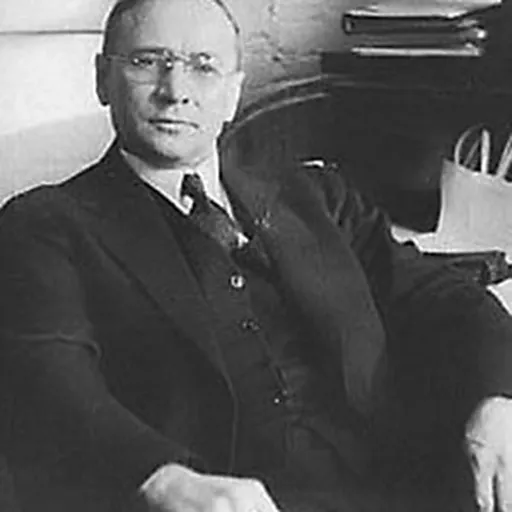
About Vladimir K. Zworykin
Lived 1888 – 1982 (aged 94). Vladimir K. Zworykin was a Russian engineer, physicist, inventor and electrical engineer.
Vladimir Kosma Zworykin (; or with the patronymic as Kosmich; or .) Zworykin anglicized his name to Vladimir Kosma Zworykin, ) was a Russian-American inventor, engineer, and pioneer of television technology. Zworykin invented a television transmitting and receiving system employing cathode-ray tubes. He played a role in the practical development of television from the early thirties, including charge storage-type tubes, infrared image tubes and the electron microscope.
Early life and education Vladimir Zworykin was born in Murom, Russia, in 1888 or 1889, to the family of a prosperous merchants. He had a relatively calm upbringing, and he rarely saw his father except on religious holidays.
He studied at the St. Petersburg Institute of Technology, under Boris Rosing. He helped Rosing with experimental work on television in the basement of Rosing's private lab at the School of Artillery of Saint Petersburg. They worked on the problem of "electrical telescopy," something Zworykin had never heard of before. At this time, electrical telescopy (or television as it was later called) was just a dream. Zworykin did not know that others had been studying the idea since the 1880s, or that Professor Rosing had been working on it in secret since 1902 and had made excellent progress. Rosing had filed his first patent on a television system in 1907, featuring a very early cathode-ray tube as a receiver, and a mechanical device as a transmitter. Its demonstration in 1911, based on an improved design, was the world's first demonstration of TV of any kind.
Zworykin married Tatiana Vasilieva in 1916, they had two daughters (the couple separated in the early 1930s).
Career Zworykin graduated in 1912. He then studied X-rays under professor Paul Langevin in Paris. He was awarded a patent for the 1925 application in 1928,
According to Albert Abramson, He continued work on it, and "he image iconoscope, presented in 1934, was a result of a collaboration between Zworykin and RCA's licensee Telefunken. ... In 1935 the Reichspost started the public broadcastings using this tube and applying a 180 lines system." Zworykin received a patent in 1928 for a color transmission version of his 1923 patent application; while a second one was eventually issued in 1938 by the Court of Appeals on a non-Farnsworth-related interference case, and over the objection of the Patent Office.
i) Session 3 Dr LF Broadway.
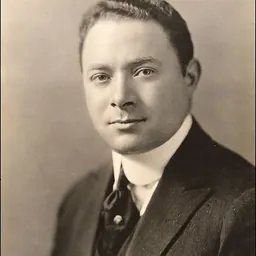
ii) Opening address by Sir James Redmond quoting LF Broadway. The group, also comprising David Sarnoff, Simeon Aisenstein and Isaac Shoenberg, knew each other well from Russia and saw possible military applications for their work on television. The group is said to have raised one million pounds sterling (about $5 million at the time) from US donors. The specific work took place at EMI-Marconi in the U.K. and resulted in Britain becoming significantly advanced in television development and able to launch a public service on 2nd November 1936. The military applications helped the development of radio-location (later named radar). In addition the design and production in quantity of television equipment and sets allowed the similar military technology (cathode ray tubes, VHF transmission and reception and wideband circuits) to be advanced. A former British defence minister, Lord Orr-Ewing, referred to the work in a 1979 BBC interview and stated “that’s how we won the Battle of Britain”.
Later life Zworykin married for a second time in 1951. His wife was Katherine Polevitzky (1888–1985), a Russian-born professor of bacteriology at the University of Pennsylvania. It was the second marriage for both. The ceremony was in Burlington, New Jersey. A photographic record of his marriage and worldwide tour can be viewed online. He retired in 1954.
New frontiers in medical engineering and biological engineering appealed to him, and he became a founder and first president of the International Federation for Medical and Biological Engineering. The Federation continues to honor outstanding research engineering with a Zworykin Award, the prize being travelling funds to the award's presentation at a World Congress.
Death Zworykin died on July 29, 1982, in Princeton, New Jersey.
Honors
In 1941, he was elected to the American Academy of Arts and Sciences.
He was awarded the Howard N. Potts Medal from The Franklin Institute in 1947.
He was elected to the American Philosophical Society in 1948.
He was named honorary vice president of RCA in 1954.
In 1966, the National Academy of Sciences, of which he was a member, awarded him the National Medal of Science for his contributions to the instruments of science, engineering, and television and for his stimulation of the application of engineering to medicine.
He was founder-president of the International Federation for Medical Electronics and Biological Engineering, a recipient of the Faraday Medal from Great Britain (1965), and a member of the U.S. National Hall of Fame from 1977.
From 1952 to 1986, the IEEE made awards to worthy engineers in the name of Vladimir K. Zworykin. More recently the Zworykin Award has been bestowed by the International Federation for Medical and Biological Engineering.
The most complete list of Zworykin's awards can be found online at historyTV.net .
Legacy Zworykin was inducted into the New Jersey Inventor's Hall of Fame and the National Inventors Hall of Fame. Additionally, Tektronix in Beaverton, Oregon has named a street on its campus after Zworykin.
In 1995 University of Illinois Press published Zworykin, Pioneer of Television by Albert Abramson.
In 2010 Leonid Parfyonov produced a documentary film "Zvorykin-Muromets" about Zworykin.
Zworykin is listed in the Russian-American Chamber of Fame of Congress of Russian Americans, which is dedicated to Russian immigrants who made outstanding contributions to American science or culture.
Don’t just read it —
keep it.
Full-length biographies made to live with: read them, listen on the way to work, watch them tonight.
- E-book
- Audio
- Video
Instant download · yours to keep · every purchase keeps this site free
Important facts
People in Vladimir K. Zworykin's life
Named in this biography and alive at the same time






Related people
Same field, nearest in time

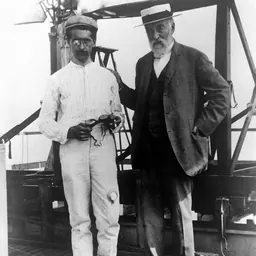


Contemporaries
People whose lives overlapped Vladimir K. Zworykin's

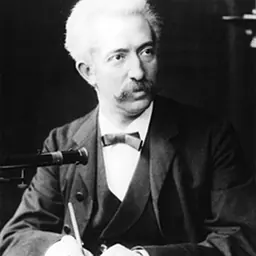
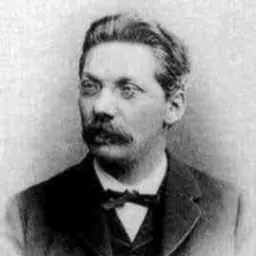


Frequently asked questions
Who was Vladimir K. Zworykin?
Russian-American engineer (1888–1982)
When was Vladimir K. Zworykin born?
Vladimir K. Zworykin was born on 17 July 1888 in Murom, United States.
When did Vladimir K. Zworykin die?
Vladimir K. Zworykin died on 29 July 1982 in Princeton.
What was Vladimir K. Zworykin's occupation?
Vladimir K. Zworykin was an engineer, physicist, inventor and electrical engineer.
What nationality was Vladimir K. Zworykin?
Vladimir K. Zworykin was Russian.
Sources & further reading
· Wikipedia: Vladimir K. Zworykin
· DBpedia: Vladimir K. Zworykin
Cite this page
APA: Biography.guide. (2026). Vladimir K. Zworykin. https://biography.guide/vladimir-k-zworykin/
MLA: "Vladimir K. Zworykin." Biography.guide, https://biography.guide/vladimir-k-zworykin/.
Chicago: "Vladimir K. Zworykin." Biography.guide. https://biography.guide/vladimir-k-zworykin/.
Data last updated: 2026-09-21 · Spot an error? Report a correction.
Portrait: Wikimedia Commons · author & licence
Page generated 2026-09-27 05:00 UTC