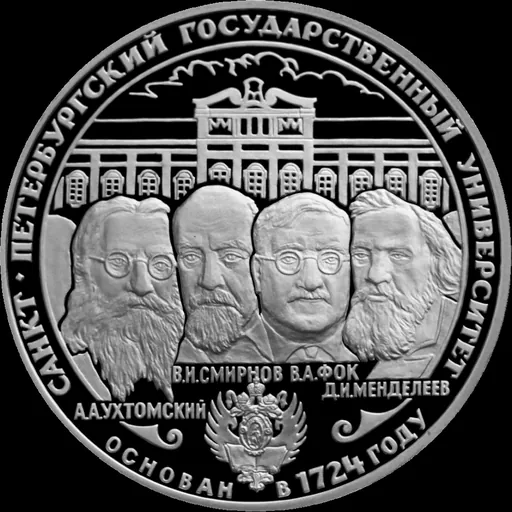
About Vladimir Fock
Lived 1898 – 1974 (aged 76). Vladimir Fock was a Russian physicist and university teacher, known for Adiabatic theorem, Creeping wave and Fock matrix.
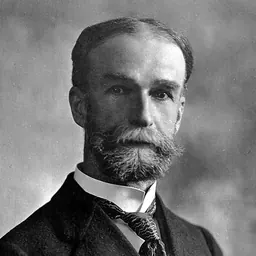
Vladimir Aleksandrovich Fock (or Fok; ) (December 22, 1898 – December 27, 1974) was a Soviet physicist, who did foundational work on quantum mechanics and quantum electrodynamics.
Biography He was born in St. Petersburg, Russia. In 1922 he graduated from Petrograd University, then continued postgraduate studies there. He became a professor there in 1932. In 1919–1923 and 1928–1941 he collaborated with the Vavilov State Optical Institute, in 1924–1936 with the Leningrad Institute of Physics and Technology, in 1934–1941 and 1944–1953 with the Lebedev Physical Institute.
Scientific work His primary scientific contribution lies in the development of quantum physics and the theory of gravitation, although he also contributed significantly to the fields of mechanics, theoretical optics, and physics of continuous media. In 1926, he derived the Klein–Gordon equation. He gave his name to Fock space, the Fock representation and Fock state, and developed the Hartree–Fock method in 1930. He made many subsequent scientific contributions during the rest of his life. Fock developed the electromagnetic methods for geophysical exploration in a book The theory of the study of the rocks resistance by the carottage method (1933), methods called well logging in modern literature.
Fock made significant contributions to general relativity theory, specifically for the many-body problems. Fock criticised on scientific grounds both Einstein's general principle of relativity, as being devoid of physical substance, and the equivalence principle, as interpreted as the equivalence of gravitation and acceleration, as having only a local validity.
In Leningrad, Fock created a scientific school in theoretical physics and raised the physics education in the USSR through his books. He wrote the first textbook on quantum mechanics Fundamentals of Quantum Mechanics (1931, 1978) and a very influential monograph The Theory of Space, Time and Gravitation (1955).
Historians of science, such as Loren Graham, see Fock as a representative and proponent of Einstein's theory of relativity within the Soviet world. At a time when most Marxist philosophers objected to relativity theory, Fock emphasized a materialistic understanding of relativity that coincided philosophically with Marxism.
He was a full member (academician) of the USSR Academy of Sciences (1939) and a member of the International Academy of Quantum Molecular Science.
Don’t just read it —
keep it.
Full-length biographies made to live with: read them, listen on the way to work, watch them tonight.
- E-book
- Audio
- Video
Instant download · yours to keep · every purchase keeps this site free
Important facts
more
Fock–Schwinger gauge, Hartree–Fock method, Klein–Gordon equation, Laplace–Runge–Lenz vector, Mehler–Fock transform, Relativistic dynamicsPeople in Vladimir Fock's life
Named in this biography and alive at the same time

Related people
Same field, nearest in time

Contemporaries
People whose lives overlapped Vladimir Fock's




Frequently asked questions
Who was Vladimir Fock?
Russian physicist (1898-1974)
When was Vladimir Fock born?
Vladimir Fock was born on 10 December 1898 in Saint Petersburg.
When did Vladimir Fock die?
Vladimir Fock died on 27 December 1974 in Saint Petersburg.
What was Vladimir Fock's occupation?
Vladimir Fock was a physicist and university teacher.
What was Vladimir Fock known for?
Vladimir Fock was known for Adiabatic theorem, Creeping wave, Fock matrix, Fock space, Fock state and Fock–Lorentz symmetry.
What nationality was Vladimir Fock?
Vladimir Fock was Russian.
Sources & further reading
Cite this page
APA: Biography.guide. (2026). Vladimir Fock. https://biography.guide/vladimir-fock/
MLA: "Vladimir Fock." Biography.guide, https://biography.guide/vladimir-fock/.
Chicago: "Vladimir Fock." Biography.guide. https://biography.guide/vladimir-fock/.
Data last updated: 2026-09-21 · Spot an error? Report a correction.
Portrait: Wikimedia Commons · author & licence
Page generated 2026-09-27 05:00 UTC