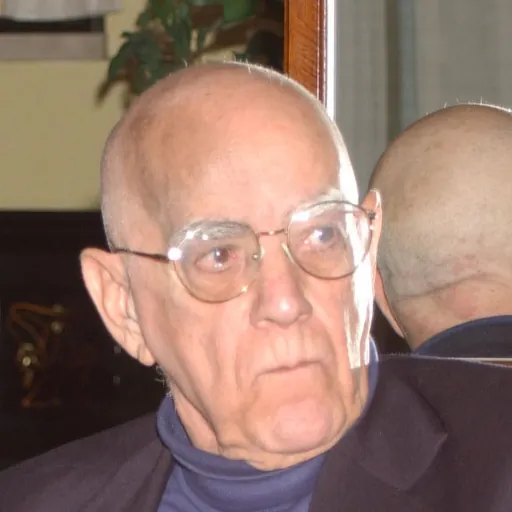
About Vittore Bocchetta
Lived 1918 – 2021 (aged 102). Vittore Bocchetta was an Italian sculptor, painter, writer, partisan, resistance fighter and literary scholar.
Vittore Bocchetta (15 November 1918 – 18 February 2021) was an Italian sculptor, painter, and academic. Bocchetta was a member of the Italian resistance movement during World War II.
Biography Vittore Bocchetta was born in Sassari, Sardinia to a military engineer. After his childhood in Sardinia, he moved with his family first to Bologna and then to Verona. Even though he belonged to a family of artists, his parents did not permit him to paint or draw because they were afraid that he might be distracted from his education.
After his father's early death in 1935, he went back to Sardinia with his family. He received a degree in classical humanities in Cagliari in 1938. Then, he returned to Verona and was admitted to the University of Florence, faculty of classical humanities and history of philosophy, where he graduated in 1944. He earned a living by teaching private lessons and as a professor of classical humanities at Ginnasio Maffei (1939) and Istituto alle Stimate (1942) in Verona.
Resistance activity (1940–1945) His dedication to the principles of political freedom led him to be reported to the fascist Italian authorities in 1941. He was soon involved in underground anti-fascist activities. On 9 September 1943, the day after the occupation of Verona by the German army, he contributed to the liberation of several hundreds of Italian soldiers from the Carlo Montanari barracks, where they were kept prisoners by the Nazis. Among the rare moments of comfort there were the visits of Father Chiot, the prison chaplain. Bocchetta later represented Father Chiot in a monument in front of the prison dedicated in 1988. When released in February 1944, he became a member of the local unit of the National Liberation Committee as an independent.
Within a few months he witnessed the death of several of his comrades from Verona. He managed to survive thanks to a series of fortuitous circumstances and his relatively young age (26 years).
In 1966, he taught conversational Italian with his 13-week television series When in Rome, broadcast by WTTW.
Between 1969 and 1973 his work was exhibited in eight one-man shows in Detroit, New York, and in particular at John Hancock Center, Chicago, that had just been opened by that time.
In 1975, following an exhibition at Chicago Public Library Cultural Center, a selection of his works was auctioned in the Auditorium of the American Dental Association, Chicago, for the benefit of the American Cancer Society.
Between 1970 and 1976 he published, with Editorial Gredos, Madrid, two scholarly books on Latin and Spanish Golden Age literature and one on 20th century western philosophy. His book Horacio en Villegas y en Fray Luis de León won him an ad honorem membership in 1972 at the Ovidium Society, University of Bucharest.
Return to Italy From 1986 to 1989 he spent several months each year in Verona, working on literary and artistic projects with a view to "polish and defend his memories".
The first work of this period is Cypress, an obelisk of stainless steel over 7 meters high. It is a monument in memory of the six young heroes that on 17 July 1944 attacked the prison of Verona and freed an important anti-fascist leader. The sculpture was inaugurated on 25 April 1988, during the official commemoration of the liberation of Italy from the Nazis, in the ground where the prison was once located. The following year (1989), during the official 25 April commemoration, the monument to Father Chiot, chaplain of the prison, was unveiled just opposite.
In 1989 he settled permanently in Verona and published the first edition of his autobiography regarding the period 1940–1945, which he subsequently revised and corrected several times following the discovery of new documents. He published the English translation in 1991 The book also represented the plot of the documentary Spiriti liberi, 1941–1945, Ribelli a Verona produced by City of Verona and Wider das Vergessen (Do not Forget) directed by the German Claus Dobberke and premiered at the Film Museum in Potsdam on 27 January 2007, the International Holocaust Remembrance Day.
He committed himself to defend the memory of the resistance against fascism with speeches, meetings in schools, articles in newspapers and magazines.
In 1995 he published an essay on the involvement of the chemical and pharmaceutical industry in Nazi Germany and its substantial impunity following the Nuremberg trial of 1947-1948.
Since 2001, he repeatedly traveled to Germany where a group of intellectuals founded the association Freundeskreis Vittore Bocchetta - Non Dimenticare that promoted his participation in various initiatives as a witness and victim of the Nazi period.
From 2003 to 2006, his sculptures and paintings were exhibited in various German cities with a traveling exhibition. On 8 May 2007 he took part in the unveiling of his sculpture Ohne Namen (Without Name) at the site of the extermination camp at Hersbruck from which he escaped in 1945.
Bocchetta died on 18 February 2021 in Verona at the age of 102.
Exhibitions Quilmes (Buenos Aires), Argentina, Consejo Municipal, 1952. Caracas (Distrito Federal), Venezuela, Paseo de los Ilustres, 1956. Detroit (Michigan), US, Detroit Bank & Trust Company, 1969. Chicago (Illinois), US, Upper Avenue National Bank, John Hancock Center, 1970. Chicago (Illinois), US, J. Walter Thompson Company, John Hancock Center, 1970. Chicago (Illinois), US, Aetna Bank, 1970. Chicago (Illinois), US, John Hancock Center, 1971; 1973. Chicago (Illinois), US, Siegel Galleries, 1971–1977. New York (New York), US, Lynn Kottler Galleries, 1973. Chicago (Illinois), US, Merrill Chase Galleries, 1974–1978; 1983; 1984. Chicago (Illinois), US, Chicago Public Library Cultural Center, 1975. Verona, Italy, Palazzo della Ragione, 1991. Verona, Italy, Officina d'arte, corso Porta Borsari 17, 1995. Caprino Veronese (Verona), Italy, Villa Carlotti, 1995. Verona, Italy, Art Gallery Leonardo, 1996. Detmold (North Rhine-Westphalia), Germany, Lippischen Landesbibliothek, 2003. Wolfsburg (Lower Saxony), Germany, Centro Italiano, 2004. Potsdam (Brandenburg), Germany, Altes Rathaus, 2004. Lüdenscheid (North Rhine-Westphalia), Germany, Sparkasse, 2005. Kassel (Hesse), Germany, Justizzentrum, 2005. Weimar (Thuringia), Germany, Literaturhaus, 2006. Nuremberg (Bavaria), Germany, Dokumentationszentrum, 2011.
Public monuments Narcissus and Black Hole, in the Chicago Public Library Cultural Center, Chicago, 1965. Painter and Potter, at Ortho-Tain Inc., Bayamon, Puerto Rico, 1966. The Egg Man and Man in the Sand, in 201 East Chestnut Street, Chicago, 1968. Mother Earth, in the Chicago Public Library Cultural Center, Chicago, 1971. Expansion, at Household International Inc., Prospect Heights, Illinois, 1983. Cipresso, in the cloister of the church Chiesa degli Scalzi, Verona, Italy, 1988. Don Chiot, in largo Don Chiot, Verona, Italy, 1989. Omaggio a Pertini, near Villa Carlotti, Caprino Veronese, Verona, Italy, 1995. Ohne Namen, in the memorial site of the concentration camp of Hersbruck, Germany, 2007.
Writings
. .
. .
Documentary films KZ Hersbruck - und das Doggerwerk, directed by Gerhard Faul (2000) Speciale Deportazione, directed by Antonello Lai - Tele Costa Smeralda (2000) Testimonianze dai Lager, directed by Eraldo Mangano - Rai Educational (2002) Spiriti liberi, 1941–1945, Ribelli a Verona, directed by Stefano Paiusco - Comune di Verona (2004) Non Dimenticare (Wider das Vergessen), directed by Claus Dobberke and Stefan Mehlhorn (2007)
Footnotes
Don’t just read it —
keep it.
Full-length biographies made to live with: read them, listen on the way to work, watch them tonight.
- E-book
- Audio
- Video
Instant download · yours to keep · every purchase keeps this site free
Important facts
People in Vittore Bocchetta's life
Named in this biography and alive at the same time





Related people
Same field, nearest in time



Contemporaries
People whose lives overlapped Vittore Bocchetta's

Frequently asked questions
Who was Vittore Bocchetta?
Italian painter (1918-2021)
When was Vittore Bocchetta born?
Vittore Bocchetta was born on 15 November 1918 in Sassari.
When did Vittore Bocchetta die?
Vittore Bocchetta died on 18 February 2021 in Verona.
What was Vittore Bocchetta's occupation?
Vittore Bocchetta was a sculptor, painter, writer, partisan, resistance fighter and literary scholar.
What nationality was Vittore Bocchetta?
Vittore Bocchetta was Italian.
Sources & further reading
· Wikipedia: Vittore Bocchetta
Cite this page
APA: Biography.guide. (2026). Vittore Bocchetta. https://biography.guide/vittore-bocchetta/
MLA: "Vittore Bocchetta." Biography.guide, https://biography.guide/vittore-bocchetta/.
Chicago: "Vittore Bocchetta." Biography.guide. https://biography.guide/vittore-bocchetta/.
Data last updated: 2026-09-20 · Spot an error? Report a correction.
Page generated 2026-09-27 05:10 UTC