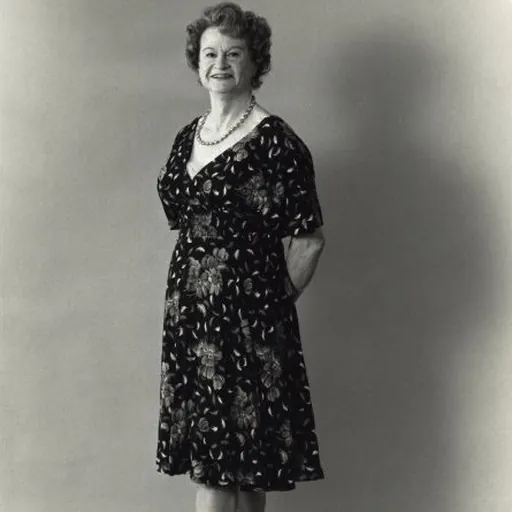
Virginia Prince
American transgender activist
About Virginia Prince
Lived 1913 – 2009 (aged 95). Virginia Prince was an American non-fiction writer, chemist and lGBTQ rights activist, known for Society for the Second Self, Transgender and Transvestia.
Virginia Charles Prince (November 23, 1912 – May 2, 2009) was an American transgender woman and transgender activist. She published Transvestia magazine, and started Full Personality Expression, which later became Tri-Ess, for male heterosexual cross-dressers.
Early life
Prince was born on November 23, 1912, in Los Angeles, California, to a Protestant family. She was assigned male at birth. At around the age of twelve Prince began cross-dressing, first using her mother's clothes. This came to a crux when Virginia, at the age of 18, went to a church Halloween party—not only in a woman's outfit but indeed passing as a woman—and won first prize. This marked "the first occasion in which [Prince] willingly appeared before others as a girl". The daughter of a surgeon father and a mother who worked in real estate investment, Prince's early life was one of privilege, with a family that was in her words "socially prominent".
Prince was not as open with her transvestism as she became in later life. However it was thanks to a psychiatrist she consulted at age 30 that she began to live a more comfortable, open lifestyle. Despite having been previously diagnosed with an unresolved Oedipus complex, Prince confided to her doctor, Karl Bowman, about her inclination of crossdressing, who in return advised her to "learn to accept [her]self... and enjoy it." Prince credits this psychiatrist, who reminded her that there are many others that live a similar lifestyle, with Transvestia'''s overarching, recurring theme of self-acceptance. The two were married on August 16, 1941, in Los Angeles, yet their marriage, according to Prince, "failed because of [her] transvestism". In July 1951, the two divorced.
Transvestia magazine For the sake of concealability, the first two issues of Transvestia were printed on pamphlets that could be hidden within the palm of one's hand, or one's pocket.
In 1960, the first issue of Prince's magazine Transvestia was published. Prince acquired the means to fund the publication after assembling a list of 25 acquaintances, each of whom were willing to donate four dollars to her start-up. Working with one hundred dollars,
With a readership of mostly white, middle-to-professional-class crossdressers, the magazine offered, among other things, dozens of published life stories and letters contributed by other crossdressers. Over the years, the publication also gained several international subscribers, notably from England, Scandinavia and Australia. This final issue edited by Virginia Prince, was unusual among Transvestia issues as it was solely an autobiographical account of Virginia's life, in which she recounted her early experiences with crossdressing, her divorce, and her work creating and maintaining Transvestia.
The magazine operated on three core objectives: To provide expression for those interested in the subjects of unusual dress and fashion. To provide information to those who, through ignorance, condemn that which they don't understand. To provide education for those who see evil when none exists. These three objectives—education, entertainment, and expression—were promoted in order to "help... readers achieve understanding, self-acceptance, [and] peace of mind". Transvestia was primarily a story driven magazine, however every issue contained a "person to person" section, in which ads for meeting others and businesses advertising transgender friendly services would be printed. This section also included a goods and services for sale section, as well as a trade and rent section.
Trans terminology, crossdresser identity and controversy
Through many of her writings, Prince has been considered a major pioneer of the transgender community. Notably, in her 1967 "The Expression of Femininity in the Male" (under the pen name "Virginia Bruce"), Prince discusses the supposed psychiatric links between cross-dressing and sexual deviation that were commonly believed in at the time. Prince firmly rejected these associations, and was also strongly opposed to the notion that true transvestites are psychiatrically disturbed.
In other works, Prince also helped popularize the term 'transgender', and erroneously asserted that she coined "transgenderist" and "transgenderism", words which she meant to be understood as describing people who live as full-time women, but have no intention of having genital surgery. Although Prince identified with the concept of androgyny (stating in her autobiographical 100th issue that she could "do [her] own thing whichever it is"), she preferred to identify as Gynandrous. This, she explained, is because although 'Charles' still resides within her, "the feminine is more important than the masculine."
Archival collections The personal and professional papers of Virginia Prince are preserved at the University of Victoria and at California State University, Northridge.
Don’t just read it —
keep it.
Full-length biographies made to live with: read them, listen on the way to work, watch them tonight.
- E-book
- Audio
- Video
Instant download · yours to keep · every purchase keeps this site free
Important facts
People in Virginia Prince's life
Named in this biography and alive at the same time




Related people
Same field, nearest in time



Contemporaries
People whose lives overlapped Virginia Prince's



Frequently asked questions
Who was Virginia Prince?
American transgender activist (1912–2009)
When was Virginia Prince born?
Virginia Prince was born on 23 November 1913 in Los Angeles.
When did Virginia Prince die?
Virginia Prince died on 2 May 2009 in Los Angeles.
What was Virginia Prince's occupation?
Virginia Prince was a non-fiction writer, chemist and lGBTQ rights activist.
What was Virginia Prince known for?
Virginia Prince was known for Society for the Second Self, Transgender and Transvestia.
What nationality was Virginia Prince?
Virginia Prince was American.
Sources & further reading
Cite this page
APA: Biography.guide. (2026). Virginia Prince. https://biography.guide/virginia-prince/
MLA: "Virginia Prince." Biography.guide, https://biography.guide/virginia-prince/.
Chicago: "Virginia Prince." Biography.guide. https://biography.guide/virginia-prince/.
Data last updated: 2026-09-22 · Spot an error? Report a correction.
Portrait: Wikimedia Commons · author & licence
Page generated 2026-09-27 05:01 UTC