
About Viola Roggenkamp
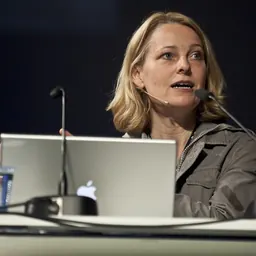
Born 1948. Viola Roggenkamp is a German opinion journalist, writer and journalist.
Viola Roggenkamp (born 15 April 1948) is a German journalist-commentator and writer. The themes to which she most often returns are those surrounding Feminism and Judaism in Germany during and following the brutish middle years of the twentieth century. Although these topics have been much revisited by scholars and critics throughout her lifetime, several of Roggenkamp's own perspectives and conclusions are well outside the mainstream. Her output includes (but is not limited to) literary portraits, essays, opinion pieces and novels.
Life and works Viola Roggenkamp was born and grew up in Hamburg. It was in Hamburg that her parents had ended up "following the liberation" in 1945, having lived "illegally" in Polish Silesia during the wartime Polish occupation. After her father died (but while her mother was still alive) she explored her parents' lives during the war years in her 2011 semi-novel, "Tochter und Vater". Discussing the book with an interviewer she later explained that "the daughter is not me, but the father in the novel is my father. My father did all the couragous and unbelievable things [as a secret member of the Polish resistance in Kraków] that Paul, the father in the novel, did". In 1977 Roggenkamp was a founder member of the team around Alice Schwarzer that created the magazine EMMA. (The name of the magazine is a wordplay based on the word "emancipation". ) She worked for EMMA as a free-lance reporter till the early 1990s. Since 1990 she has been writing for the Berlin-based weekly publication die Jüdische Allgemeine. In 2016 she became, in addition, a regular contributor to the monthly magazine, Cicero. Roggenkamp's first published "novel" appeared only in 2004. "Familienleben" ("Family life"), which can be described as an "autobiographically inspired novel", was well received by leading critics. Recommended to television viewers by the influential presenter and literary critic Elke Heidenreich, it quickly proved a commercial success, notwithstanding its unfashionable length. The narrator-protagonist is a 13-year-old child called Fania. Fania is the younger of the parents' two daughters. The narrative deals with the daily life of a German-Jewish family living in Hamburg in 1967. In her powerfully positive review of the book in Der Spiegel, Jana Hensel provides a little context: "For three decades Viola Roggenkamp kept her project for a novel to herself. The result, now, is an almost eerily perfect book ... All the characters in it are perfectly defined with great dramatic clarity, replete with their psychological contradictions". "Tochter und Vater" (2011) again incorporated as its starting point and at its core, the author's own experiences, and what she had discerned of her parents' lives in Silesia during the war. The subtitle is more enlightening than the main title: "Jüdische Frauen und Männer in Deutschland sprechen von ihrer Mutter" ("Jewish women and men in Germany talk about their mothers"). The volume is based on 26 interview-portraits in which higher-profile Germans talk about their mothers, all of whom are holocaust survivors. The interviewees include Stefan Heym, Esther Dischereit, Wladimir Kaminer,
Erika Mann controversy In 2005 Viola Roggenkamp published a lengthy essay – some identify it as a short book – on Erika Mann, a daughter – probably her father's favourite daughter – of Thomas Mann. The essay was entitled "Erika Mann. Eine jüdische Tochter": it reignited the smouldering controversy about Erika Mann's own attitude to her mother's Jewish ancestry. For many people Thomas Mann was the greatest German language writer of the twentieth century. Roggenkamp's contribution concerning his attitude to his wife's Jewish provenance was bound to attract attention. Roggenkamp asserted that although much had been written about Thomas and Katia Mann, Katia's Jewish ancestry had been very little delved into, beyond bald statements recording the fact that she had, like her mother and like her children, been baptised (as a Christian). Roggenkamp was particularly critical, in this respect, of so-called "Mann-experts" such as Heinrich Breloer, as well as Inge and Walter Jens. Roggenkamp contended that the tendency of the Mann family (along with their many admirers and other researchers) to ignore the Jewish roots of Thomas Mann's wealthy father-in-law, Alfred Pringsheim amounted to denial and was deeply damaging. From California, the scholar (and Vienna-born holocaust survivor) Ruth Klüger summarized Roggenkamp's position for readers of Die Welt:
Klüger is strongly positive about Roggenkamp's imputations as to Erika Mann's inner thoughts and beliefs. Her insistence that much of the book's explosive impact comes from a wider context, in which discussion of the fate of German Jewry during the post-war period has been suppressed, is a judgement that Roggenkamp self-evidently shares. The summary to her review is overwhelmingly supportive:
Commentators piled in on both sides. (Some were even content to try colonizing the middle ground.) Viola Roggenkamp's public profile, along with appreciation of her insights, were permanently raised and enhanced. Roland H. Wiegenstein applied a little psychological interpretation of his own in Die Berliner Literaturkritik, suggesting that Roggenkamp's decision to share her conclusions on Erika Mann's denial of her Jewishness was, "... certainly all of a piece with the historical illuminations that the author has previously shared in her novels of family life. .... For Viola roggenkamp, Erika Mann becomes a kind of flawed role model ("Identifikationsfigur"), just as Rahel Varnhagen was for the young Hannah Arendt. Roggenkamp conducts a phoney battle with her heroine and wishes the matter could be other than it is".
Tilmann Lahme, who provided his review in the Frankfurter Allgemeine Zeitung, is deeply underwhelmed. He does not think that Roggenkamp had found out too much about why Erika Mann, like her mother before her, wanted nothing to do with her Jewish roots. But he has discovered plenty about Roggenkamp's own grief over the loss of Jewish lives in Germany, and about her anger, "although it remains unclear why this is principally directed against Thomas Mann".
Don’t just read it —
keep it.
Full-length biographies made to live with: read them, listen on the way to work, watch them tonight.
- E-book
- Audio
- Video
Instant download · yours to keep · every purchase keeps this site free
Important facts
People in Viola Roggenkamp's life
Named in this biography and alive at the same time


Related people
Same field, nearest in time

Contemporaries
People whose lives overlapped Viola Roggenkamp's



Frequently asked questions
Who is Viola Roggenkamp?
German opinion journalist and writer
When was Viola Roggenkamp born?
Viola Roggenkamp was born on 15 April 1948 in Hamburg.
What is Viola Roggenkamp's occupation?
Viola Roggenkamp is an opinion journalist, writer and journalist.
What nationality is Viola Roggenkamp?
Viola Roggenkamp is German.
Sources & further reading
Cite this page
APA: Biography.guide. (2026). Viola Roggenkamp. https://biography.guide/viola-roggenkamp/
MLA: "Viola Roggenkamp." Biography.guide, https://biography.guide/viola-roggenkamp/.
Chicago: "Viola Roggenkamp." Biography.guide. https://biography.guide/viola-roggenkamp/.
Data last updated: 2026-09-22 · Spot an error? Report a correction.
Portrait: Wikimedia Commons · author & licence
Page generated 2026-09-27 05:01 UTC