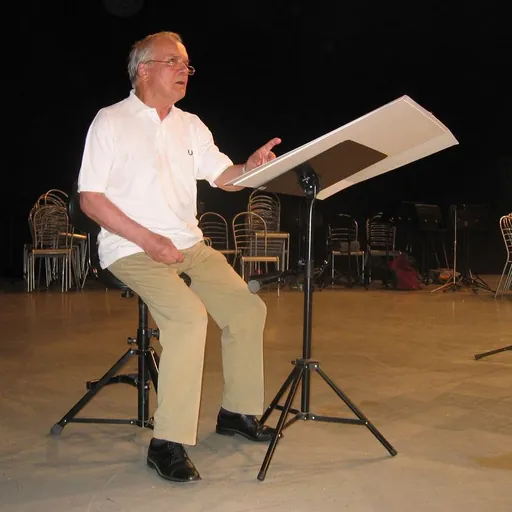
About Vinko Globokar
Born 1934. Vinko Globokar is a French and Slovenian composer, conductor, music educator, jazz musician, university teacher and trombonist.
Vinko Globokar (born 7 July 1934) is a French-Slovenian avant-garde composer and trombonist.
Globokar's music uses unconventional and extended techniques, places great emphasis on spontaneity and creativity, and often relies on improvisation. His extensive output is largely unknown outside of experimental music circles.
As a trombonist, he has premiered works by Luciano Berio, Mauricio Kagel, René Leibowitz, Karlheinz Stockhausen, and Toru Takemitsu, as well as his own compositions.
Biography Globokar was born in Anderny, Meurthe-et-Moselle, France. In 1947 he moved to Yugoslavia, where he attended DIC in Ljubljana, Slovenia. Here, he played jazz trombone until 1955, at which point he moved to Paris to study at the Conservatoire de Paris. At the Conservatoire, he studied composition with René Leibowitz (a disciple of Arnold Schoenberg) and trombone with André Lafosse. In 1965, he moved to Berlin and began composition lessons with Luciano Berio, whose Sequenza V he later premiered at Carnegie Recital Hall in 1966.
He has conducted his compositions with Finnish Radio Symphony Orchestra, Orchestre philharmonique de Radio France, Jerusalem Symphony Orchestra, RTV Slovenia Symphony Orchestra, Warsaw National Philharmonic Orchestra, and Westdeutscher Rundfunk. From 1983 until 1999, he directed 20th-century music with the Orchestra Giovanile Italiana in Florence.
In 2002, Globokar was bestowed with the Prešeren Award for lifetime achievement.
Musical style Globokar's music is notable for its spontaneity, energy, and innovative use of unorthodox instrumental and compositional techniques. His works often feature indeterminacy and improvisation, reflecting his own background in jazz and free improvisation. His pieces employ a variety of extended techniques. For example, in his solo percussion piece Toucher, the performer narrates a story while simultaneously playing the syllabic patterns on a percussion array.
Works (selection)
Stage works L’idôle (2012) Music theatre for girls’ choir and four percussionists. Text: Georges Lewkowicz L‘armonia drammatica (1987–1990) Music drama for orchestra, mixed choir, 7 singers and tenor saxophone. Text: Edoardo Sanguineti Les Émigrés (1982–85) Triptych Miserere (1982) for five narrators, Jazz trio and orchestra Réalités / Augenblicke (1984) for five singers, tape, film and slides Sternbild der Grenze (1985) for five singers, mezzo soprano, baritone and 18 musicians
Orchestra works Radiographie d’un roman (2009/10) for mixed choir (and seven soloists), accordion solo, percussion solo, 30 instrumentalists and live-electronic. Text: Vinko Globokar Mutation for a singing orchestra. Text: Michael Gielen Der Engel der Geschichte Part 1: Zerfall (2000) for two orchestral groups and tape playback Part 2: Mars (2001/02) for two orchestral groups, tape and live-electronic Part 3: Hoffnung (2003/2004) for two orchestral groups and sampler Les otages (2003) for orchestra and sampler Les chemins de la liberté (2003/05) for orchestra without conductor Anti-zapping (2003/05) for orchestra Masse Macht und Individuum (1995) for orchestra and four soloists Labour (1992) for large orchestra Eisenberg (1990) Orchestra version
Ensemble works and vocal music Kaleidoskop im Nebel (2012/13) for chamber ensemble L’Exil N° 1 (2012) for soprano (or tenor) and five instrumentalists. Text montage in seven languages by Vinko Globokar L‘Éxil N° 2 (2012) for soprano (or tenor) and 13 instrumentalists. Text montage in seven languages by Vinko Globokar Eppure si muove (2003) for conducting trombonist and eleven instrumentalists La Prison (2001) for eight instruments
Chamber music Avgustin, dober je vin (2002) for wind quintet Terres brûlées, ensuite... (1998) for saxophone, piano and percussion (written for Trio Accanto) Discours IX (1993) for two pianos Élégie balkanique (1992) for flute, guitar and percussion Discours V (1981) for saxophone quartet Discours VIII (1990) for wind quintet Discours VII (1986) for brass quintet Plan (1965) for flute, clarinet, oboe, trombone, and percussion
Solo works NOTES (1972) for solo piano Voix Instrumentalisée (1973) for bass clarinet Toucher (1973) for percussion ?Corporel (1985) for percussion Oblak Semen (1996) for trombone Dialog über Wasser (1994) for acoustic and electric guitar Dialog über Luft (1994) for accordion Dialog über Erde (1994) for percussion Dialog über Feuer (1994) for double bass
Don’t just read it —
keep it.
Full-length biographies made to live with: read them, listen on the way to work, watch them tonight.
- E-book
- Audio
- Video
Instant download · yours to keep · every purchase keeps this site free
Important facts
People in Vinko Globokar's life
Named in this biography and alive at the same time


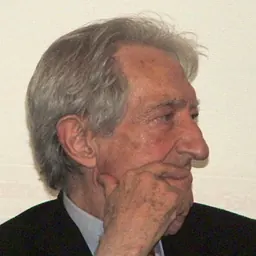

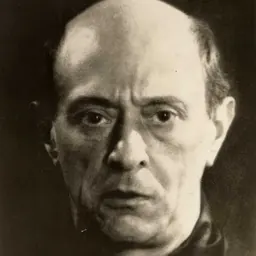


Related people
Same field, nearest in time
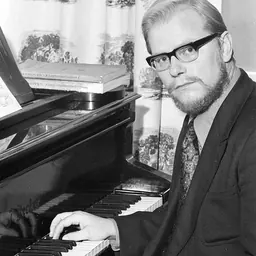



Contemporaries
People whose lives overlapped Vinko Globokar's


Frequently asked questions
Who is Vinko Globokar?
Slovenian musician
When was Vinko Globokar born?
Vinko Globokar was born on 7 July 1934 in Anderny.
What is Vinko Globokar's occupation?
Vinko Globokar is a composer, conductor, music educator, jazz musician, university teacher and trombonist.
What nationality is Vinko Globokar?
Vinko Globokar is French and Slovenian.
Sources & further reading
Cite this page
APA: Biography.guide. (2026). Vinko Globokar. https://biography.guide/vinko-globokar/
MLA: "Vinko Globokar." Biography.guide, https://biography.guide/vinko-globokar/.
Chicago: "Vinko Globokar." Biography.guide. https://biography.guide/vinko-globokar/.
Data last updated: 2026-09-21 · Spot an error? Report a correction.
Portrait: Wikimedia Commons · author & licence
Page generated 2026-09-27 04:59 UTC