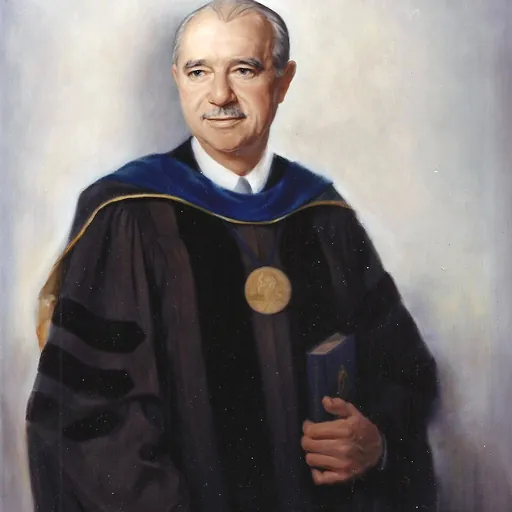
About Vincent du Vigneaud
Lived 1901 – 1978 (aged 77). Vincent du Vigneaud was an American biochemist, university teacher and chemist, known for Oxytocin and Vasopressin.
Vincent du Vigneaud (May 18, 1901 – December 11, 1978) was an American biochemist. He was recipient of the 1955 Nobel Prize in Chemistry "for his work on biochemically important sulphur compounds, especially for the first synthesis of a polypeptide hormone," a reference to his work on the peptide hormone oxytocin.
Biography Vincent du Vigneaud was born in Chicago in 1901. Of French descent, he was the son of inventor and mechanic Alfred du Vigneaud and Mary Theresa. There he became an expert in milking cows, which inspired him to become a farmer. However, his elder sister, Beatrice, persuaded him to take up chemistry at the University of Illinois at Urbana-Champaign, after which he enrolled in the chemical engineering course. He later recalled: I found during the first year that it was chemistry rather than engineering that appealed to me most. I switched to a major in chemistry, since I was deeply impressed by the senior student's work, especially in organic chemistry. I also found that I was most interested in those aspects of organic chemistry that had to do with medical substances and began to develop an interest in biochemistry. With little support from the family, he found odd jobs to support himself.
In 1932, he started working at the George Washington University Medical School in Washington, D.C., and in 1938, he attended the Cornell Medical College in New York City, where he stayed until his emeritation in 1967. Following retirement, he held a position at Cornell University in Ithaca, New York. and vasopressin via manipulating the AVP gene, he had established a reputation from his research on insulin, biotin, transmethylation, and penicillin.
He also carried out a series of structure-activity relationships for oxytocin and vasopressin, perhaps the first of their type for peptides. That work culminated in the publication of a book entitled A Trail of Research in Sulphur Chemistry and Metabolism and Related Fields.
Honours Du Vigneaud joined Alpha Chi Sigma while at the University of Illinois in 1930. He was elected to the United States National Academy of Sciences and the American Philosophical Society in 1944, and the American Academy of Arts and Sciences in 1948. He received the 1955 Nobel Prize in Chemistry "for his work on biochemically important sulphur compounds, especially for the first synthesis of a polypeptide hormone," a reference to his work on the peptide hormone oxytocin.
Don’t just read it —
keep it.
Full-length biographies made to live with: read them, listen on the way to work, watch them tonight.
- E-book
- Audio
- Video
Instant download · yours to keep · every purchase keeps this site free
Important facts
People in Vincent du Vigneaud's life
Named in this biography and alive at the same time

Related people
Same field, nearest in time



Contemporaries
People whose lives overlapped Vincent du Vigneaud's


Frequently asked questions
Who was Vincent du Vigneaud?
American biochemist (1901–1978)
When was Vincent du Vigneaud born?
Vincent du Vigneaud was born on 18 May 1901 in Chicago.
When did Vincent du Vigneaud die?
Vincent du Vigneaud died on 11 December 1978 in White Plains.
What was Vincent du Vigneaud's occupation?
Vincent du Vigneaud was a biochemist, university teacher and chemist.
What was Vincent du Vigneaud known for?
Vincent du Vigneaud was known for Oxytocin and Vasopressin.
What nationality was Vincent du Vigneaud?
Vincent du Vigneaud was American.
Sources & further reading
· Wikipedia: Vincent du Vigneaud
· DBpedia: Vincent du Vigneaud
Cite this page
APA: Biography.guide. (2026). Vincent du Vigneaud. https://biography.guide/vincent-du-vigneaud/
MLA: "Vincent du Vigneaud." Biography.guide, https://biography.guide/vincent-du-vigneaud/.
Chicago: "Vincent du Vigneaud." Biography.guide. https://biography.guide/vincent-du-vigneaud/.
Data last updated: 2026-09-24 · Spot an error? Report a correction.
Portrait: Wikimedia Commons · author & licence
Page generated 2026-09-27 05:09 UTC