
About Vina Mazumdar
Lived 1927 – 2013 (aged 86). Vina Mazumdar was an Indian sociologist, university teacher and women studies.
Dr. Vina Mazumdar (28 March 1927 – 30 May 2013) was an Indian academic, feminist, a pioneer in women's studies in India and a leading figure of the Indian women's movement. She was amongst the first women academics to combine activism with scholarly research in women's studies. She was secretary of the first Committee on the Status of Women in India that brought out the first report on the condition of women in the country, Towards Equality. She was the founding Director of the Centre for Women's Development Studies (CWDS), an autonomous organisation established in 1980, under the Indian Council of Social Science Research (ICSSR). She was a National Research Professor at the Centre for Women's Development Studies, Delhi.
Early life and education Vina Mazumdar was born in a middle-class Bengali household in Kolkata, the youngest of five children, three boys and two girls. Her father, Prakash Majumdar, was an engineer. Her uncle was the noted historian R.C. Majumdar (1888–1980). She returned to Oxford University in 1960, and received her D.Phil. there in 1962, with her doctoral thesis, Imperial Policy in India, 1905–1910.
Career
She started her career as a lecturer of Political Science in Patna University in 1951, soon becoming the first Secretary of the Patna University Teachers' Association. Later, she taught at Berhampur University, where she was appointed upon the recommendation of Professor Bidhu Bhusan Das, her friend from Oxford University, who was Director of Public Instruction, Odisha, at the time. Subsequently, she joined the University Grants Commission Secretariat, New Delhi as an Education Officer and became a Fellow of the Indian Institute of Advanced Studies, Shimla, for the research project, 'University Education and Social Change in India' (April 1970 – Dec. 1970).
She was Member Secretary for the Committee on the Status of Women in India (1971–74). The committee, appointed by the Government of India in 1971, was reconstituted in 1973 with her, a late entrant, as Member Secretary. The report of the committee, Towards Equality, highlighted the rise in poverty amongst women in the transition from agrarian to industrial society, as also the decline of sex ratio in India. Eventually, the report became a turning point both for Women's Studies and the women's movement in India. Later Mazumdar became Director, Programme of Women's Studies, Indian Council of Social Science Research from 1975 to 80. Mazumdar helped organise a meeting to support the recommendations of the Rama Rao Committee on Hindu Law Reform (to expand the inheritance rights of daughters.
In 1980, she co-founded the Centre for Women's Development Studies (CWDS), New Delhi and remained its founder-Director from 1980 till her retirement in 1991. CWDS initiated the concept of "action-research" as it studied landless tribal peasant women in Jhilimili village in Bankura district and Medinipur of West Bengal at the 'Reorientation Camp for Seasonally Migrant Women Labourers' organized by the Government of West Bengal. Through her career, Mazumdar straddled both the scholarship and activism side of women's studies, which she referred as "women's studies movement". She was also a founding-member of the Indian Association for Women's Studies (IAWS), founded 1982. She not just played a key role in its establishment by later served as the General Secretary of its first executive committee (1981-1984) and its president (1998-2000). Thereafter she was Senior Fellow at CWDS and JP Naik National Fellow, ICSSR for two years. From 1996 to 2005 she was the chairperson, Centre for Women's Development Studies, New Delhi. In 2006, she was appointed a National Research Professor of Social Sciences by the Government of India.
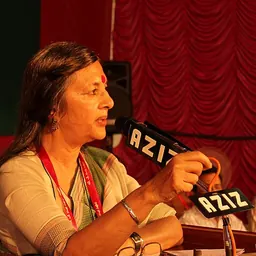
She published her memoir, Memories of a Rolling Stone in 2010, which was released by communist politician Brinda Karat in Delhi. while Pamela Philipose, described its publication as a "cause for celebration", highlighting Mazumdar's role in shaping India's women's movement and women's studies.
Personal life She married musician Shankar Mazumdar in 1952, whom she met while working in Patna. Upon her marriage, she changed the spelling of her surname from Majumdar (her maiden name) to Mazumdar (her marital name).
Don’t just read it —
keep it.
Full-length biographies made to live with: read them, listen on the way to work, watch them tonight.
- E-book
- Audio
- Video
Instant download · yours to keep · every purchase keeps this site free
Important facts
People in Vina Mazumdar's life
Named in this biography and alive at the same time

Related people
Same field, nearest in time



Contemporaries
People whose lives overlapped Vina Mazumdar's


Frequently asked questions
Who was Vina Mazumdar?
Indian academic, feminist (1927-2013)
When was Vina Mazumdar born?
Vina Mazumdar was born on 28 March 1927 in Kolkata.
When did Vina Mazumdar die?
Vina Mazumdar died on 30 May 2013 in New Delhi.
What was Vina Mazumdar's occupation?
Vina Mazumdar was a sociologist, university teacher and women studies.
What nationality was Vina Mazumdar?
Vina Mazumdar was Indian.
Sources & further reading
Cite this page
APA: Biography.guide. (2026). Vina Mazumdar. https://biography.guide/vina-mazumdar/
MLA: "Vina Mazumdar." Biography.guide, https://biography.guide/vina-mazumdar/.
Chicago: "Vina Mazumdar." Biography.guide. https://biography.guide/vina-mazumdar/.
Data last updated: 2026-09-24 · Spot an error? Report a correction.
Page generated 2026-09-27 05:04 UTC