
About Victor Trikojus
Lived 1902 – 1985 (aged 82). Victor Trikojus was an Australian biochemist.
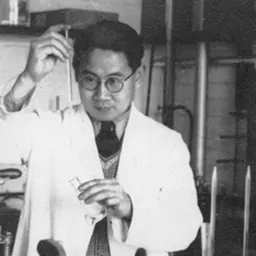
Victor Martin "Trik" Trikojus (1902–1985) was an Australian professor of biochemistry. Described as "more important than any other person in leading Australia into modern biochemistry", he was the second professor and head of the School of Biochemistry at the University of Melbourne from 1943 to 1968.
Early life Trikojus was born on 5 February 1902 in Darlinghurst, Sydney, to August Trikojus (1857–1911) and Charlotte (née Thompson, 1879–1955), his second wife. His father was a hairdresser and tobacconist of Lithuanian background born in Tilsit, East Prussia (now Sovetsk, Kaliningrad Oblast, Russia). His mother was of English background, born in Port Macquarie. He was the eldest of three children.
Trikojus attended Sydney Technical High School from 1916 to 1920 where he studied physics, chemistry, mathematics, history, English, German, woodwork, metalwork, and mechanical drawing. He became head prefect, captain and dux of the school, and a member of its rugby and rowing teams. It was here where he received the nickname "Trik", by which he would be known to his family, friends and colleagues for the rest of his life. In that same year, he was awarded an 1851 Exhibition science research scholarship and chose to study at the University of Oxford under William Henry Perkin Jr. where he also rowed in the Queens College Eight. Trikojus' thesis was entitled 'The Introduction of the Methylenedioxy Group and of Similar Groups into the Aromatic Nucleus'; evidence of Perkin's habit of assigning his students small pieces of larger problems. This thesis earned him his Doctorate of Philosophy in 1927 making him only the second Australian to do so at Oxford, after Henry Brose. Trikojus and Perkin Jr. also published work on the synthesis of safrole. Following this, he was awarded a third year of his scholarship, which he spent in Munich, working under Heinrich Wieland at the Laboratorium des Staates.
Research and Teaching After nine months in Munich, Trikojus returned to Sydney late in 1928, due to his mother becoming ill. There he found a position of lecturer in the Department of Organic Chemistry at the University of Sydney. From having a European father and spending time in those countries, Trikojus felt comfortable in the more-vibrant émigré communities in Sydney. There he met his future wife, Russian émigrée Lisuscha Engels (born 1905 Fryanovo, Russian Empire, died 1984, Melbourne), who had accompanied her wool-buyer father from Germany. In 1932 he took up a lectureship in medical organic chemistry in the Department of Medicine. That was also the year he and Lisuscha married, living in Kings Cross. In print, his wife's first name was often anglicised to Elizabeth.
Until 1936, Trikojus' research was centred on discovering the chemical structures of organic compounds, and occasionally developing methods to synthesise organic compounds in the laboratory. He had published nine scientific papers on this kind of work. 1936 marked a major shift in his interests when the head of his department, Prof. Charles George Lambie, published work on thyroid hormone metabolism. Trikojus began his sabbatical leave that year in Germany, at the University of Freiburg, working on thyrotropic hormone (better known as thyroid-stimulating hormone) with Arnold Loeser. Thyroid enzymes would remain his primary research interest throughout his scientific career. After returning to Australia in 1937, Trikojus and Lisuscha had another daughter, Natalja.
On 1 November 1937, Trikojus wrote an article entitled ‘Some impressions of Germany and neighbouring countries’ (Australian Institute of International Affairs), in which he stated, "I have been greatly impressed by the regeneration which Hitler has wrought in the nation" and "The anti-Jewish propaganda continues, but it is not serious... It is interesting to note that any Jews who are useful to the Nazis are kept in their positions". These comments, which his colleagues later labelled as 'naive', assumed far greater significance after the outbreak of war and, together with Trikojus' involvement in choosing German scientists to be brought to Australia by the government, resulted in accusations of being a Nazi sympathiser. These accusations were strenuously rejected by his colleagues as either unfounded allegations or misinterpretations combined with misunderstandings of the political environment of the 1930s and 1940s. he organised the up-scaling of drug production for 11 different drugs critical for the war effort including ascorbic acid (vitamin C) and sulfaguanidine. His previous experience in the development of methods to synthesise organic compounds was invaluable in his efforts. His son, future cinematographer Alexander (Sasha) Trikojus was also born that year.
Meanwhile, suspicions grew regarding Trikojus' loyalty to Australia, given his German-born father and extensive ties to Germany. In late 1940 it was rumoured that his office had been searched. The Ministerial Order for his detention, signed by Robert Menzies on 6 January 1941, contained 19 grounds for his internment. His biographer Ross Humphreys places these assertions in five categories: "misunderstandings, supposedly subversive statements... inappropriately applied, non-specific accusations, guilt by association, [and his] chairmanship of the Drugs sub-committee." The case against him was never made clear and Trikojus never spoke publicly about it; there were suggestions that internal rivalries at the University of Sydney, including his acrimonious relationship with Henry Brose, who was also arrested, had played a part. He ceded patent rights for his sulfaguanidine manufacturing process to Monsanto so full-scale production could be expedited. His process for ascorbic acid synthesis was likewise handed over to Colonial Sugar Refineries (now CSR limited). He spent much of his time and energy doing administrative work to bring the department up to the standard of the other major universities.
During his tenure, the University of Melbourne was transformed from an undergraduate teaching university to an internationally oriented research university that encouraged collaboration between universities. In 1948 Trikojus and his protégé F. J. R. Hird isolated and identified the thyroid hormone triiodothyronine (T3), however this discovery is generally attributed to Rosalind Pitt-Rivers, who read their paper but omitted mention of it. In 1958 he was president of University House, the university's staff club. He was also Melbourne's first professorial dean of graduate studies (1963–65) and a foundation member (1965–66) of the Australian Research Grants Committee. He also supervised graduate students, including the masters research of Catherine Anne Money, Suffering Parkinson's disease in his later years, Victor Trikojus died on 27 January 1985 in the Melbourne suburb of Kew and was cremated. 73 boxes of his papers were donated by his family to The University of Melbourne Archives, where they are held.
Don’t just read it —
keep it.
Full-length biographies made to live with: read them, listen on the way to work, watch them tonight.
- E-book
- Audio
- Video
Instant download · yours to keep · every purchase keeps this site free
Important facts
People in Victor Trikojus's life
Named in this biography and alive at the same time



Related people
Same field, nearest in time



Contemporaries
People whose lives overlapped Victor Trikojus's


Frequently asked questions
Who was Victor Trikojus?
(1902-1985) professor of biochemistry
When was Victor Trikojus born?
Victor Trikojus was born on 5 February 1902 in Darlinghurst.
When did Victor Trikojus die?
Victor Trikojus died on 27 January 1985 in Kew.
What was Victor Trikojus's occupation?
Victor Trikojus was a biochemist.
What nationality was Victor Trikojus?
Victor Trikojus was Australian.
Sources & further reading
Cite this page
APA: Biography.guide. (2026). Victor Trikojus. https://biography.guide/victor-trikojus/
MLA: "Victor Trikojus." Biography.guide, https://biography.guide/victor-trikojus/.
Chicago: "Victor Trikojus." Biography.guide. https://biography.guide/victor-trikojus/.
Data last updated: 2026-09-20 · Spot an error? Report a correction.
Page generated 2026-09-27 05:30 UTC