Victor Prévost
French butcher, policeman, murderer
About Victor Prévost
Lived 1836 – 1880 (aged 43). Victor Prévost was a French butcher, cuirassier and peace officer.
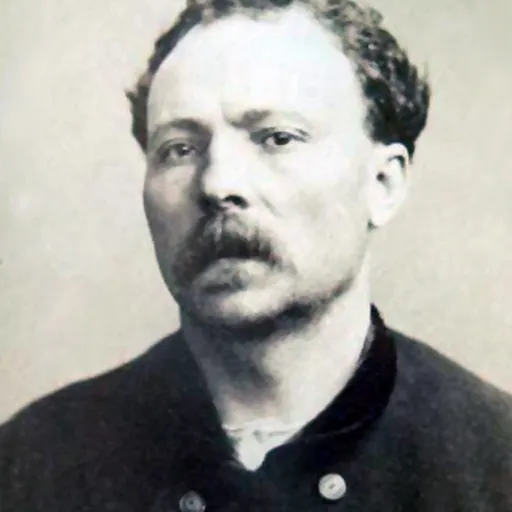
Victor Joseph Prévost (11 December 1836 – 19 January 1880), also known as The La Chapelle Butcher and The Handsome Man, was a French former butcher, cuirassier, cent-gardes, policeman, murderer and possible serial killer. He killed at least two victims, and tried to hide his crimes by decapitating his victims. Because of Prévost's profession as a policeman in his neighbourhood where he committed his crimes, his military past in a renowned elite corps and what he did with the victims' bodies, his case caused a great impact on the contemporary public: "Since the Abadie trial, no criminal case had interested the French public as much."
Biography Youth and apprenticeship Victor Joseph Prévost was born in Mormant, Seine-et-Marne, France on 11 December 1836. His father, Pierre, was a coachman, and his mother, Barbe (née Griette), was unemployed. He had two older brothers: Leon and Adolphe, four and two years older respectively. From birth, Prévost was afflicted with bulimia, particularly inherited from his father, which remained with him for the rest of his life.
At the age of 14, Prévost's parents placed him as an apprentice at a trellis manufacturer on Rue Saint-Jacques in Paris. Although surrounded by young girls at an early age, young Prévost was treated harshly, sleeping on a bed without a mattress and having to work as much as an adult. Prévost's boss brutalized him and, to punish him for his bulimia, which he mistook for simple greed, reduced his daily food portions.
Prévost was naturally kind and considerate. While in the Jardin du Luxembourg, he saw a large boy steal a toy accordion from a smaller one, which he managed to get back and return to the child. Aware of his strength, Prévost never hesitated to help the many push carriages that had difficulties in climbing the steep slope of the Rue de la Montagne-Sainte-Geneviève. One day, while running an errand for his boss, Prévost saw the cart of a milkman hit a boy of his age carrying a rack full of meat. While the milkman ran away, Prévost helped the young victim get up and, finding that the boy was no longer in shape to resume his service, he loaded the heavy piece of meat on his head effortlessly and then delivered it to its recipient, a butcher holding a shop on Rue Mouffetard.
His return to civilian life was short, as he signed a 7-year-old contract on 14 October 1862 and returned to the 2nd regiment. Because of his experience with the cuirassiers, his good service and his height of 6 feet (at the time, the average size of men was about 5 foot 5 inches), he entered the very strict recruitment criteria of the prestigious cent-gardes Squadron that he joined on 20 January 1866, and was assigned the number 418.
Consisting of large, experienced cavalry, the squadron of cent-gardes escorted the emperor Napoleon III on horseback. Their large size and their brilliant uniforms gave them very high prestige, and one of their peculiarities was to remain in all circumstances impeccably fixed, like statues, which earned them the nickname "caryatids of power".
The reputation of the cent-gardes in this area was of a humorous manner: a humorous engraving at the time, published by the Le Bon Marché, was that of a cent-gardes officer, back at his quarters at the end to the Court, busy emptying his boots filled with love letters by admirers while he was standing still.
It seemed that Prévost was particularly noticed for his physique: "He represented the physical beauty and we could've molded the other hundred guards like him.".
Prévost was not easy to converse with: He was nonetheless very helpful, and loved children. Besides his working hours, he happened to escort home stray kids, offering them treats he purchased on the way. His success with the fair sex complicated the life of his boss: Because of this, Prévost was exiled as a monitor in Gare du Nord, where there were only men.
Crimes and punishment
Murder of Alexandre Lenoble
On 10 September 1879, at about 8 o'clock in the evening, Madame Thiéry, a resident of the district which was deserted at this hour, saw at the corner of the Rue de La Chapelle and Rue du Pré maudit the tall figure of a man, dressed in a cattle driver's gown and a silk cap, leaning over the stream that passed there. Intrigued, she watched him from a distance and ended up seeing him walk away towards Ney Boulevard. Madame Thiéry cautiously approached the place he abandoned and discovered, half stuck in a manhole, a packet containing freshly cut meat. At that moment, a peacekeeper named Hardy came by and she asked him for help. They immediately decided to take the package to the police station, but took the advice of a butcher and a pharmacist, who recognized fragments from a skinned human arm. Research was immediately undertaken and 77 additional pieces were discovered, three of which were recovered from a rag-picker who was about to sell them for consumption. Other parts, including a hand and "the parts of a person who belongs to the male sex" were found in a ditch near the fortifications near the Poterne des Poisonniers. At the Paris morgue, where the pieces were transferred, efforts were made to reconstitute the body of the victim by reassembly, as to when they were discovered, that still remained a secret. In the end, only the head was missing, as well as a piece that could never be found because a poor man had probably "picked up it carefully, packaged it, like a piece of veal falling from the net of a housewife, cooked it in his hut and enjoyed it with the family." A first vigorous blow, with both of my hands, struck him down; the second hit broke the skull; the third was useless. He made no movement, did not utter a cry, gurgling at intervals. I then undressed my victim, put him in a trunk and stripped the body of flesh entirely to prevent recognition. At three o'clock, I began to cut up the corpse, and at five o'clock, my work was finished. I flushed the liquid parts in the lavatories, and I disposed of the solid ones in the sewers, vacant lots and the ditches around the fortifications. My job being done, I had dinner, and at around 10 o'clock I went to bed. This morning, I resumed my work with Lenoble's head, his jewellery box and his clothes at home. His guilt being proven, Prévost was first sent to the lock-up before being incarcerated in Mazas Prison to await trial.
Alexandre Lenoble was a 38-year-old jewellery broker who had just recently established his own business. He left behind a widow and two children, aged 11 and 6. The butcher knife used by Prévost to dismember the victim is kept at the Musée de la préfecture de police in Paris.
Murder of Adèle Blondin
Prévost also had a mistress named Adèle Blondin. She had been for some time the governess of a rich old man who, to thank her, had left her a sum of 30,000 francs. Blondin sometimes helped her impoverished sister but, being economical, she lived on a monthly income of 1,500 francs from its capital placed in state annuity. Blondin bought a business and began earning a few thousand francs worth of money. Being suspicious, she usually hid her values, money and main jewellery. Prévost is suspected of having previously murdered another peacekeeper, who disappeared without a trace four years before, an act which he categorically denied. To put an end to an inquiry with uncertain results that promised to be long, while the authorities wanted to finish quickly, he was made to write a written statement in which he expressed his repentance for his two confirmed crimes. Prévost swore that if he was guilty of anything, he would confess without hesitation.
A few minutes before his execution, when Prévost was asked for the last time if he had anything else to say, he replied: "I confessed to the two crimes I committed. That's enough, unfortunately. I did not make other mistakes in my life...".
Gold or silver?
Prévost did not disdain the money taken from his victims, but at the same time, he did not seek wealth or even an easier lifestyle. The opinion of his colleagues and friend Doré was unambiguous: "Prévost had only one word to say: to swim in opulence. He was a lady's man. He frequented around very rich people who would have been happy to sacrifice their fortune to him, but if he accepted attendance at diners and parties, he rejected money and gifts. He would see himself as dishonored by accepting them. You should have seen the indignant air with which he exclaimed 'Do they take me for a barbel?'" |sign=|source=
Trial Victor Prévost's trial was held before the cour d'assises in Seine, chaired by Mr. Hardouin and two assessors, on 7 December 1879. At quarter past eleven, the accused entered, accompanied by eight guards. The defence was provided by Mr. Bouchot, while the Attorney General was Mr. Lefebvre de Biefville. While reading through the indictment, which included details and the way in which the two murders were committed, Prévost stood upright and remained calm, but his discouragement could be felt. He then answered questions from the judge, who made him confirm the facts and clarify details.
On 26 December 1879, an appeal was dismissed by the Criminal Division of the cour d'assises. The next day, his lawyer made him sign a petition for a pardon. The then-president, Jules Grévy, generally was not very reluctant to grant pardons to those sentenced to death, but followed the recommendations of the commissions of pardons, which concluded that justice must follow its course because of the particularly sordid crimes and Prévost's profession. Grévy justified his decision to the condemned's lawyer in the following letter: The pardon was formally rejected on 18 January, and Louis Deibler, recently appointed chief executioner on 15 May, was summoned to the prosecutor's office of the Republic and issued the ultimate requisition: Order is given to the chief executioner of criminal judgments to seize Victor Prévost, sentenced to death by the cour d'assises of Seine, on 8 December 1879, and proceed with his execution in public on Monday, 19 January 1880, at seven o'clock in the morning. Between his identification and his execution, it took a little more than four months.
As for the executioner Louis Deibler, that was his first execution in Paris, as he had previously practised his job in the provinces. For this first time, he was to be assisted by his first deputy designate, Alphonse-Léon Berger (later chief executioner of Corsica, 1870–1875), who was dismissed from Prévost's execution, which caused a lasting quarrel between the two men.
Autopsy and scientific studies
Prévost's family did not claim his body, so he was put at the disposal of the dean of the Faculty of Forensic Medicine, for the purpose of an autopsy and phrenological studies.
However, legal procedures required a mock burial in the cemetery. Immediately after the execution, the coffin containing Prévost's body and head was loaded with a bran container into a van that went off on the field with a great trot, escorted by mounted gendarmes, to go to the hospice cemeteries which adjoined Ivry Cemetery. It was followed by three cars, carrying the chaplain, accompanied by the head of the security services and the journalists. At precisely 7:45, the van stopped near an open pit surrounded by gravediggers. Prévost's body was exhumed from the coffin, and placed in a light wooden coffin, with his head slipped between his legs. Father Crozes recited a final prayer before the coffin was temporarily closed with two nails. Ultimately, the pit became bloodied, which came from the bottom of the coffin. At the end of the brief ceremony, the coffin was loaded into a medical van, which immediately left towards the medical faculty. From his analysis, with assorted scholarly considerations, Prévost as put in the category of "smart murderers", but functional defects in the brain made it "very abnormal". Another scholar, Louis Bélières, resumed this study in 1909 by comparing Prévost's brain to those of other criminals.
Bulimia From a very young age, Victor Prévost suffered from insatiable bulimia, inherited from his father, which manifested itself throughout his life: "I have a good appetite, I eat well; but do not gain weight.", he wrote in prison. The autopsy notes anomalies present in his digestive prison that could perhaps have a link with his perpetual munching, but no study was conducted beyond simple observations. During a banquet organized by the Friendly Association of the Ancient Cent-Gardes, Brigadier Valentin recounted having surprised Prévost, while he was stealing from the squadron's raw meat supplies. Several of his ex-comrades confirmed that he had declared: "to the human appetite".
Don’t just read it —
keep it.
Full-length biographies made to live with: read them, listen on the way to work, watch them tonight.
- E-book
- Audio
- Video
Instant download · yours to keep · every purchase keeps this site free
Important facts
People in Victor Prévost's life
Named in this biography and alive at the same time

Related people
Same field, nearest in time


Contemporaries
People whose lives overlapped Victor Prévost's





Frequently asked questions
Who was Victor Prévost?
French butcher, policeman, murderer (1836-1880)
When was Victor Prévost born?
Victor Prévost was born on 11 December 1836 in Mormant.
When did Victor Prévost die?
Victor Prévost died on 19 January 1880 in La Roquette Prisons.
What was Victor Prévost's occupation?
Victor Prévost was a butcher, cuirassier and peace officer.
What nationality was Victor Prévost?
Victor Prévost was French.
Sources & further reading
Cite this page
APA: Biography.guide. (2026). Victor Prévost. https://biography.guide/victor-prevost-butcher/
MLA: "Victor Prévost." Biography.guide, https://biography.guide/victor-prevost-butcher/.
Chicago: "Victor Prévost." Biography.guide. https://biography.guide/victor-prevost-butcher/.
Data last updated: 2026-09-20 · Spot an error? Report a correction.
Portrait: Wikimedia Commons · author & licence
Page generated 2026-09-27 04:58 UTC